
The Bible does not mention the oriole by name. No major English translation contains the word, and searching Bible-specific resources for 'oriole' consistently returns nothing. So if you saw an oriole this morning and felt something shift in you, the honest starting point is this: what you are working with is not a named biblical symbol but a spiritually interpretive one, built from what Scripture does say about birds in general, about song, beauty, nesting, provision, and God's care for all living things. That is not a weak foundation. It is actually a rich one, and this guide will show you how to use it responsibly.
Biblical Meaning of Oriole Bird: Faithful Symbol Guide

Eleanor Hartwell
21 Apr 2026
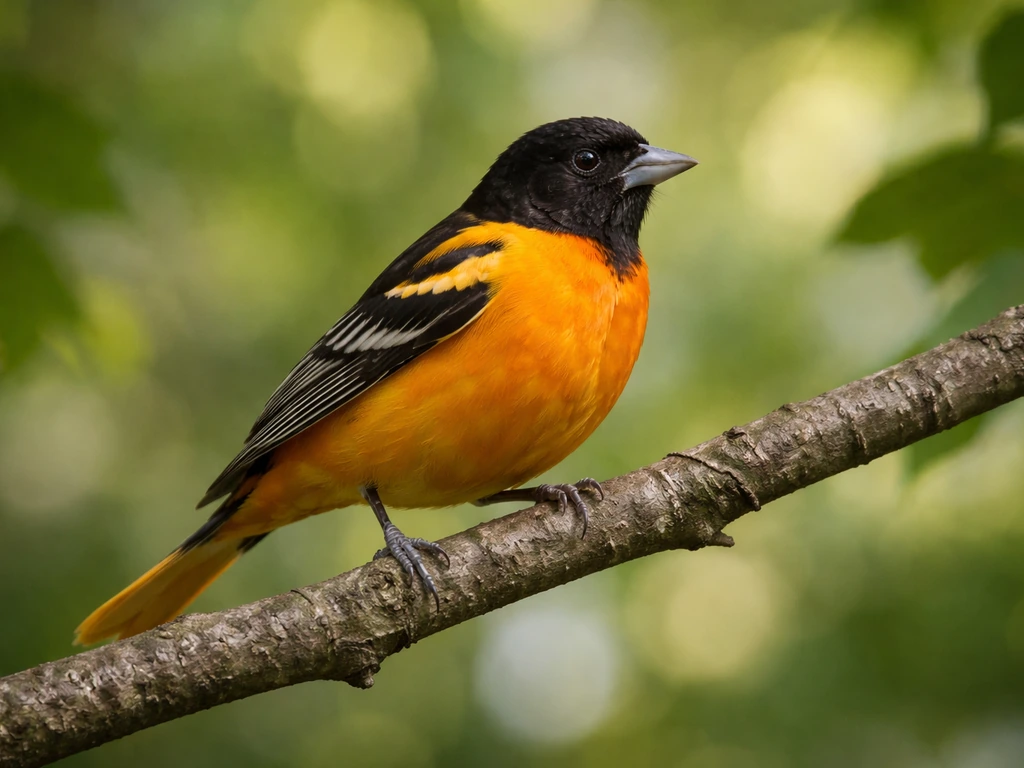
Does the Bible actually mention orioles?
The short answer is no. The word 'oriole' does not appear in the King James Version, the NIV, the ESV, the NASB, or any widely used English Bible translation. The name itself comes from the Latin 'aureolus,' meaning golden, which is why some websites try to draw a line between orioles and biblical references to gold or light.
That connection is more about etymology than Scripture, though, and you should treat it as a poetic resonance rather than a biblical citation. The oriole is simply not a bird the biblical writers named and assigned meaning to, the way eagles, sparrows, ravens, and doves are addressed directly in the text. If you want the broader bird-in-Scripture angle, see what does a bird symbolize in the bible as the adjacent starting point.
What this means practically is that building a biblical meaning for the oriole requires working from the outside in: starting with what the Bible says about birds broadly, then considering which of those themes fit what the oriole actually is and does as a bird. This is legitimate interpretive work, and believers have done it with many animals for centuries. The key is being transparent about it, which is exactly what we will do here.
Biblical themes that map naturally onto the oriole
Even without a named verse, the oriole connects meaningfully to several recurring biblical themes. The bird's biology and behavior are actually a strong fit with what Scripture already emphasizes about birds. Here is where the real interpretive work happens.
Song and praise
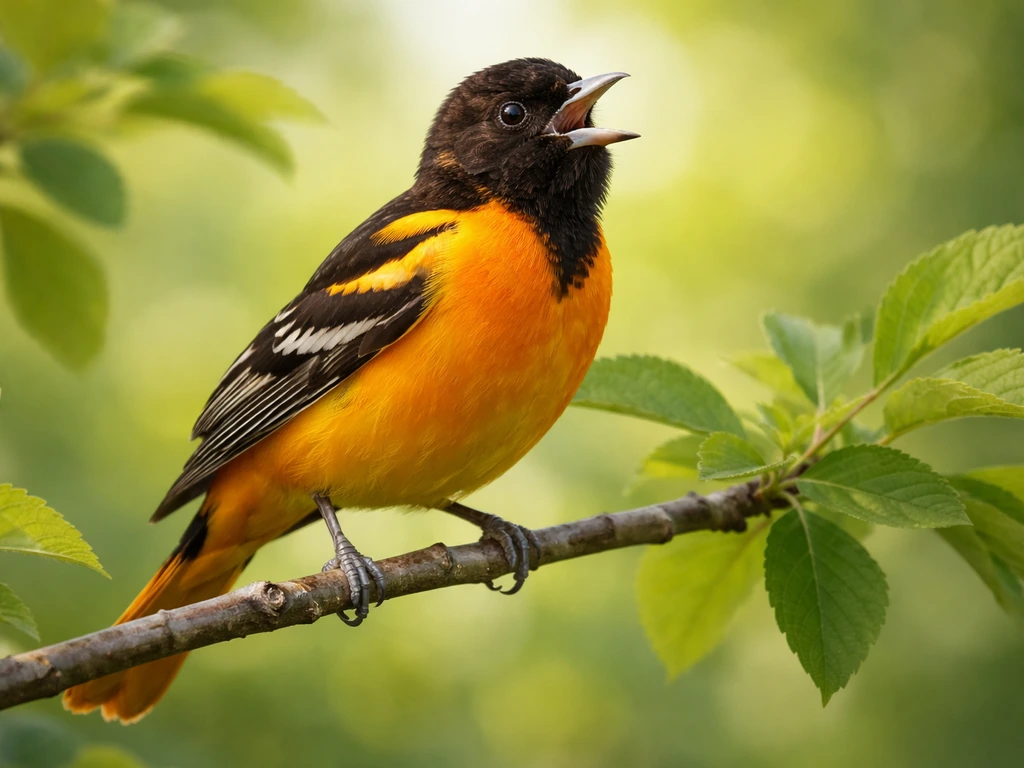
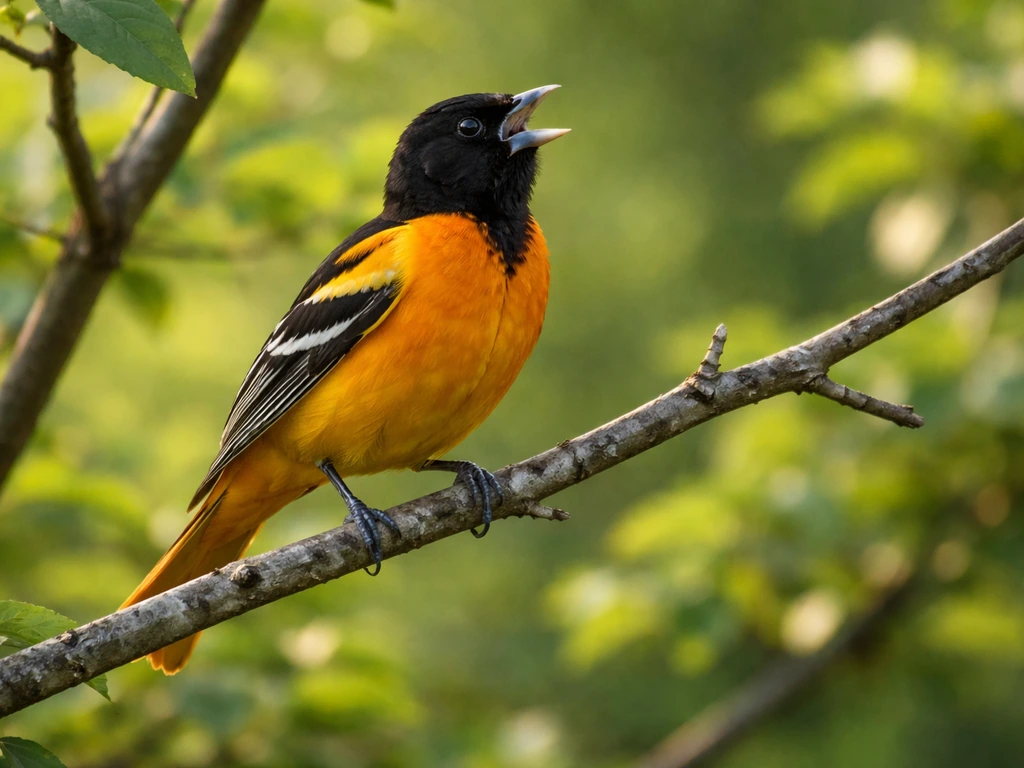
The oriole is one of the most distinctive songbirds in North America. Its flute-like, clear whistle is unmistakable and is widely recognized as a sound that stops people mid-stride. Scripture repeatedly uses birdsong as a metaphor for praise and the expression of joy before God.
The psalmists write of creation itself singing (Psalm 96:12, Psalm 98:8), and the Song of Solomon describes the season of renewal with the words: 'The flowers appear on the earth, the time of singing has come, and the voice of the turtledove is heard in our land' (Song of Solomon 2:12).
The biblical impulse is to hear a bird's voice and feel something spiritual in it, not because the bird is delivering a coded message, but because its song participates in the wider chorus of created things that declare God's glory.
Beauty and God's creative care
The male Baltimore oriole's brilliant orange and black plumage is hard to ignore. Jesus, in the Sermon on the Mount, pointed to the natural world's beauty as evidence of God's care: 'Consider the lilies of the field, how they grow: they neither toil nor spin, yet I tell you, even Solomon in all his glory was not arrayed like one of these' (Matthew 6:28-29). While Jesus used flowers in that particular example, the logic extends to all of creation's beauty, including birds. The oriole's vivid coloring fits naturally into the biblical idea that created beauty is intentional, not incidental, and that noticing it is a form of spiritual attentiveness.
Nesting and God's provision
Orioles are famous for their elaborate hanging nests, woven with plant fibers and suspended from the tips of tree branches. Psalm 104:17 describes birds building nests as part of creation's ordered provision: 'where the birds build their nests; the stork makes her home in the cypresses.' The point of that psalm is that God has arranged the world so that living things have what they need. An oriole nest near your home, particularly if it is new or prominent, can be read through this lens: not as a supernatural omen, but as a reminder of a biblical theme that God provides habitation and security for his creatures, and by extension, for you.
Migration and seasonal renewal
Orioles are migratory birds. In North America, the Baltimore oriole arrives in spring after wintering in Central America or the Caribbean, and its return is reliably tied to warmer months and new growth. Jeremiah 8:7 notes that 'even the stork in the sky knows her appointed seasons; the dove, the swift and the thrush observe the time of their migration.' The biblical writer uses this as a contrast with human stubbornness, but embedded in the verse is a genuine appreciation for migration as a God-ordered cycle. Seeing an oriole arrive in spring, particularly at a time of personal transition or waiting, fits squarely within a biblical framework of seasonal renewal and the faithfulness of God's created rhythms.
God's care for every bird
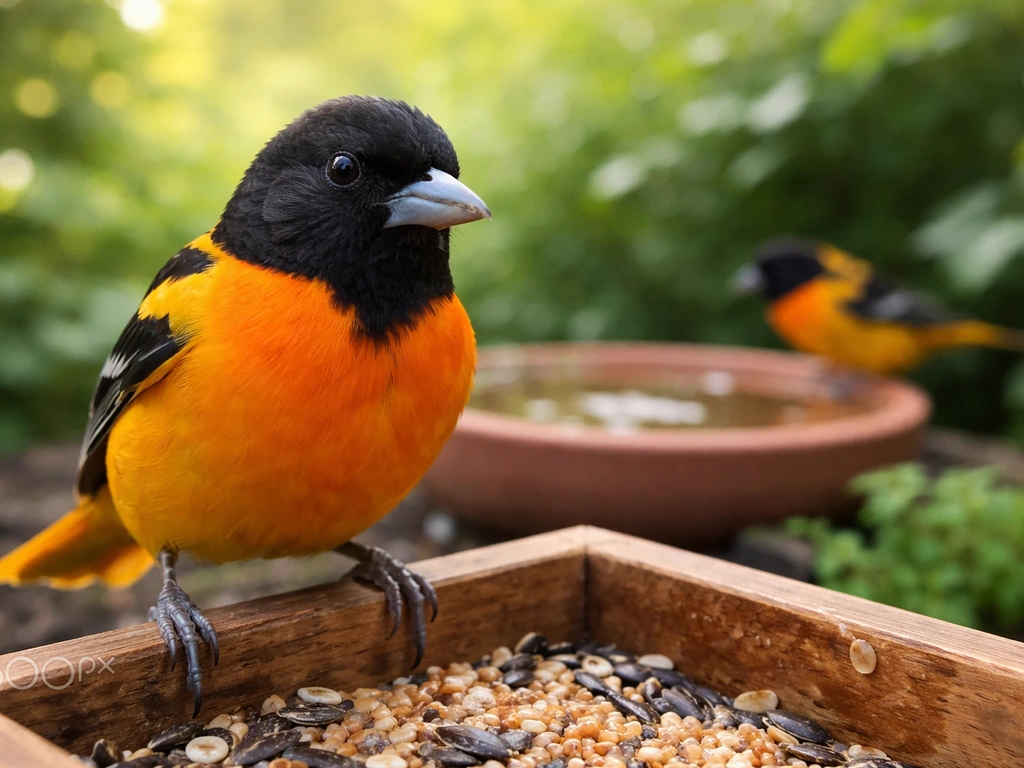
The most directly applicable biblical passage to any bird encounter is Matthew 6:26, where Jesus says: 'Look at the birds of the air: they do not sow or reap or gather into barns, and yet your heavenly Father feeds them. Are you not of more value than they?
' The companion passage in Matthew 10:29 adds: 'Are not two sparrows sold for a penny? Yet not one of them will fall to the ground apart from your Father. ' Luke 12:6-7 reinforces the same idea with even stronger language about God's detailed awareness. None of these passages are about orioles specifically, but they are about every bird, including orioles.
If you see one, Scripture gives you a legitimate reason to let it remind you that God notices and sustains what seems small and ordinary.
What people are usually looking for: joy, renewal, and encouragement
Most people searching for the biblical meaning of the oriole are not doing technical theology. They had an encounter that felt meaningful, and they want to know if their intuition has any grounding. These are the most commonly sought interpretations, and here is how they hold up against actual biblical themes.
| Interpretation | Biblical grounding | Confidence level |
|---|---|---|
| Joy and gladness | Birdsong as praise; creation rejoicing (Psalm 96, Song of Solomon 2:12) | Strong thematic fit |
| God's care and provision | Matthew 6:26, Matthew 10:29, Luke 12:6-7 | Directly supported |
| Renewal and new seasons | Jeremiah 8:7 on migration; Psalm 104 on created rhythms | Strong thematic fit |
| Good news or encouragement | Romans 10:15 ('beautiful feet' imagery); general messenger role of birds in Scripture | Interpretive, not direct |
| Worship and praise | Birdsong as creation's praise; Psalm 148:10 calling birds to praise God | Strong thematic fit |
| Hope after difficulty | Isaiah 40:31 on renewed strength; oriole's spring arrival after winter | Poetic/symbolic, not direct |
| A message from a deceased loved one | No biblical support; crosses into territory Scripture does not endorse | Not supported biblically |
The last row matters. One popular search combines bird symbolism with the idea that birds carry messages from deceased relatives. Scripture does not support this, and in fact cautions against seeking hidden communications from the dead (Deuteronomy 18:11). If that is what you are hoping the oriole means, this is a place where a biblically grounded reading gently redirects rather than confirms.
What different oriole encounters might mean
Context matters in interpretation, and different kinds of encounters naturally suggest different themes. Here is how to think through the most common ones.
Seeing an oriole
A clear, vivid sighting of an oriole, especially if it is unexpected or unusually close, fits well with the biblical theme of attentiveness. Jesus' invitation to 'look at the birds of the air' is an imperative to pay attention. If you noticed the oriole, one grounded question to ask is: what were you thinking about or worrying about in that moment? The biblical logic of Matthew 6:26 is that the bird's existence is a reminder to release anxiety and trust in God's provision. Matthew 6:26 explains Jesus’ point that the birds are fed by the heavenly Father. The oriole's brightness makes it hard to ignore, which is part of what makes the encounter feel significant.
Hearing its song
Hearing an oriole before seeing it, or hearing it while going through something emotionally heavy, maps naturally onto the biblical use of birdsong as praise and as a marker of seasons turning. The Song of Solomon describes hearing bird voices as a sign that the 'time of singing has come' after a long, difficult season. If you heard the oriole's call and felt something lift in you, that is worth sitting with. It is not necessarily a divine message in the transactional sense, but it may be your spirit responding to a creation-based reminder of what the Psalms call 'times of refreshing.'
An oriole nesting near your home
Finding an oriole nest in your yard or near your home, especially the iconic hanging pouch-style nest, is worth connecting to Psalm 104:17's image of birds finding secure habitation as part of God's ordered provision. It can also serve as a prompt to reflect on your own sense of home, stability, and rootedness. Questions worth journaling: Do I feel secure right now? Am I building something that will last? Is there something in my life that needs weaving together the way an oriole weaves its nest?
An oriole indoors or injured
An injured or displaced oriole, or one that has somehow entered an enclosed space, is a more distressing encounter. Biblically, Matthew 10:29 is the passage that speaks most directly to this: 'not one of them will fall to the ground apart from your Father.' The verse does not promise that birds never fall or get hurt; it promises that even when they do, God is aware. If you find an injured oriole, the most practical and faith-consistent response is to help it if you can (contact a wildlife rehabilitator), and to let the encounter prompt reflection on your own experience of being in a difficult, disorienting place while still being held in God's awareness.
How to discern a biblical message without crossing into superstition
This is the most important section of this guide, and it is worth reading carefully. Deuteronomy 18:10 explicitly lists interpreting omens among practices God's people are told to avoid. The Hebrew term translated 'interprets omens' in that passage refers to seeking hidden knowledge or divine guidance through signs in the natural world, with the expectation that you can decode certainty from them. This is the line between meaningful attentiveness and superstition, and it is a real line.
What this means practically is that saying 'the oriole reminded me of God's care and I felt encouraged' is spiritually healthy. If you are asking what is a hummingbird a sign of, the safest biblical approach is to interpret it through themes like God’s care for living things, rather than treating the bird as a coded message the oriole reminded me of God's care. Saying 'the oriole appeared three times this week so God is definitely telling me to accept that job offer' is treating a bird as an omen, which is precisely what Scripture cautions against. The difference is not about whether birds can prompt spiritual reflection (they clearly can, given how often Jesus and the psalmists use them). The difference is about certainty and the source of that certainty.
Romans 12:2 offers the better model: 'Do not be conformed to this world, but be transformed by the renewing of your mind, that by testing you may discern what is the will of God.' Paul's method of discernment is through a renewed, transformed mind, not through reading signs. That does not mean you cannot let an oriole sighting prompt a moment of reflection or prayer. It means that reflection should then move toward Scripture, community, prayer, and wisdom, not back toward the bird as the source of the answer.
What holds up vs. what is interpretive symbolism
- Solid ground: Letting an oriole sighting prompt reflection on God's provision, using Matthew 6:26 or Matthew 10:29 as your anchor
- Solid ground: Connecting the oriole's spring arrival to biblical themes of seasonal renewal and God's faithful rhythms
- Solid ground: Using an oriole encounter as an entry point to prayer or journaling about a current situation
- Interpretive symbolism (use with humility): Connecting the oriole's song to praise or the breaking of a spiritually heavy season
- Interpretive symbolism (use with humility): Reading a nesting oriole as a prompt about home, security, or building something lasting
- Not biblically supported: Treating the oriole as a confirmed sign or omen delivering a specific divine message
- Not biblically supported: Assigning the oriole as a communication from a deceased person
Oriole symbolism vs. generic bird symbolism: a quick distinction
Because the oriole is not named in Scripture, some of what you will find online is simply generic bird symbolism reassigned to the oriole. It is worth knowing the difference. General bird symbolism in the Bible tends to center on freedom, transcendence, the soul's relationship to God, and divine messenger themes (think doves, ravens, and eagles, all named with specific roles). The oriole does not carry those specific named roles. What makes the oriole distinct, both visually and spiritually, is the combination of vivid beauty, rich song, skillful nest-building, and spring migration. Those are the threads worth pulling when you are looking for meaning that is genuinely oriole-specific rather than applicable to any bird you might see.
It is also worth distinguishing the Baltimore oriole (the bright orange and black North American species) from the Old World golden oriole (Oriolus oriolus), which is found across Europe and Asia. If you are in North America, you are almost certainly thinking about the Baltimore oriole. Some older symbolic sources reference the golden oriole and its associations with light and clarity in European and Middle Eastern contexts, but those are cultural frameworks, not biblical ones. The interpretive principles in this guide apply to either species, but knowing which bird you actually saw matters for grounding the encounter in reality, which is always the starting point for good discernment.
If you are drawn to exploring broader bird symbolism in a biblical frame, the general question of what birds represent in Scripture is its own rich topic, as are the specific biblical meanings attached to hummingbirds and the interpretation of birds appearing in dreams. If you are also wondering about the humming bird biblical meaning, you can apply the same approach of grounding symbolism in Scripture, then matching themes to what the bird represents hummingbirds.
If you want the bird-in-dream biblical meaning specifically, look at the same biblical bird themes and then test your takeaway against Scripture rather than treating the dream as a certainty interpretation of birds appearing in dreams. If you are also researching humming bird biblical meaning, the same interpretive principles in this guide will help you stay grounded and avoid turning signs into certainties specific biblical meanings attached to hummingbirds. what is a humming bird a sign of.
The oriole's symbolism is best understood as a specific thread within that larger biblical fabric, not identical to it.
Practical next steps: how to actually work with this

If you are here because a specific encounter with an oriole felt significant, the most useful thing you can do is not to keep searching for a verse that names the oriole (it does not exist) but to move into active reflection using the themes that do exist. Here is a practical framework.
Journaling prompts
- What was I thinking or feeling when I saw or heard the oriole? Write it out without editing.
- Which of these themes resonates most with where I am right now: provision, joy, renewal, song/praise, or secure habitation? Why?
- Is there a biblical passage about birds or God's care that I have read before but not really believed for my own situation? What would it mean to actually take it seriously today?
- If the oriole's arrival in spring represents something ending its long migration, what 'winter season' in my life might be ending or shifting?
- Am I seeking a sign because I need certainty, or because I am genuinely open to being reminded of something? Be honest here.
Prayer and meditation suggestions
Read Matthew 6:25-34 slowly, substituting your current worry for 'what you will eat or drink.' Sit with the image of the birds being fed and ask: what would it feel like to actually trust this? You can also pray through Psalm 104, which describes God's provision for all of creation in vivid, sensory language. The psalm ends with the writer's own praise spilling out of that observation: 'I will sing to the Lord all my life' (Psalm 104:33). Let the oriole encounter become an entry point to that kind of prayer rather than a question you need answered.
Decision-making guidance
If you are at a crossroads and hoping the oriole is a directional sign, use Romans 12:2 as your anchor process rather than the bird itself. Write down the decision. Then ask: what does Scripture say about the values at stake here? What do trusted people in my community think? What is the orientation of my own renewed mind when I am not anxious about the outcome? The oriole can legitimately be the moment that opened the question back up for you. But the discernment process itself runs through Scripture and community, not through the bird's return.
One last thing worth saying: the fact that you paused at an oriole, that its color or song stopped you and made you want to understand something, is itself not a trivial thing. The Psalms repeatedly describe people who see the natural world and feel drawn toward God by it. That impulse is worth honoring. The goal is just to let that impulse lead you somewhere solid, toward Scripture, toward prayer, toward honest reflection, rather than toward certainty that was never available in the first place.
FAQ
Does the Bible ever imply that orioles specifically are “God’s messages” with a guaranteed meaning?
No. Scripture does not name orioles, so the Bible never assigns a fixed, guaranteed message to that exact bird. A spiritually meaningful encounter can be real, but the safest approach is to treat it as a prompt for reflection on Scripture, not as a certainty that skips prayer, counsel, and context.
If I keep seeing orioles repeatedly, is that a sign I should make a specific decision now?
Frequent sightings can motivate you to pause, but Scripture warns against decoding outcomes from natural signs. Instead of concluding “this confirms X,” use the next-step process in Romans 12:2 (values first, Scripture second, trusted counsel third). Then decide based on consistency with God’s character and your situation, not based on the birds’ frequency.
How can I tell the difference between biblical reflection and superstition when the oriole feels “too perfect” to ignore?
A helpful test is where your certainty lands. If you end up moving toward worship, prayer, repentance, and wise action, that aligns with “renewing your mind.” If you end up demanding a hidden, guaranteed forecast from the bird, that aligns with the kind of sign-seeking Scripture cautions against (Deuteronomy 18).
What if I’m interpreting from the wrong species, like confusing a Baltimore oriole with a golden oriole?
Species matters because the encounter is rooted in what you actually saw. If you are in North America, it is usually the Baltimore oriole, so be careful with older symbolic claims that came from other regions. To ground yourself, focus on the consistent biblical themes (God’s care, provision, seasonality, created praise) rather than treating cultural associations as biblical certainty.
Can I pray that God speaks to me through the oriole, and is that still grounded?
Yes, as long as your prayer doesn’t turn the bird into the final authority. A grounded way to pray is to ask God for wisdom and peace, then read Scripture and take practical steps afterward. For example, you can pray through Matthew 6:26 about anxiety, rather than asking the oriole to reveal a hidden timetable for an answer.
What should I do spiritually if the oriole encounter is distressing, like the bird looks sick or gets stuck indoors?
Treat it as both compassion and reflection. Practically, contact a wildlife rehabilitator if you can do so safely. Spiritually, lean on the reassurance that God is aware even in vulnerable moments (Matthew 10:29), then use it to examine how you are doing under pressure, rather than concluding the bird “means” judgment.
Is it okay to assign a personal meaning to an oriole encounter, even if there is no verse naming it?
Yes, if you label it as a personal takeaway rather than a Bible-authored decree. The article’s safest approach is “transparent interpretation”: connect your personal meaning to themes Scripture already supports, then test it by Scripture, community wisdom, and the fruit it produces (peace, trust, clarity, obedience).
Does the oriole’s bright orange or black coloring mean something like “gold, light, or purity” in a biblical way?
Color can inspire reflection, but etymology-based links (like Latin word origins) are not the same as biblical meaning. If you want to use the image, translate it into a biblical theme you can justify from Scripture, such as intentional beauty and God’s care, rather than assuming the bird’s appearance carries a coded message.
What if my encounter happened while I was grieving, and I’m tempted to think the bird is from a deceased loved one?
Scripture does not support seeking comfort through secret messages from the dead, and it explicitly discourages that kind of sign-seeking (Deuteronomy 18:11). If grief is present, it is more grounded to pray for comfort directly and seek support (faith community, counseling if needed), then let the oriole function as a prompt to remember God’s care and presence, not as a channel to the dead.
How can I use the oriole encounter practically if I do not want only “ideas,” but actual next steps?
Pick one concrete action that matches the theme. For anxiety prompts, practice a specific trust step (for example, write down the worry, then rewrite it as a prayer grounded in Matthew 6:25-34). For discernment, follow a decision workflow (values, Scripture, trusted counsel, then choose). For a nest or song prompt, do a short gratitude practice (thank God for provision, then journal one question about stability or renewal).