A two-headed bird most commonly symbolizes duality: the tension or balance between two opposing forces, two directions of awareness, or two realms of authority. But that general meaning shifts significantly depending on where the image comes from. A Byzantine double-headed eagle carved into a church wall carries a very different weight than a two-headed bird in a Hindu mythological context, a heraldic coat of arms, or a dream you had last Tuesday. The most useful thing you can do before settling on an interpretation is figure out which tradition produced the image, because that single step will take you from a vague feeling to something genuinely meaningful.
Two-Headed Bird Meaning: Symbolism, Omens, and Spiritual Messages

Eleanor Hartwell
25 Apr 2026
Real animal, artwork, or myth? What you're actually looking at
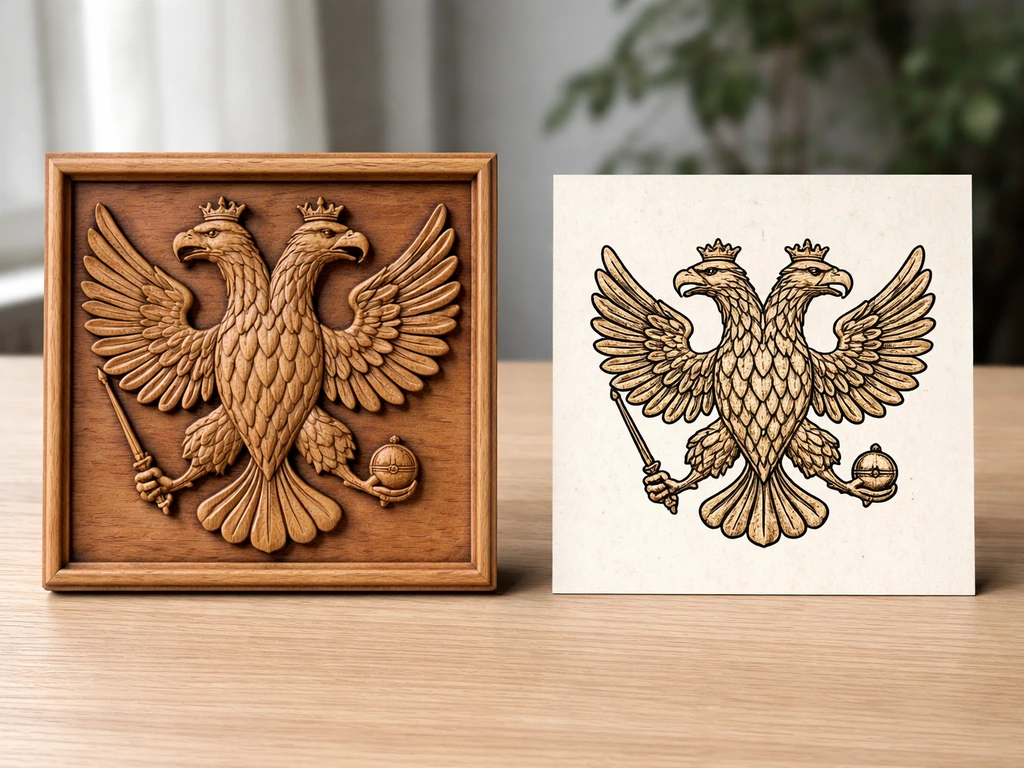
Two-headed birds do not exist in nature. Any image you have encountered is almost certainly one of three things: a piece of art or heraldry rooted in a specific cultural tradition, a mythological creature from a religious or folk tradition, or a modern illustration drawing on one of those older sources. Knowing which category applies completely changes how you read the symbol.
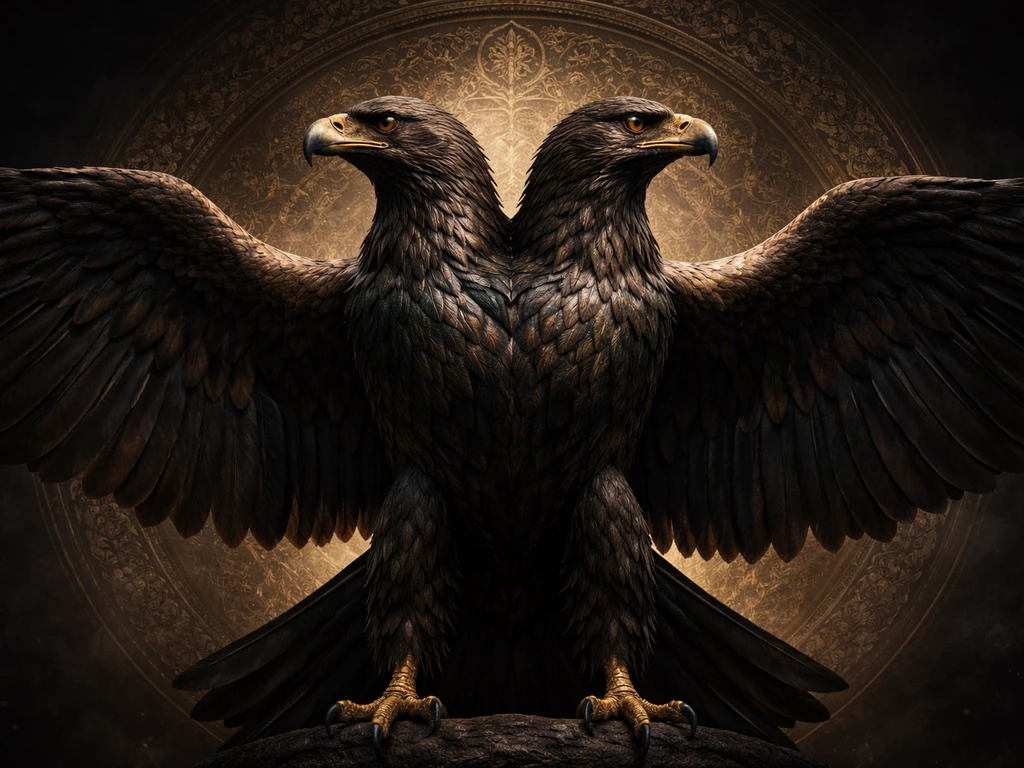
The most historically widespread version is the double-headed eagle, a heraldic motif with roots stretching back to at least the late third millennium BC. An early depiction appears on a ceremonial axe head from the Bactria-Margiana Archaeological Complex, and the image was later adopted by the Byzantine Empire, the Holy Roman Empire, Russia, Serbia, and several Balkan states. The double-headed eagle motif is associated with the Palaiologos dynasty of blank" rel="noopener noreferrer">the Byzantine Empire, and modern uses often connect to that Byzantine imperial usage, possibly derived from earlier Roman imperial eagle traditions. It also appeared in Islamic contexts, including Seljuk and Mamluk usage. Today it still appears in the Greek Orthodox Church and on Balkan national flags. This is a political and religious symbol with a very specific grammar, not a universal folk omen.
The second major tradition is the Gandabherunda, a two-headed bird from Hindu mythology associated with Vishnu. In this context the creature is described as extraordinarily powerful and magical, a divine form rather than a symbol of conflict or warning. It served as the royal insignia of the Wodeyar dynasty of Mysore and is now the official emblem of the Government of Karnataka, depicted as a white bird on a red shield. The Gandabherunda is sometimes linked in popular culture to questions about which empire made India seem golden, but its origin is specifically tied to Hindu tradition and Mysore royal iconography Wodeyar dynasty of Mysore. That is a completely different symbolic register from European heraldry, even though the visual shape looks similar.
If your image is a tattoo, an amulet, a dream image, or a piece of modern spiritual art, it is likely drawing on one of these older traditions consciously or unconsciously. Identifying which one is the starting point for any honest interpretation.
What 'two heads' actually means as a symbol
Two heads on a single body create an immediate visual tension. The creature faces two directions at once, which is why the core symbolic themes cluster around duality, vigilance, and the holding of opposites. Here are the interpretive threads that appear across traditions most consistently.
- Dual authority or dual sovereignty: In Byzantine usage, the two heads explicitly represented the emperor's authority over both secular and religious matters, and his dominion over East and West simultaneously. The tension between the two heads was not conflict but completeness.
- Vigilance and all-seeing awareness: A creature that watches in two directions at once cannot be surprised from behind. Many heraldic and mythological uses carry this protective meaning, which is why the image appears on fortress gates, palace walls, and church carvings.
- Duality and opposing forces: Two heads can represent any pair of opposites: body and spirit, past and future, inner and outer life, conscious and unconscious mind. This is the most flexible interpretation and the one most commonly used in modern spiritual contexts.
- Choices and crossroads: When two heads face outward in opposite directions, the image can be read as standing at a decision point, needing to weigh two paths or two voices before acting.
- Power and divine strength: In the Gandabherunda tradition, the two heads amplify rather than divide. The creature is portrayed as more powerful precisely because of its doubled nature, not troubled by it.
- Imbalance or conflicting influences: In some folk and modern interpretations, a two-headed creature that appears distressed or asymmetrical can signal internal conflict, competing obligations, or being pulled in directions that do not serve you.
Notice that these meanings do not all say the same thing. Dual sovereignty and internal conflict are nearly opposite readings. That is not a flaw in the symbol system; it reflects the fact that symbols are genuinely polysemous, meaning multiple valid meanings can be attached to the same image depending on context. The image itself does not determine the meaning. The tradition, the setting, and your own situation all contribute. Medievalists.net describes the Byzantine double-headed eagle as a charge linked to “Empire,” where its two heads represent dual sovereignty, including secular and religious dominance, or control over East and West Byzantine double-headed eagle as a charge linked to “Empire”.
Why birds specifically carry spiritual weight

Across a remarkable range of cultures and eras, birds occupy a specific symbolic role: they are creatures of the threshold, moving between earth and sky, between the visible and invisible. Because they fly, they are naturally associated with communication between realms, divine messages, guidance, and the soul's capacity to transcend material limits. In many spiritual traditions a bird appearing at a significant moment is understood as a messenger or a sign, not because this is scripturally definitive across all religions, but because the symbolic logic of flight makes it feel that way intuitively and that intuition is ancient.
Freedom, hope, and transcendence are the most consistently attributed qualities. A bird is never bound to the ground. Even a small bird can cross vast distances, navigate by forces invisible to humans, and disappear into a sky that feels, to us, like a higher dimension. When you layer that onto the two-headed symbol, you are combining the theme of duality or choice with the theme of spiritual communication and elevation. The resulting image is rich: a messenger that holds two truths at once, or a soul navigating between two worlds.
It is worth noting that the spiritual significance of birds is widely felt but not uniformly defined. The idea that birds carry divine messages is a personal and culturally shaped belief, not a proven metaphysical fact. Treating the symbol as an invitation to reflect is more useful than treating it as a literal prediction.
Warning or blessing? How the two symbols combine
When you put 'two heads' and 'bird' together, you get a layered symbol that can land in genuinely different places depending on tone, tradition, and presentation. Here is how the most common interpretations break down.
| Reading | What it suggests | Typical tradition or context |
|---|---|---|
| Dual sovereignty / spiritual authority | A blessing of completeness: holding two realms in balance, or being called to bridge two worlds | Byzantine, Holy Roman Empire, Orthodox Christianity |
| Divine power and protection | A sign of extraordinary strength, magical or divine favor, protection over a people or place | Hindu mythology (Gandabherunda), royal insignia |
| Vigilance and all-seeing guidance | Protection against being blindsided; awareness operating in multiple directions at once | Heraldic / fortress / protective amulet contexts |
| Crossroads and decision | A prompt to weigh two equally important paths before acting; neither direction is wrong yet | Folk symbolism, modern spiritual interpretation |
| Internal conflict or division | A caution that you may be trying to serve two incompatible masters or suppressing an internal voice | Modern psychological / spiritual reading, especially if the image appears distressed or asymmetrical |
| Spiritual messenger carrying dual truth | A communication from a higher source that contains apparent contradiction, and you are asked to hold both sides | Contemporary spiritual symbolism, dream imagery |
The warning-versus-blessing question usually resolves when you look at how the image is presented. A symmetrical, upright two-headed bird with equal, alert heads typically leans toward power, authority, or completeness. An asymmetrical image where one head droops, the bird looks distressed, or the two heads face away from each other in strain tends to carry the conflict or division reading. This is not a rigid rule, but it is a useful starting point and it mirrors how heraldic grammar actually works: position, posture, and symmetry all carry deliberate meaning.
How to trace the tradition behind your specific image
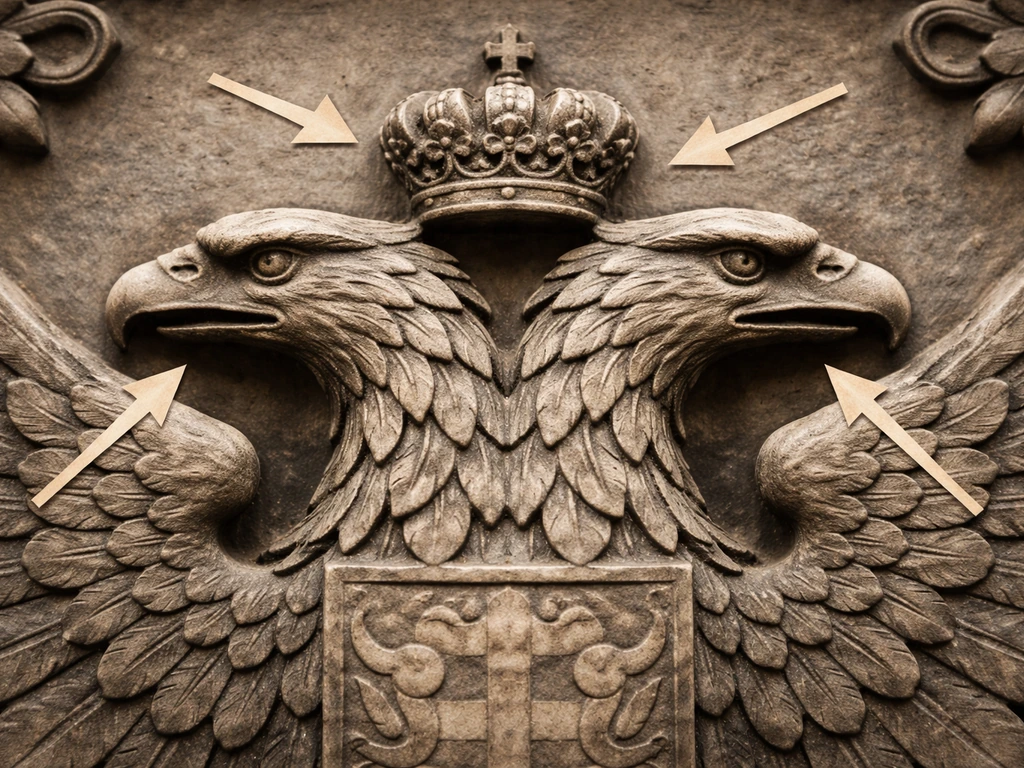
Before you decide what a two-headed bird means for you personally, it helps to do a quick iconographic scan of the image itself. Iconography is simply the study of what is depicted; iconology is what that depiction means culturally. Separating these two steps prevents you from jumping straight to personal meaning before you understand what you are actually looking at.
- Look at the species. Is it an eagle, a peacock, a generic bird, or something fantastical? Eagles dominate heraldic and imperial contexts. A more fantastical or richly ornamented creature suggests mythological origins. A simple or abstract form may be folk art or modern spiritual design.
- Check the posture and symmetry. Are both heads identical and alert, suggesting balanced authority or vigilance? Or do they differ in size, orientation, or expression, which would push toward conflict or duality of a more personal kind?
- Note the color and setting. The Gandabherunda is typically depicted in white on red. Byzantine double-headed eagles appear in gold and black. Color in heraldry is not decorative; it carries specific meaning in the tradition that produced the image.
- Ask where you encountered it. A church carving, a national flag, a coat of arms, a tattoo parlor design, a dream, a piece of jewelry, or a manuscript illustration each points toward a different interpretive framework.
- Research the geographic or cultural origin if possible. Balkan or Eastern European? Likely Byzantine or Orthodox influence. South Indian? Gandabherunda territory. Central Asian or Middle Eastern? Possibly Seljuk or older steppe traditions. Modern Western spiritual context? Probably drawing on all of the above loosely.
If you cannot trace the origin precisely, that is fine. The point of this process is not to become a heraldry scholar but to give yourself enough context to know whether you are reading a symbol of imperial authority, divine power, or personal spiritual guidance. Those three things call for very different responses.
How to actually use this meaning in your life right now
Once you have a working interpretation, the most practical thing you can do is treat it as a lens rather than a verdict. A symbol does not tell you what will happen. It invites you to look at what is already happening through a particular frame. Here is a simple method that works whether your image came from a dream, an art encounter, a family crest, or a tattoo you are considering.
Questions to sit with
- What was happening in your life when you encountered or became drawn to this image? Symbols tend to surface when something in you is ready to engage with what they represent.
- What was your immediate emotional response? Comfort, unease, awe, or recognition all tell you something about which reading is most alive for you right now.
- Are the two heads in your image at peace with each other or in tension? Let that visual cue guide you toward the 'harmony and completeness' interpretation or the 'conflict and division' one.
- Are you currently navigating a situation where two directions, two loyalties, or two belief systems are pulling at you? If yes, the crossroads reading is probably the most personally relevant.
- Does the image feel protective or overwhelming? Protective suggests the vigilance and guardian reading. Overwhelming suggests the internal conflict reading deserves more attention.
A simple reflection practice
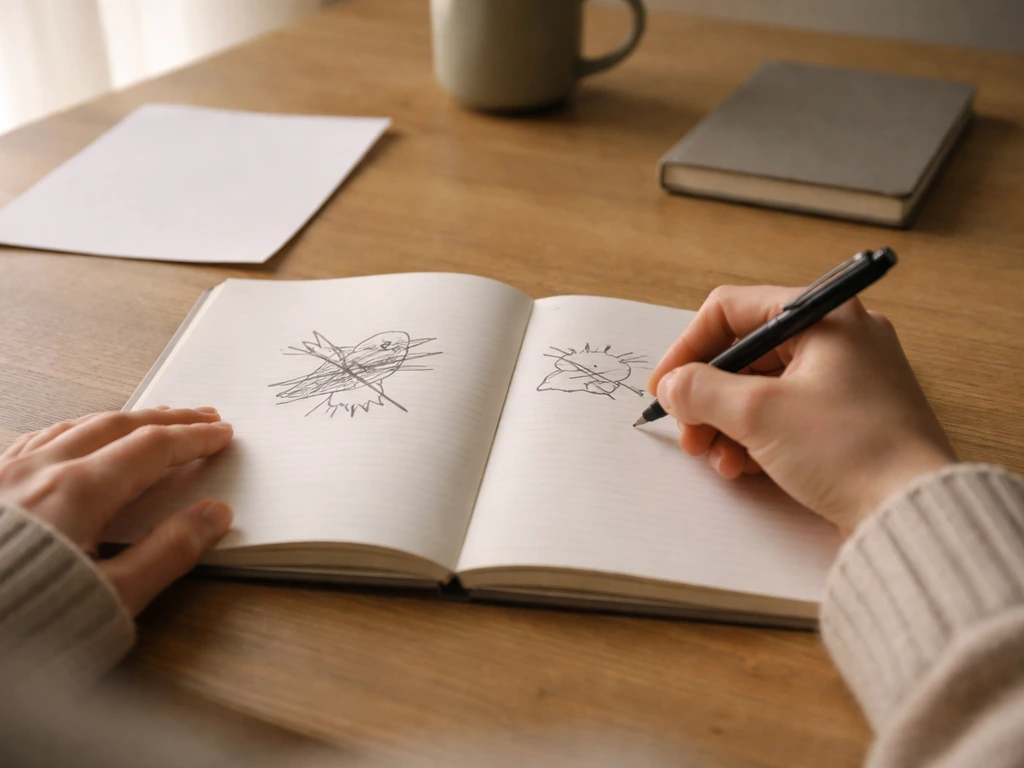
Journaling is one of the most reliable ways to work with symbolic material because it forces you to move from vague feeling to articulated thought. Spend ten minutes writing freely about what each of the two heads in your image might represent in your current life. Name each head. Give it a voice. This is not mystical performance; it is a practical way to surface tensions or insights that the symbol is pointing toward. Many people find that by the end of a short writing session, the 'meaning' of the image has clarified not because the symbol told them something but because the process of reflection did.
What not to do with this symbol
Do not treat a two-headed bird image as a literal prediction of doom, division, or misfortune. The symbol has been used for thousands of years as a marker of strength, authority, divine power, and balanced sovereignty. Even in its most cautionary readings, it is an invitation to self-awareness, not a sentence. If the image appeared in a dream or during an emotionally charged time, it deserves attention and reflection, not alarm. The same caution applies in reverse: do not force a purely positive reading if something about the image or your situation genuinely feels unresolved. Let the symbol be complex, because that complexity is exactly what makes it useful.
If you are exploring related territory, you might also find meaning in the broader question of how birds across cultures carry specific messages, or in how ancient carved objects like bird stones were used as spiritual tools by earlier peoples. If you are comparing it to older sayings, you may also find it useful to consider two stones one bird meaning as a related “two-in-one” idea. The two-headed bird sits in a rich symbolic neighborhood, and understanding that neighborhood always deepens the reading of any single image within it. Some people also connect this kind of bird symbolism to the historical “good lord bird” telegram story good lord bird telegram. If you want the story’s implications, the bird revelation explained approach breaks down the symbolic context step by step.
FAQ
How can I tell if a two-headed bird image is meant as a heraldic emblem rather than a spiritual omen?
Look for cues like shields, crowns, symmetrical placement, and formal inscriptions. Heraldic versions tend to be centered, balanced, and styled with specific “grammar” (posture, spacing, direction), while spiritual artwork more often uses mood, color gradients, or nonstandard composition. If it appears as part of an official-looking crest or flag-like design, treat it as identity and authority first.
What if my image is not clearly a “bird,” it looks more like an eagle or a mythic creature with wings and a beak. Does that change the meaning?
Yes. If the creature resembles a specific historical motif like a double-headed eagle, the political and religious authority register becomes more likely. If it is drawn in a more generic “two-headed bird” style, it may be borrowing the visual idea without the original cultural rules, which means you should rely more heavily on the context (where you saw it, who made it, and its framing) than on the shape alone.
Can a two-headed bird meaning be different depending on whether the heads face the same direction or different directions?
Often, yes. When both heads look aligned, it suggests unified purpose, completeness, or coordinated sovereignty. When the heads look toward separate sides, it commonly emphasizes choice, vigilance across boundaries, or internal tension. Use this as a starting point, then confirm with posture (upright versus drooping) and overall symmetry.
Is it a mistake to interpret a two-headed bird based only on a dream without knowing what tradition the dream image resembles?
It can be. Dreams are personal, but the image you see still usually has a visual lineage. If your dream contains crisp, emblem-like details (uniform symmetry, shield elements, crown/insignia cues), try to match those details to known icon types before concluding it is purely “your psyche.” If it is painterly or emotionally surreal with no emblem cues, a personal reflection approach is safer.
If someone tells me “doom is coming” because of a two-headed bird, how should I sanity-check that?
Use three filters. First, check whether the image matches a historical emblem associated with authority or divine power, not just a scary interpretation. Second, examine your own situation for what already feels unresolved, since the symbol often functions as a reflection lens rather than a prediction. Third, prefer nuanced questions over forecasts, for example, “What dual tension needs integration?” instead of “What tragedy will happen?”.
Does the two-headed bird always mean duality, or can it point to something else?
Duality is the most consistent visual core, but it can express different pairings depending on context, such as two directions of attention, two jurisdictions, two roles, or two truths held together. If your image or setting emphasizes power structures (crowns, emblems, official color schemes), dual sovereignty readings may be stronger than “internal conflict” readings.
How should I interpret it if I found the image on social media or as a modern tattoo design, not in a historical context?
Treat it as derivative unless you can identify the source style. Modern designs can blend multiple traditions, which means you should not assume the meaning from the visual alone. Ask yourself what the artist is emphasizing (authority, protection, spiritual awakening, personal identity). Your “intended symbolism” matters because contemporary creators often reframe the old motifs.
What practical journaling prompts work best if I’m trying to figure out what the two heads represent in my life?
Try prompts that force specificity: “What is Head A protecting or trying to control right now?” and “What does Head B want to listen to that I keep ignoring?” Then add, “Where do these two aims clash, and where do they complement?” Naming the heads often clarifies whether the issue is conflict, coordination, or choice between paths.
If I can’t trace the origin precisely, is there still a reliable way to interpret the symbol?
Yes. Focus on iconology-light but context-heavy reading: identify the presentation (symmetry, posture, whether it looks like an emblem), the setting (church, myth story, tattoo placement, dream atmosphere), and your current emotional problem space (tension, decision-making, or feeling split). Even without an origin, these factors narrow the range and reduce guesswork.
Can the same two-headed bird image support both a “blessing” and a “warning” at the same time?
Often, yes. A symbol can act like a two-sided lens, where “blessing” corresponds to strength, guidance, or transcendence, and “warning” corresponds to imbalance or unresolved tension. Instead of choosing one, map which part of your situation feels empowered versus which part feels divided, then decide what action would integrate the two.