Two birds stand above all others as sacred in ancient Egypt: the ibis, regarded as the earthly form of Thoth, god of wisdom and writing, and the falcon, the living image of Horus, god of kingship and the sky. If you are trying to identify a single 'most sacred' bird, the ibis and the falcon are the two you need to know. Both appear in temple reliefs, funerary statuettes, mummified offerings, and hieroglyphic writing across thousands of years of Egyptian religious practice, and both are backed by museum collections and peer-reviewed scholarship rather than just popular retellings.
Which Bird Was Regarded Sacred in Ancient Egypt?

Eleanor Hartwell
2 May 2026
Why Egyptian religion has more than one sacred bird
The idea of a single sacred bird of Egypt is a simplification that collapses a rich, centuries-long tradition into a soundbite. Egyptian religion was polytheistic, regionally varied, and changed across historical periods, so which bird was 'the' sacred bird depended heavily on which deity, which temple, and which era you were talking about. Scholars at the Oriental Institute have emphasized that sacred-bird cult practice is period-dependent rather than a single Egypt-wide rule.
The ibis was sacred in the context of Thoth's cult; the falcon was sacred in the context of Horus, Ra, and solar worship; the vulture was associated with Nekhbet, goddess of Upper Egypt; and the sacred scarab beetle's companion the goose represented the primordial creator Amun. CNRS research has documented that millions of ibis and birds of prey were mummified as offerings across multiple deity cults, showing that the practice was widespread and not limited to one bird-to-god pairing.
That said, if someone asks which bird was most widely recognized as sacred in ancient Egypt, the ibis and the falcon dominate both the archaeological record and the scholarly consensus. The Metropolitan Museum of Art notes that ibis representations in copper alloy are among the most numerous sacred-animal statuettes ever recovered, alongside cat, falcon, and Apis. So rather than looking for one answer, think of it as two primary birds with a supporting cast.
The ibis: sacred bird of Thoth, god of wisdom
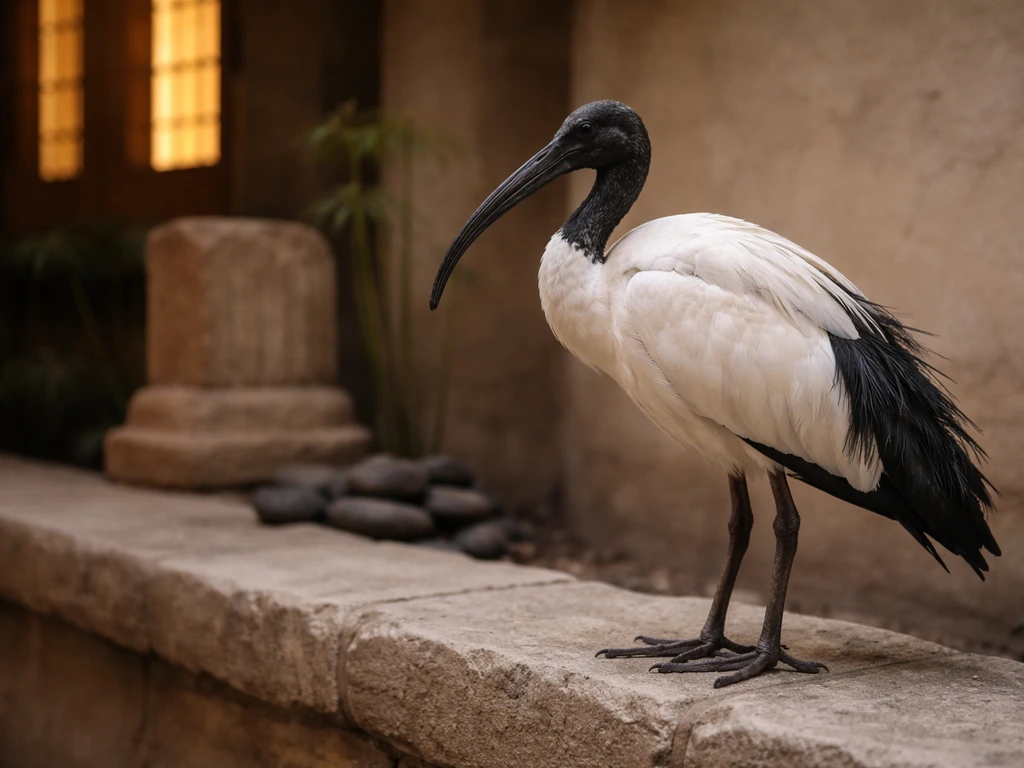
The Sacred Ibis (Threskiornis aethiopicus) was considered the earthly manifestation of Thoth, the god who oversaw wisdom, writing, science, and the weighing of souls in the afterlife. A papyrus preserved at the Oriental Institute is addressed directly 'to the ibis, Thoth,' which is as explicit as ancient textual evidence gets.
The American Ornithological Society describes the Sacred Ibis as 'the earthly form of Thoth,' and a PLOS Biology peer-reviewed summary calls the bird 'a manifestation of Thoth, god of wisdom and writing. ' This link was not metaphorical window dressing; it had institutional force. Ibis mummies were produced in the millions as votive offerings to Thoth, with PLOS ONE research documenting large-scale archaeological evidence for sacred ibis mummification at sites including Saqqara.
Thoth's cult persisted from early dynastic times through the Ptolemaic and even Roman periods, giving the ibis one of the longest runs as a sacred bird in human history. The Bibliotheca Alexandrina's Antiquities Museum holds a Statue of Thoth as an Ibis and notes that ibis worship continued until Roman times, a span of well over two thousand years.
How the ibis appears in Egyptian art and inscriptions
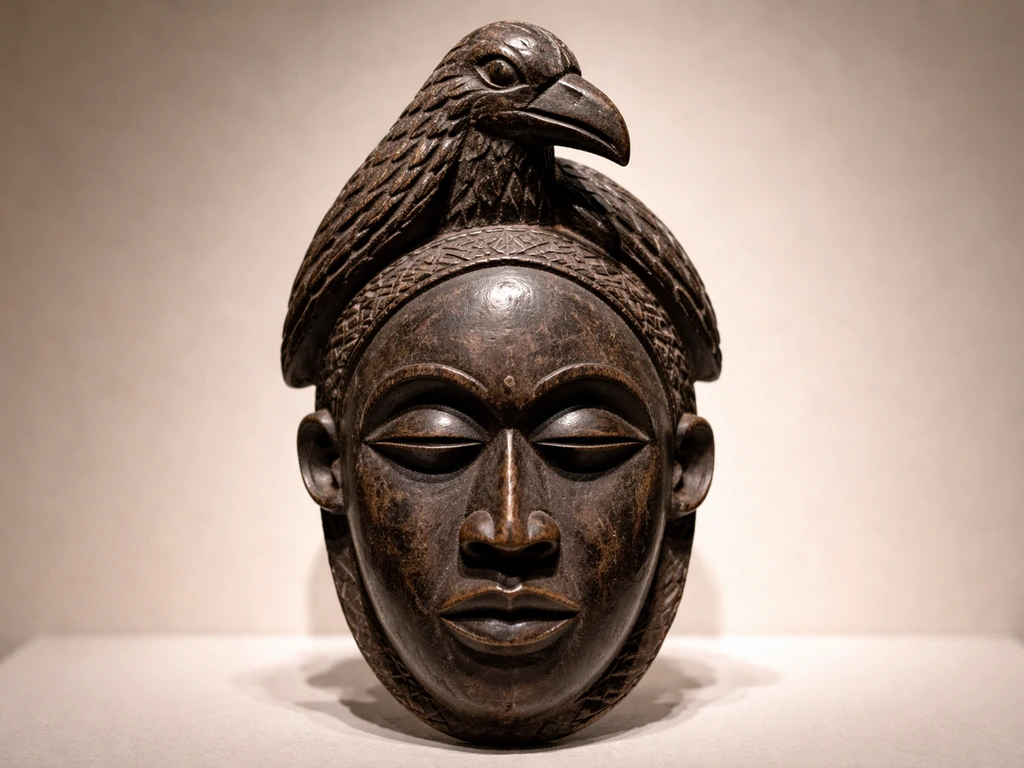
Recognizing Thoth in Egyptian art is usually straightforward once you know what to look for. The most common form is a human body with an ibis head, often holding a palette and stylus to signal the scribal and intellectual domain Thoth governed. African mask symbolism can vary, but bird-on-head motifs often relate to spiritual power, protection, or status bird-on-head meaning.
The Met holds multiple examples, including an ibis-headed Thoth figure and an inlay depicting Thoth as the ibis with a Maat feather, the latter underscoring the connection between Thoth, truth, and cosmic order. The British Museum catalog identifies ibis-headed standing figures in blue glazed composition, showing that this iconographic pattern appears across artifact types and materials. Thoth also appears occasionally as a full ibis, not a hybrid human-bird form, particularly in statue contexts.
The Bibliotheca Alexandrina holds one such statue of Thoth fully in ibis form.
The falcon: sacred bird of Horus, god of kingship
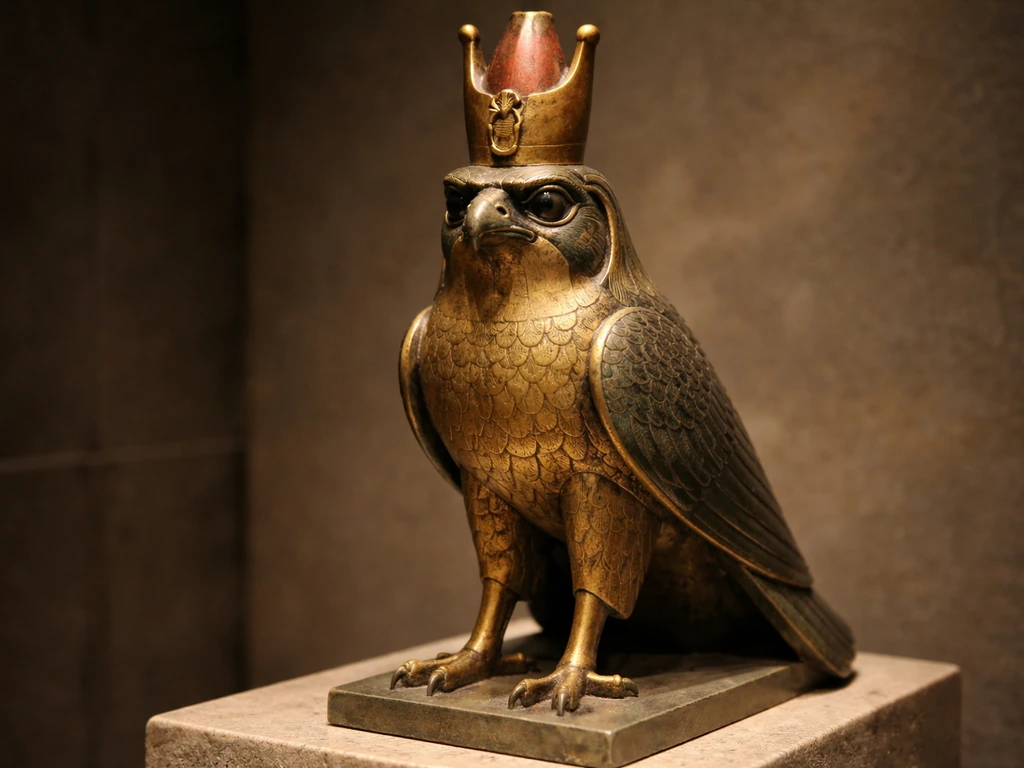
The falcon, specifically the peregrine or lanner falcon, was the sacred bird of Horus, one of the most important gods in the entire Egyptian pantheon. Horus embodied divine kingship: every pharaoh was considered the living Horus, and the legitimacy of royal rule was symbolically expressed through the falcon image. [The Walters Art Museum states clearly that Horus was depicted as a hawk or as a man with a hawk's head. ](https://art.
thewalters. org/object/22. 64/) The Harvard Art Museums explain that the falcon's predatory flight and commanding aerial character made the raptor a natural fit for Horus as the god of the living king and royal power. The North Carolina Museum of Art notes that Horus representations carry the specific markings of the lanner falcon, showing that Egyptian artists were observationally precise about which species they were depicting.
The North Carolina Museum of Art object page for a Horus Falcon describes the type in multiple forms, including as a full falcon, a falcon-headed man, or a fully anthropomorphic image Horus representations carry the specific markings of the lanner falcon.
The falcon's sacred role extended beyond Horus alone. The Met notes that falcon mummy boxes were associated with Horus cult but also with broader solar worship, and CNRS research confirms that birds of prey mummies were offered to Horus, Ra, and other deities. University of Manchester research documents a Festival of the Coronation of the Sacred Falcon at the temple of Edfu, illustrating just how elaborate and formalized falcon veneration became. But Horus remains the primary deity of the falcon, and the iconographic connection is so strong that the Horus falcon has its own hieroglyph: Gardiner sign G5, the falcon ideogram used as a logogram for the Egyptian word meaning 'Horus.'
How the falcon appears in Egyptian art and inscriptions
The standard Horus falcon in art appears in several reliable forms. The most iconic is a falcon wearing the double crown (pschent), which combined the white crown of Upper Egypt and the red crown of Lower Egypt. The Met's catalog entry for the 'Horus falcon in double crown' explains that this iconography directly symbolizes the union of the two lands and Horus' role as legitimate ruler of all Egypt.
The Detroit Institute of Arts describes the Falcon of Horus wearing the double crown as an image of divine kingship, and notes that such objects sometimes served as containers for the mummified remains of the bird itself. The Grand Egyptian Museum holds a gilt bronze hawk statuette showing the typical late-period pattern: falcon form, wearing a crown and a broad gilded collar.
The Gardner Museum describes Horus' eyes as representing the sun and moon, adding a cosmic dimension to the royal symbolism.
How to confirm which sacred bird you are looking at
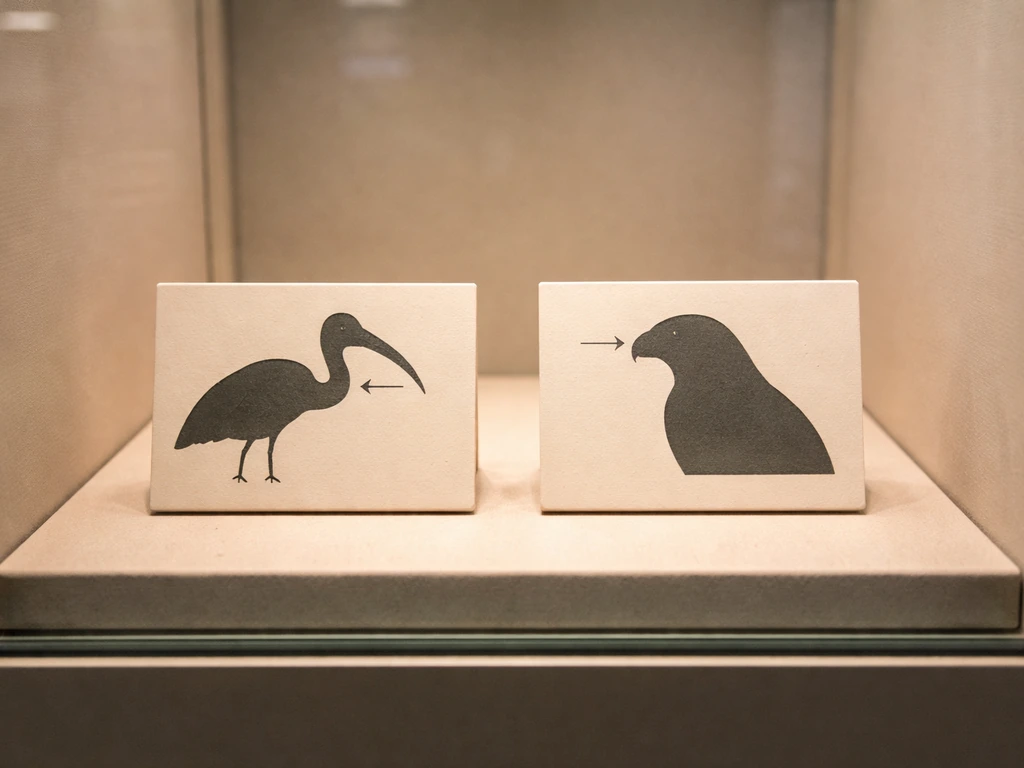
Whether you are standing in front of a museum case, looking at a photo of a relief, or reading a catalog entry, a short checklist will help you confidently identify the bird and its deity association.
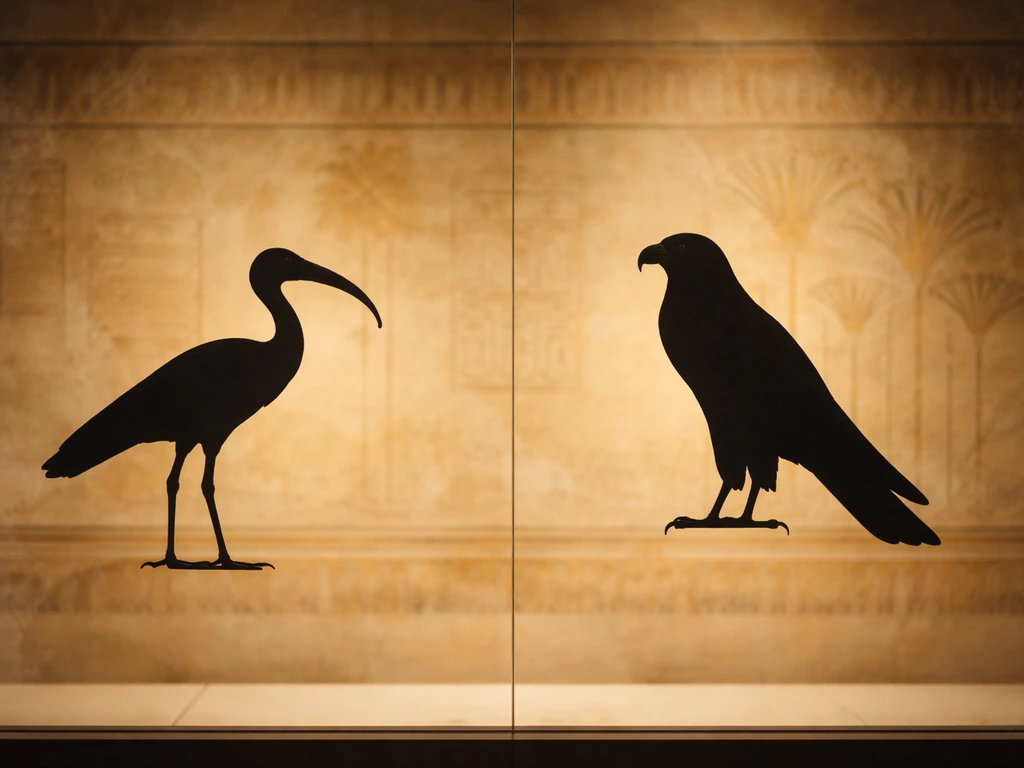
- Check the head shape first: a long downward-curved beak indicates an ibis (Thoth); a short hooked raptor beak indicates a falcon or hawk (Horus, Ra, or solar cult).
- Look for the body type: ibis-headed human figures with a palette or stylus point to Thoth; falcon-headed human figures or full falcon forms with a crown point to Horus.
- Identify the crown: the double crown (tall white cone inside a red flat-topped cap) is a strong marker for Horus; a sun disk with a uraeus on a falcon signals Ra-Horakhty, a solar fusion deity.
- Look for the Gardiner G5 hieroglyph nearby: a small seated falcon is the logogram for Horus in hieroglyphic inscriptions.
- Read the museum label for the deity name in transliteration: Thoth appears as ḏḥwty in scholarly texts; Horus as ḥr(w).
- Check the artifact's provenance and period: ibis cult peaked in the Late Period and Ptolemaic era; Horus falcon imagery spans from the Old Kingdom onward.
- Look for associated objects: scribal palettes, writing reeds, or Maat feathers alongside a bird form reinforce Thoth; uraeus serpents, crowns, and royal cartouches reinforce Horus.
- For mummified birds, check the sarcophagus shape and inscriptions: ibis mummy boxes typically have an elongated narrow form; falcon mummy boxes are often broader with raptor-shaped lids.
A quick side-by-side comparison
| Feature | Ibis (Thoth) | Falcon (Horus) |
|---|---|---|
| Primary deity | Thoth | Horus (also Ra, Ra-Horakhty) |
| Domain | Wisdom, writing, scribal arts, magic, afterlife judgment | Kingship, sky, solar power, royal legitimacy |
| Iconographic form | Ibis-headed human figure or full ibis; palette and stylus | Falcon-headed human figure or full falcon; double crown, uraeus |
| Key hieroglyph | Not a single standard logogram | Gardiner G5 (falcon, logogram for Horus) |
| Mummy evidence | Millions of ibis mummies at Saqqara and beyond | Falcon mummies at Saqqara; Festival of the Sacred Falcon at Edfu |
| Period of peak veneration | Late Period through Ptolemaic and Roman times | Old Kingdom through Ptolemaic period |
| Best museum examples | Met ibis-headed Thoth; British Museum blue glazed figure; Bibliotheca Alexandrina ibis statue | Met Horus falcon in double crown; DIA Falcon of Horus; GEM gilt bronze hawk |
What these sacred birds mean for spiritual interpretation today
It is worth being clear about the distinction between historical religious function and symbolic meaning. In ancient Egypt, the ibis and the falcon were not merely symbols; they were considered actual embodiments of divine forces, which is a different and more literal claim than what most modern readers mean by symbolism. That said, the symbolic dimensions of both birds translate powerfully into contemporary spiritual frameworks.
The ibis carries themes of wisdom, learning, discernment, and the careful recording of truth. Thoth's role as the divine scribe, the keeper of cosmic records, and the one who weighed souls against Maat's feather in the afterlife gives the ibis a profound association with intellectual honesty and spiritual accountability. If you encounter ibis imagery in an Egyptian context and feel drawn to its meaning, the invitation is toward deeper inquiry, toward studying, toward truth-telling, and toward understanding how knowledge relates to justice. The site's connected topic on Egyptian bird hieroglyph meaning explores how this scribal symbolism embedded itself into the very structure of the Egyptian writing system.
The falcon, as the bird of Horus, carries themes of protection, royal authority, clear vision, and the bridge between heaven and earth. Horus as a sky god whose eyes were the sun and moon is one of the most visually striking cosmic images in any mythology. The falcon's ability to hover at great height before striking with precision made it a natural image for divine oversight and decisive action.
For modern readers, the Horus falcon often resonates as a symbol of focused power, spiritual protection, and the ability to see the larger picture. The Horus bird meaning topic on this site covers that symbolism in full depth. If you are also curious about a Hamsa bird meaning in cultural and spiritual contexts, it is worth comparing how different symbols are interpreted across traditions Horus bird meaning.
Both birds also connect to the theme of the afterlife. Thoth guided and judged souls; Horus escorted the deceased king to eternal life. That convergence of wisdom and protection in the afterlife journey gives these two sacred birds a complementary spiritual logic, one providing the light of understanding, the other the power of guardianship.
Where to go next: best sources and search terms
If you want to go deeper than general articles, the following sources and strategies will give you genuinely reliable, nuanced information rather than recycled summaries.
Primary and scholarly sources worth consulting
- Between Heaven and Earth: Birds in Ancient Egypt, edited by Rozenn Bailleul-LeSuer (Oriental Institute Museum Publications 35, University of Chicago): this is the benchmark academic volume on sacred birds in Egyptian religion, covering ibis, falcon, and many other species with period-specific evidence.
- UCLA Encyclopedia of Egyptology (UEE): freely available online in PDF form; search for 'Thoth' and 'Horus' entries for scholarly synthesis with full bibliographies.
- Metropolitan Museum of Art online collection (metmuseum.org): search 'Thoth ibis,' 'Horus falcon,' and 'sacred animal' to access catalog entries with curatorial notes and artifact photographs.
- British Museum Collection Online (britishmuseum.org): similar searches yield hundreds of relevant statuettes, amulets, and mummy cases with detailed iconographic descriptions.
- Grand Egyptian Museum (GEM, Giza): their online catalog includes falcon statuettes and ibis objects with Arabic and English labeling.
- PLOS Biology and PLOS ONE: for the scientific evidence on ibis mummies, search 'Sacred Ibis mummies Thoth' in those journals directly; the articles are open access.
- Oriental Institute SAOC and OIMP publications (oi.uchicago.edu): freely downloadable PDFs include primary-source discussions of Thoth, the ibis papyrus, and sacred falcon festivals.
Search terms that will get you better results
- "Sacred ibis" Thoth "Late Period" OR "Ptolemaic" site: metmuseum.org OR site:britishmuseum.org
- "Horus falcon" double crown iconography museum
- Gardiner G5 hieroglyph Horus logogram
- "Threskiornis aethiopicus" Thoth mummy Saqqara
- "Between Heaven and Earth" Bailleul-LeSuer birds ancient Egypt
- Thoth ibis-headed scribe "scribal palette" Egyptian art
- UCLA Encyclopedia of Egyptology Thoth PDF
- Oriental Institute OIMP 35 sacred birds
- "Festival of the Coronation of the Sacred Falcon" Edfu
One practical tip: when a general web search gives you confident-sounding but unsourced claims about 'the sacred bird of Egypt,' cross-check immediately against a museum catalog entry or the OIMP 35 volume. The nuanced reality, multiple birds, multiple deities, period-specific cult practices, is far more interesting than any single-bird answer anyway, and it will give you a much richer appreciation of what Egyptian sacred-bird tradition actually was.
FAQ
Is there truly one “most sacred” bird in ancient Egypt, or were there several?
If you need a single direct answer for a specific question, it is safer to say “ibis (Thoth)” or “falcon (Horus)” rather than “one sacred bird.” Ancient Egypt had different sacred-bird cults by deity, region, and era, so the “most sacred” bird changes with the context you are studying.
How can I tell whether an ibis image is specifically Thoth and not just an ibis symbol?
To avoid the common mix-up, do not assume every “ibis” figure is Thoth. Some ibis imagery can emphasize scribal themes or temple contexts without necessarily functioning as Thoth himself in that scene. Check whether the artwork includes Thoth’s attributes (for example, palette and stylus) or the specific deity cues.
What visual clues distinguish a Horus falcon image from other Egyptian birds of prey?
Iconography helps a lot, especially for the falcon. A falcon wearing the double crown (pschent) is a strong indicator of Horus and royal legitimacy, while other bird-of-prey images may point to broader solar or funerary roles. Also note material and function, like whether it appears as a mummy container versus a standard deity figure.
Did Egyptians always depict the exact same bird species, or did artists sometimes use more general “falcon” imagery?
Not always. The sacred status of birds is strongly tied to religious practice and cult sites, but the species shown can vary depending on the artist, period, and available local birds. When exact species matter, treat it as an interpretive identification and look for markings, attitudes, and source descriptions rather than relying on generic “falcon” labels.
Besides the ibis and falcon, which other birds are most often discussed as sacred in Egyptian religion?
Yes, because sacred-bird veneration was not limited to just one or two deities. If your question is about “what birds were regarded sacred,” you should also consider the vulture connected with Nekhbet and the sacred scarab beetle with Amun’s creative associations, as these appear in different ritual networks.
When I see a bird artifact in a museum, what checklist should I use to identify its religious meaning?
For a practical museum or artifact workflow, record three things before you decide on the deity-bird link: (1) the object type (statuette, relief, mummified offering, amulet, box), (2) any crown or regalia (double crown for Horus), and (3) whether written labels or hieroglyphs accompany the figure. These cues reduce guesswork compared with relying on bird shape alone.
If I must pick just one species as the best general answer, should I say ibis or falcon?
If the goal is “which bird was sacred,” you can use the ibis and falcon as your best default starting point, because they dominate the long-term record. If the goal is “which bird was the most widely worshiped,” you should still frame it as cult-scale evidence and accept that the answer may differ by site and period rather than by a single universal bird.
How do I reconcile “birds as divine embodiments” with modern descriptions that call them just symbols?
A careful reader should distinguish worship and embodiment claims from modern symbolism. Egyptians often treated these birds as divine embodiments in their cult practice, while modern interpretations may describe their “meaning” in more metaphorical terms. When reading secondary sources, check whether they are describing ritual practice, iconography, or later symbolic reinterpretations.
What is the fastest way to fact-check a site that claims one bird was sacred above all others?
If you encounter a claim online that “X is the sacred bird of Egypt,” test it against at least one museum catalog entry or scholarly reference, and look for qualifiers like deity, region, and date. Strong claims without such qualifiers are a red flag, because the real pattern is multiple sacred birds across multiple cults.
What common mistakes do people make when trying to identify ibis-headed Thoth or the Horus falcon from photos?
Because many images are stylized, you can miss the point if you focus only on the head or silhouette. Compare the figure’s attributes, head gear, and associated writing, and remember that Thoth can appear as an ibis-headed man, while the Horus falcon often carries royal regalia like the double crown. Using these markers prevents over-identifying generic bird forms.
Next Article
African Mask With Bird on Head Meaning: How to Identify It
Meaning of an African bird head mask: identify the bird and symbols to narrow spiritual or cultural interpretations.