
An African mask with a bird on the head most commonly signals one of three things: a connection to ancestral or spirit communication, a specific named bird spirit tied to a regional tradition (like the Chokwe Kapukulu), or a ritual function where the bird's qualities (sharp sight, flight, freedom) are being invoked. But here is the honest answer you need first: 'African mask with a bird on head' is not a single object with a single meaning.
African Mask With Bird on Head Meaning: How to Identify It

Eleanor Hartwell
20 Apr 2026
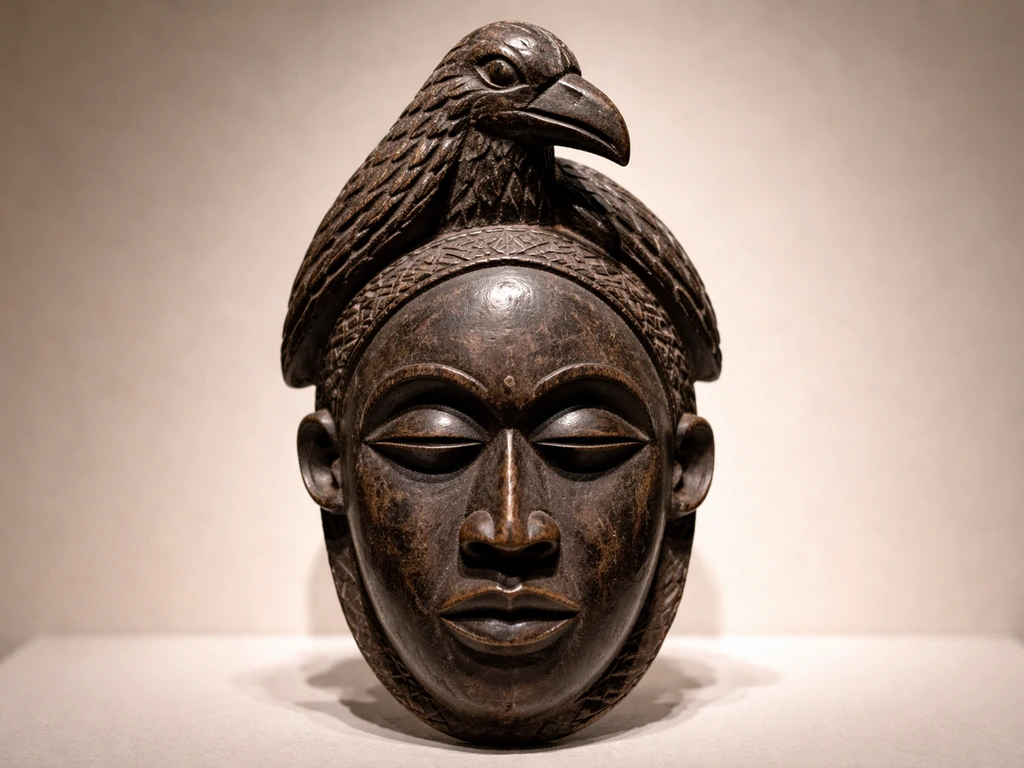
It is a description that could fit dozens of distinct mask traditions across West, Central, and Southern Africa, each with their own symbolic language. To get the real interpretation, you need to identify the mask's region, the bird species depicted, and the specific tradition it belongs to. This article walks you through how to do exactly that.
What 'African mask with a bird on head' actually refers to
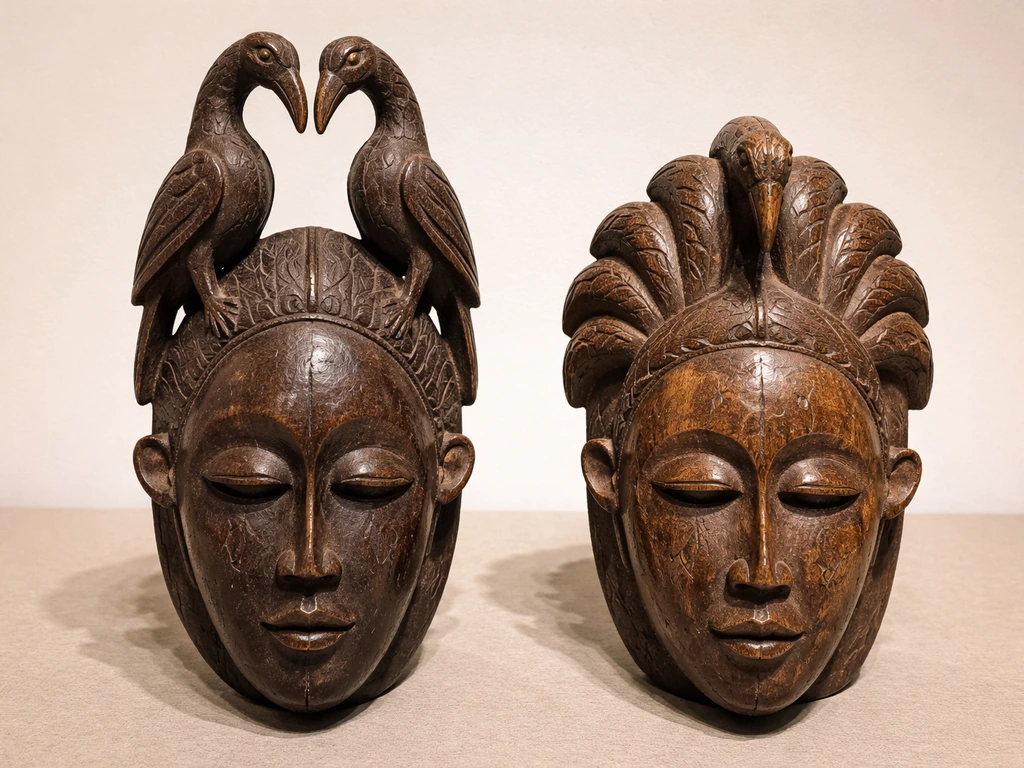
The phrase covers a genuinely wide range of objects. You might be looking at a Yoruba mask with a superstructure of two birds carved on top, as documented by the Detroit Institute of Arts. It could be a Chokwe bird mask from Angola, where a specific spirit called Kapukulu is represented through the form of a bird's head. It might be a Bwa mask from Burkina Faso where the lower portion is shaped like a large bird.
Or it could be a helmet-style crest mask with multiple bird figures nailed or attached to the crown, as cataloged by the Smithsonian. All of these get described as 'African mask with a bird on head' in casual search language, but they come from different peoples, carry different meanings, and are used in entirely different ritual contexts.
The Metropolitan Museum of Art makes a point worth sitting with: African masks are dynamic objects. They are not wall decorations with a fixed symbol dictionary. They come alive through costume, dance, and music, and the surface materials themselves are often understood as carrying mystical power. Extracting a single universal 'bird on head = X' meaning from any one of these objects without knowing its context is a shortcut that leads to misreading. That said, there are patterns and recurring themes across traditions that give you a useful starting framework, as long as you hold those interpretations loosely until you identify the specific mask.
How to identify the mask you're looking at
Before interpreting, identify. The more detail you can pin down visually, the closer you get to a reliable meaning. Here is what to look at carefully.
The bird's form and species
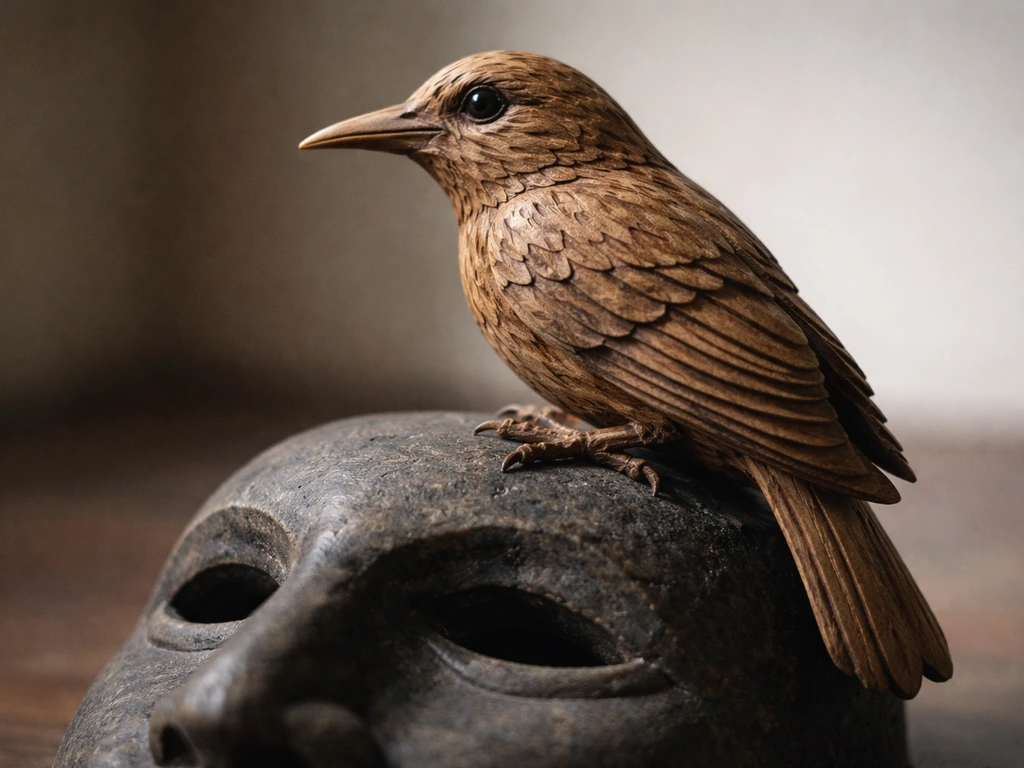
Is the bird abstract and stylized, or naturalistic with recognizable features like a long beak, spread wings, or a backward-turned head? A bird depicted with its head turned backward while its feet face forward and an egg in its mouth is almost certainly a Sankofa bird, from Akan tradition in Ghana. Berea College explains Sankofa as an Akan concept focused on learning from the past to ensure a strong future [Sankofa bird, from Akan tradition in Ghana](https://www. berea.
edu/centers/carter-g-woodson-center-for-interracial-education/the-power-of-sankofa/). That is a highly specific and recognizable motif. A mask where the entire form communicates 'the essence of a bird's head,' as Sotheby's describes for the Chokwe example, is a different object entirely. The Bwa mask tradition includes bird shapes where even scholars note uncertainty about the species, sometimes suggesting the bird could represent a sacrificial chicken rather than a wild species.
Species matters because, as one Yoruba gelede specialist puts it, the meaning of a bird motif depends on the name of the bird, its behavior, and the associations that name carries in the local language and oral tradition.
The mask's structure and how the bird sits on it
Is the bird a carved superstructure rising above a face mask? Is it a separate headdress worn entirely on top of the head while the dancer's face is covered in netting, as the High Museum of Art documents for certain bird headdresses? Is it a helmet-style crest mask with multiple bird figures attached on top? Or is the entire mask shaped like a bird's head, replacing the human face entirely?
Each of these structures points to a different tradition and a different use. The Smithsonian's crest mask with four birds nailed on top is a completely different object category from a wearable bird headdress where the dancer's body is covered in a feathered tunic. Structure is one of your clearest identification clues.
Materials and construction details
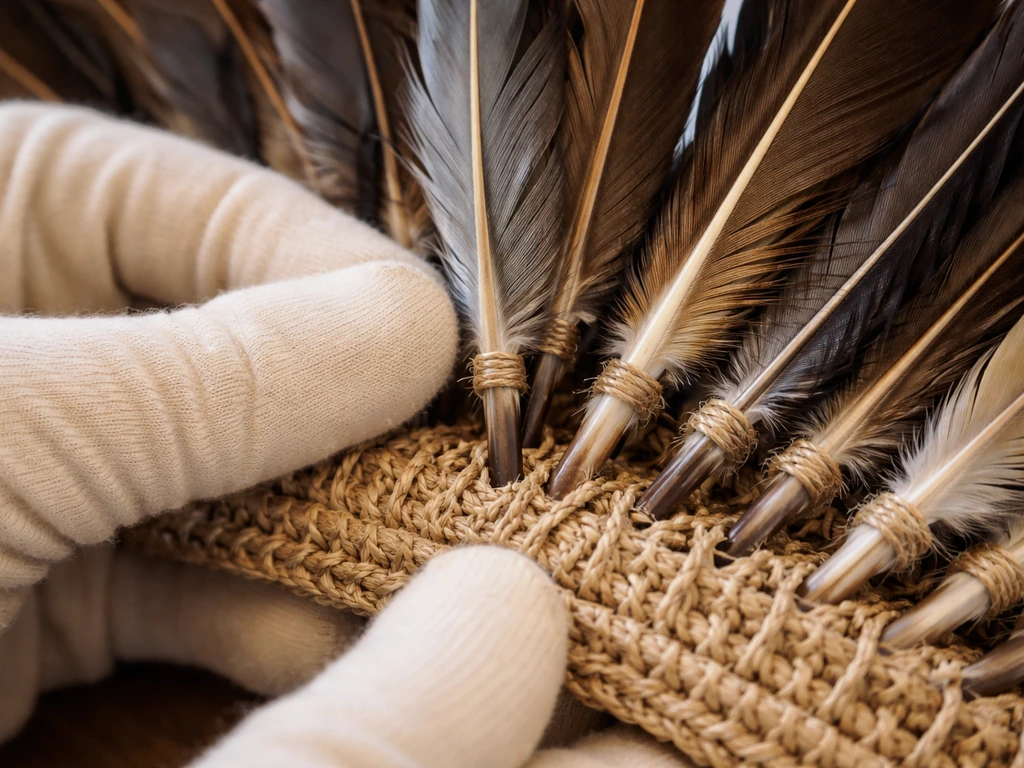
What the mask is made of narrows the field considerably. The Art Institute of Chicago documents a feather headdress constructed by pushing bird quills into a crocheted or basketry crown and securing them with cotton or raffia thread. The Cleveland Museum of Art records a headdress using hundreds of red tail feathers from the African gray parrot (Psittacus erithacus). Polychromed wood, plant fiber, iron nails, natural pigments, and raffia all point to specific regional workshops and traditions. If you have the physical object or a detailed image, note the primary material (carved wood, feather construction, mixed media), any surface treatment (paint, metal, fiber), and how the bird element is attached or integrated.
| Tradition / Region | Bird Motif Description | Primary Materials | Key Symbolic Link |
|---|---|---|---|
| Yoruba (West Africa) | Two-bird superstructure above face mask | Wood, polychrome paint | Status, spiritual authority, paired duality |
| Chokwe (Angola/Central Africa) | Entire mask as bird head (Kapukulu spirit) | Wood, pigment | Bird spirit invocation, hunting, sharp sight |
| Bwa (Burkina Faso) | Lower mask shaped as large bird | Wood, paint, fiber | Sacrificial or totemic animal, community ritual |
| Akan/Sankofa (Ghana) | Stylized bird, head turned back, egg in mouth | Gold, wood, textile | Ancestral wisdom, learning from the past |
| Kifwebe (DR Congo) | Mask features that shift identity (hawk when beardless) | Wood, pigment, raffia | Categorical identity, spirit classification |
| Crest mask traditions (varied) | Multiple birds fixed to top of helmet mask | Wood, iron nails, paint | Collective spiritual presence, protection |
What birds on masks and heads symbolize across African traditions
Even with regional variation, certain symbolic threads run consistently enough through African bird imagery that they form a useful interpretive foundation. Flight is the most persistent: birds move between earth and sky, making them natural candidates for representing the movement between human and spirit realms, between the living and the ancestors. This is not unique to Africa. The same logic shows up in Egyptian ibis and Horus falcon imagery, in the Aztec eagle, and in countless other traditions where birds are understood as messengers or intermediaries. But in African mask contexts, the bird is not just a symbol sitting on top of the object. It is often actively performing that intermediary role during the masquerade.
Protection is another consistent thread. A bird worn on the head or carved above the face can signal that the wearer or the mask itself is under spiritual protection, or that the wearer is extending that protection to the community. The Chokwe bird mask used in preparation for hunting captures this practically: invoking the spirit of a sharp-eyed bird before a hunt is both spiritual and functional. The bird's known behavior (keen vision, precision, aerial vantage) is being borrowed and applied to the hunter's task.
Ancestral communication is the third major symbolic category. Birds appear repeatedly in African traditions as vehicles through which ancestors speak, warn, or guide the living. When a bird sits above a mask's face, it can be read as the ancestor or spirit watching over the ceremony from above, present but not entirely embodied. The Art Institute of Chicago's note that 'by wearing birds on his crown' a ruler or ritual specialist signals something specific about their role supports this: the bird is not decorative, it is relational. It marks a relationship between the wearer and something beyond the visible world.
Cultural and religious interpretations across African and diaspora contexts
Across West Africa, bird imagery in masquerade traditions tends to cluster around royalty, spiritual authority, and transition rituals. The Yoruba gelede tradition uses bird motifs with meanings that are highly specific to the individual bird's name and behavior in Yoruba oral tradition. A parrot, a hornbill, and an eagle carry entirely different associations, and the meaning of the mask changes accordingly. The Sankofa bird from Akan tradition is probably the most widely recognized African bird symbol in diaspora contexts today.
Its distinctive backward-looking posture and the egg it carries communicate one of the most direct symbolic messages in any African tradition: you must know where you came from to know where you are going. It is used widely in African and African American cultural contexts to represent ancestral reflection and reclamation.
In Central African traditions, especially among the Chokwe, bird masks are tied to named spirits with specific ritual functions. The Kapukulu bird spirit represents a distinct spiritual entity, not a generic 'bird energy. ' Only a few such masks are documented, which makes identification especially important: if someone is claiming a Chokwe bird mask connection, the visual form should communicate the essence of a bird's head in a very particular way.
In the Kifwebe tradition of the Democratic Republic of Congo, the presence or absence of a beard on a mask changes how it is categorized, with certain forms associated with hawks. Crocker Art Museum hosts interpretive material for an exhibition specifically focused on Kifwebe masks from Songye and Luba traditions, making it a useful authority reference for understanding what Kifwebe is.
This level of specificity is a reminder that visual details that look minor to an outside observer can completely alter a mask's meaning within its own tradition.
In Caribbean and diaspora masquerade traditions, bird imagery has traveled but the chain of specific meaning has often broken. The Horniman Museum notes that today many people in Caribbean masquerade contexts do not know the original history or meaning behind the traditions they perform, because West African, Central African, and indigenous Caribbean traditions merged across centuries of displacement. A bird in a Caribbean Carnival costume may carry the visual memory of West African bird masks without the specific spiritual vocabulary that originally animated it. This is not a diminishment, it is a transformation, and it matters for interpretation: diaspora bird symbols should be read in their current cultural context, not assumed to carry unchanged African meanings.
What your bird-on-mask encounter might be telling you
If you came to this question because you encountered a specific mask and felt drawn to its bird imagery, that response is worth taking seriously alongside the cultural research. Bird symbols across traditions, including African ones, tend to activate similar personal resonances: a sense of being watched over, a feeling of being at a threshold or transition, an intuition that something from the past (an ancestor, a memory, an unresolved question) is present.
If the bird on the mask you saw had its head turned back, blank" rel="noopener noreferrer">Sankofa's message about ancestral wisdom and reflection may be directly relevant to where you are right now. If you want to go deeper into the specific sphinx bird meaning, start by identifying whether the bird form matches the Sankofa tradition Sankofa bird. If the bird was depicted in flight or with wings spread, the symbolism of movement, freedom, and perspective is likely in play.
The Chokwe Kapukulu connection is worth considering if the mask you encountered looked like it was channeling a bird's essence rather than merely depicting one, and if your encounter felt less like admiring art and more like being seen. The 'sharp-eyed bird' invoked before a hunt is a symbol of clarity and precision, useful to consider when you are facing a decision that requires focus and vision rather than force. If the mask had multiple birds, the Smithsonian's crest mask tradition suggests collective spiritual presence, which might speak to a moment in your life where you are feeling supported by more than just visible allies.
That said, treat any personal interpretation as probabilistic until you confirm the mask's origin. A 2024 research article in Human Ecology argues that masquerade meaning is layered and highly specific within local ritual repertoires, and that generic interpretations flatten what is actually a nuanced, community-embedded practice. Personal resonance is real and worth following as a thread, but it works best when it is anchored to at least an approximate cultural identification.
Practical next steps to get the right answer for your specific mask
Here is what to do now, in order of effectiveness.
- Document the visual details: Write down or photograph the bird's form (stylized vs. naturalistic), how it sits on the mask (superstructure, integrated crest, separate headdress, full bird-head form), the primary materials (wood, feathers, fiber, metal), and any surface decoration (paint colors, patterns, added materials). These details are your search vocabulary.
- Search museum collection databases directly: The Metropolitan Museum of Art, British Museum, Smithsonian Institution, Detroit Institute of Arts, Art Institute of Chicago, Brooklyn Museum, and Cleveland Museum of Art all have searchable online collections with cultural attribution and scholarly notes. Search for your visual description plus 'mask' and 'Africa' to find comparable objects.
- Use auction catalog descriptions as a cross-reference: Sotheby's, Christie's, and Bonhams publish detailed provenance and cultural attribution notes for African masks. These are written by specialists and often name the tradition, the ritual context, and the specific motif. Searching their archives for comparable bird mask descriptions is a legitimate research tool.
- Ask the right questions if the mask has a known origin: If you saw it in a museum, ask the curator for the object record or the cultural attribution notes. If you found it in a shop or online listing, ask for provenance documentation: where it was acquired, from whom, and what region it is attributed to. No provenance is itself important information.
- Match the bird species to oral tradition: Once you have a regional attribution (Yoruba, Chokwe, Bwa, Akan, etc.), search for that people's oral traditions and known bird symbolism. A Yoruba mask's bird meaning depends on the Yoruba name for that bird. A Chokwe mask's bird depends on whether it matches the Kapukulu spirit's described form. This step is where the cultural meaning becomes specific rather than generic.
- Avoid universal 'symbol dictionary' shortcuts: Sites that list 'bird on African mask = ancestor protection' without cultural attribution are giving you a starting hypothesis, not a confirmed meaning. Treat them as prompts for further research, not conclusions.
If you are interested in how bird symbolism functions in related Egyptian and West African spiritual contexts, the Horus falcon and the sacred ibis traditions offer some of the most documented examples of birds as divine intermediaries in African spiritual history. In ancient Egypt, the sacred ibis was regarded as a revered bird closely tied to Thoth and religious symbolism Horus falcon and the sacred ibis traditions.
In ancient Egypt, the sacred ibis was a wading bird that was sacred in ancient Egypt and closely tied to divine symbolism. Understanding the Egyptian bird hieroglyph meaning for the ibis can also help you interpret how birds were used as divine signs. The Sankofa bird is probably the most approachable entry point for understanding how a single African bird symbol carries layered meaning across both its origin culture and the diaspora that inherited it.
These connections are worth exploring alongside any specific mask identification you pursue.
The honest bottom line: an African mask with a bird on the head is most likely communicating something about spiritual vision, ancestral connection, or ritual protection. If you are looking for another bird-related symbol with a distinct cultural interpretation, you can also explore hamsa bird meaning as a comparison point alongside the African mask meanings. To understand how people use Horus imagery to read bird meanings, it helps to look at the Horus bird meaning tradition as well.
But which of those it is, and what it means for you, depends entirely on which mask it actually is. Do the identification work first. The meaning will be more specific, more accurate, and ultimately more useful than any general answer can be.
FAQ
How can I tell if the bird motif is Sankofa versus just a bird facing backward in general?
Look for the Sankofa-specific combination (a backward-looking bird posture plus an egg or return/ancestral cue). If the beak is not clearly oriented toward the past, and there is no egg carried or equivalent Sankofa hallmark, the meaning may shift to a different bird or local variant even if it “looks similar.”
What’s the fastest way to narrow down the mask tradition when I only have a photo?
Start with structure (separate headdress on top versus crest/helmet versus the whole mask shaped like a bird head). Then zoom in on the bird details (beak length, tail shape, wing spread, head direction). Finally, check materials visible in the image (painted wood versus feather quills versus layered fiber), since workshop and regional techniques often leave consistent traces.
If the bird species is unclear, how should I handle the interpretation?
Treat the meaning as less certain and avoid locking into a specific “named bird spirit” reading. Instead, use behavior-based clues you can confirm (sharp sight, flight, protection, intermediary role). If a species cannot be verified, the interpretation should remain broader until you identify the tradition and local bird-name associations.
Can an “African bird mask” meaning be different depending on whether the wearer dances versus it being displayed as art?
Yes. In masquerade contexts, the bird element can be considered active (worn to perform an intermediary or protective function) rather than a static symbol. If your only access is a museum display without performance context, you should downgrade certainty and interpret the bird imagery as likely tied to ritual roles rather than a purely decorative emblem.
What are common mistakes people make when searching “African mask with bird on head meaning”?
The biggest errors are assuming a one-to-one symbol dictionary (bird on head equals one fixed meaning) and ignoring regional and structural differences. Another common mistake is mixing diaspora adaptations with original African traditions, then treating the modern costume version as if it carried the same ceremonial vocabulary.
If I see multiple birds on the crown or crest, does it always mean “more spirits” or something collective?
Not always. Multiple bird figures can indicate a crest-style category, a specific named role, or a combined ritual emphasis, but the correct interpretation depends on how the birds are arranged (count, placement, attachment style) and what tradition the crest belongs to. Use the object category first (crest mask versus headdress) before concluding the meaning is “collective.”
Why does material matter so much for meaning and identification?
Feather construction, specific color palettes, and attachment methods can point to particular regional workshops and known costume techniques. For example, a quill-based crown stitched into a fiber framework can suggest a different maker tradition than a polychromed wood-and-metal approach, even when both depict birds.
Is it appropriate to rely on personal resonance, and how do I keep it from becoming speculation?
You can treat personal resonance as a starting thread, but anchor it to at least an approximate identification (region or tradition, bird posture, structure, and identifiable motifs). If you cannot verify the mask’s origin or bird motif with reasonable confidence, keep the personal interpretation probabilistic rather than definitive.
What should I do if someone claims a specific identity, like “this is Chokwe Kapukulu,” based on appearance alone?
Ask for the concrete visual match they are using, especially the bird-head essence and any hallmarks tied to the specific spirit or mask form. If the claim is based only on “there’s a bird on top,” treat it as low confidence, because the article’s core point is that small structural and motif details change categorization within traditions.
How can I compare bird symbolism from other cultures without assuming it maps directly onto African mask meaning?
Use comparison only to generate hypotheses, not to replace identification. For instance, if another tradition interprets birds as divine intermediaries, that can support a “mediator or protection” possibility, but you still need the mask’s region, bird posture, and structure to determine whether the African tradition uses the same conceptual focus.
Next Article
What Bird Is a Sign From Heaven? Meaning and How to Interpret
Which bird is often seen as a sign from heaven, plus a step-by-step way to interpret your specific encounter.