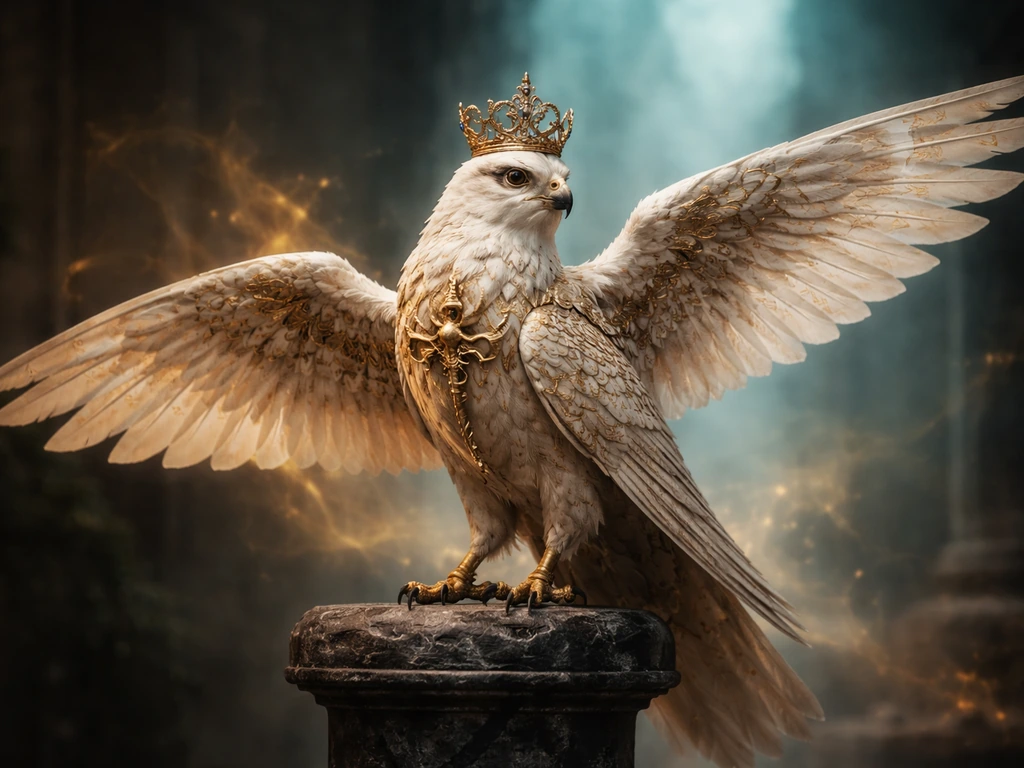
The phrase 'the bird of Hermes is my name eating my wings to make me tame' comes from the Ripley Scroll, a series of illustrated alchemical manuscripts attributed to the 15th-century English alchemist George Ripley. The 'bird of Hermes' is a crowned, human-headed bird that appears in the scroll's imagery, biting or eating its own wing. It is a symbol of cyclical transformation, self-consuming change, and the messenger energy associated with Hermes/Mercury. If you came across this phrase online and are trying to understand what it means spiritually, you are looking at one of the most striking bird symbols in Western esoteric tradition.
The Bird of Hermes Is My Name Ripley Scroll Explained

Eleanor Hartwell
26 Apr 2026
What 'the bird of Hermes' actually means
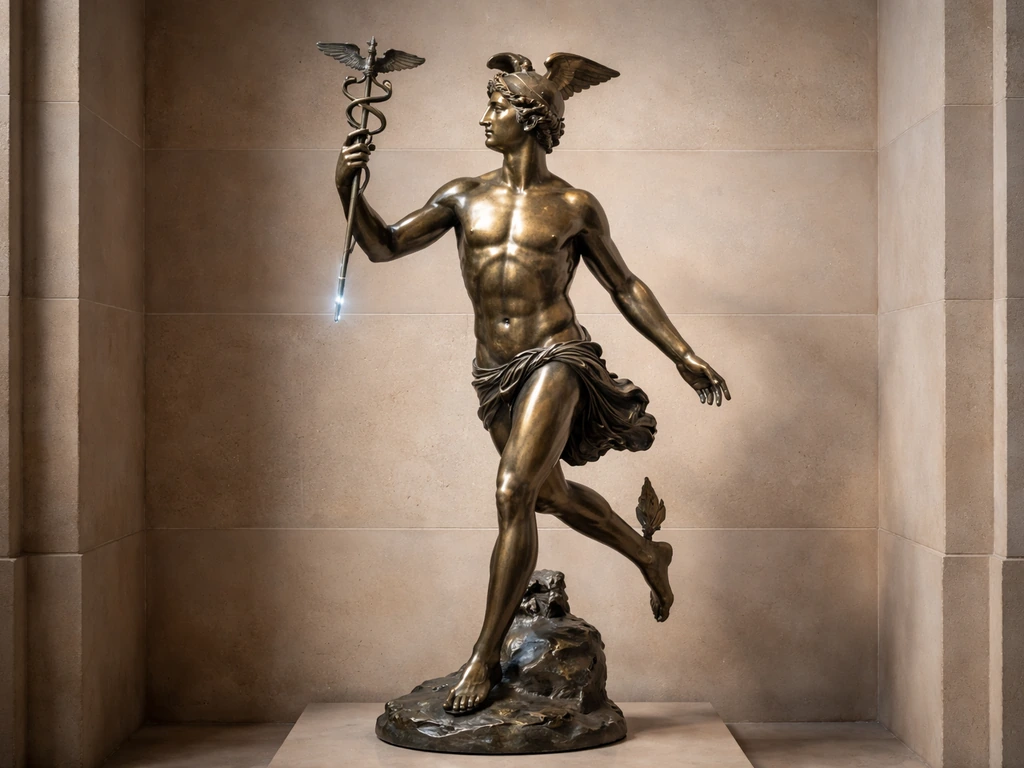
In Graeco-Roman mythology, Hermes is the gods' herald and messenger, the figure who moves between worlds, carries divine communications, and guides souls. His Roman counterpart is Mercury. Both are depicted with winged sandals and a caduceus, the herald's wand whose very name derives from the Greek word for 'messenger' or 'envoy.' Flight is at the core of Hermes' identity, so when ancient and medieval thinkers needed a symbol for a substance or principle that moved between states, they reached for bird imagery tied to his name.
The 'bird of Hermes' in alchemical writing specifically refers to mercury (the element), which alchemists saw as a shape-shifting, transitional material that could move between solid, liquid, and vapor. They personified it as a bird because birds, like mercury, move between earth and sky, between solid ground and open air. Hermes as messenger of the gods and mercury as the volatile, transforming element got fused into a single bird symbol. That symbol carried all the weight of divine communication, transformation, and the crossing of thresholds.
If you are interested in the broader identity of Hermes and his sacred birds, the ibis and the crane both carry associations with Hermes across different cultural contexts. The ibis and the crane are often discussed as Hermes' sacred birds in different traditions, offering clues about how ancient writers linked Hermes with specific animals Hermes and his sacred birds. What makes the Ripley Scroll's bird distinctive is how specifically it dramatizes self-transformation through that wing-eating image.
What the Ripley Scroll is
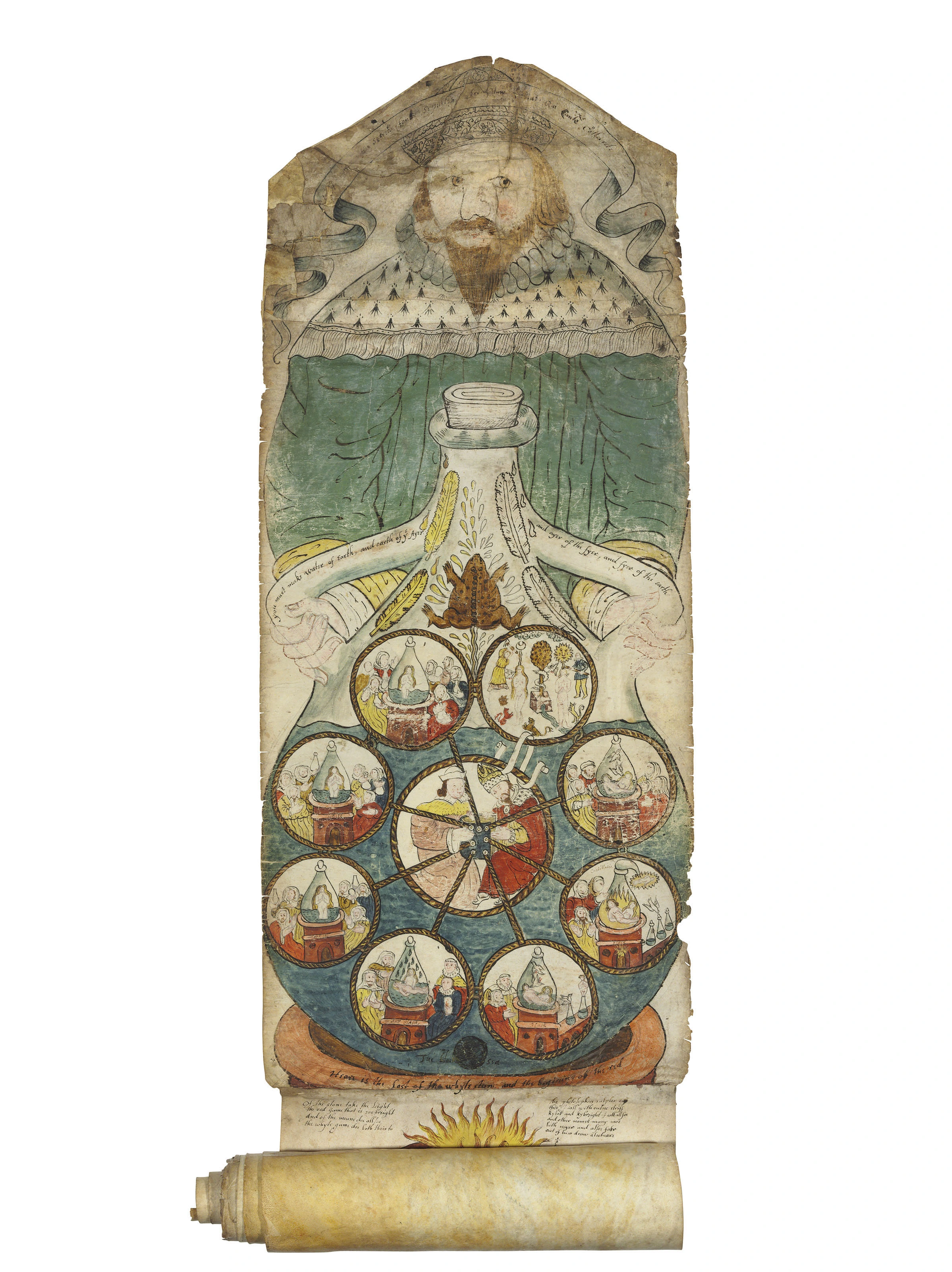
The Ripley Scroll is not one single document. It is a family of illustrated alchemical manuscripts, most of them produced in England between roughly 1480 and the early 1600s, attributed to George Ripley, a 15th-century English canon and alchemist. Multiple versions survive today, held at institutions including the Beinecke Library at Yale (Mellon MS 41), the Royal College of Physicians of Edinburgh, and the Wellcome Collection in London. Christie's auctioned a 1624 example that described 'the Bird of Hermes' as 'a crowned human-headed bird with wings outstretched beneath a blazing sun.' Each version is a long, rolled manuscript, sometimes several feet long, combining emblematic illustrations with verses in Middle or Early Modern English.
The scroll's imagery is dense and sequential, walking the reader through the stages of an alchemical process using animal figures, symbolic landscapes, and verse captions. It is a visual and textual system, not just a pretty picture. The bird of Hermes panel is one of the most recognizable sections because of how vividly it illustrates the idea of a substance transforming by consuming itself.
Elias Ashmole's 1652 anthology Theatrum Chemicum Britannicum was a key early print venue for English alchemical verse including material attributed to Ripley, which helped spread this imagery beyond manuscript collectors into a broader reading audience. Princeton Digital PUL notes that in 1652 Elias Ashmole published the first English edition of Ripley Scroll verses in Theatrum Chemicum Britannicum. That's part of why the phrase circulates so widely online today.
How the phrase actually appears in the scroll (and why wordings vary)
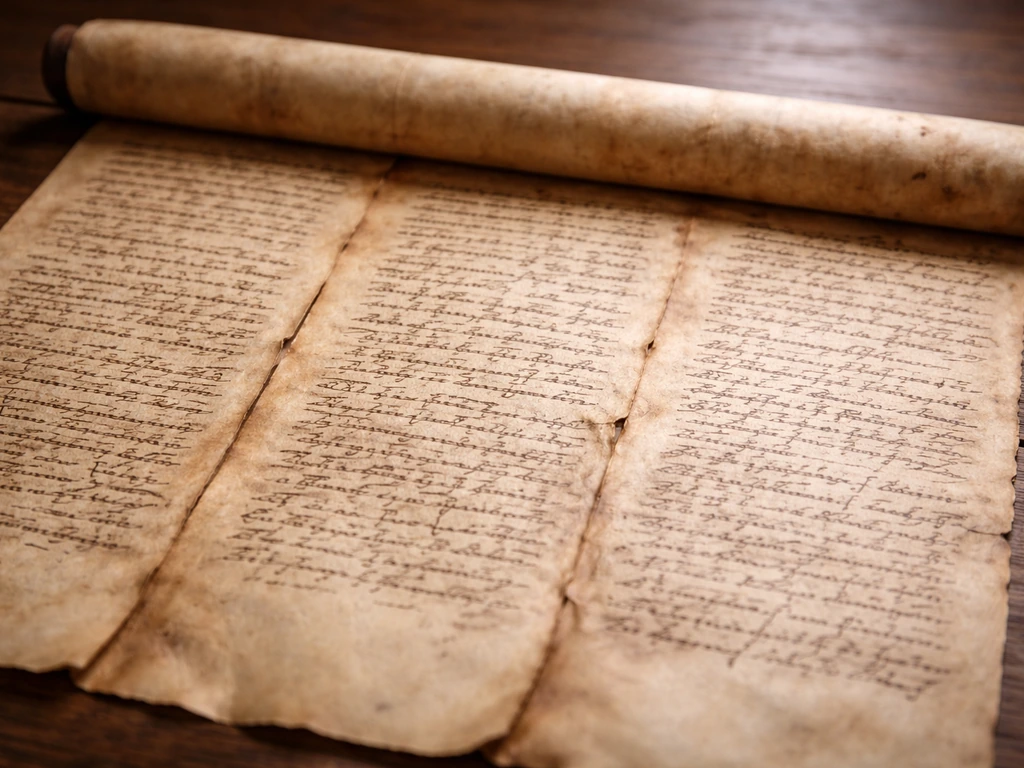
The Wellcome Collection's description, drawing on Ashmole's 1652 account, places the legend in the third panel of the scroll and gives the spelling: 'The Birde of hermes is my name: eatings my winges to make me tame.' Online PDFs and transcriptions, including ones circulating on sites like the Alchemy Website, often render it as: 'The bird of Hermes is my name eating my wings to make me tame.' Some versions spread across two lines in the scroll itself, with one line reading 'Standeth the bird of Hermes Eating his wings variable' and a later line giving the 'is my name' formulation.
The variation you see online almost always comes down to which manuscript a transcriber was working from, whether they modernized spelling, and whether they were capturing the full verse or just the most memorable couplet. The core meaning does not change across versions, but if you are trying to verify an exact quote you found somewhere, it is worth tracing which edition or scan the source is using. Compendium Naturalis notes that a modernized unified text exists on the Alchemy Website, which is a useful comparison point. The Beinecke and Wellcome holdings are the most rigorously catalogued primary sources.
| Source / Version | Wording of the key line |
|---|---|
| Wellcome Collection / Ashmole 1652 account | The Birde of hermes is my name: eatings my winges to make me tame |
| Online PDFs / Alchemy Website transcription | The bird of Hermes is my name eating my wings to make me tame |
| RCPE manuscript description | Crowned Bird of Hermes biting its left wing, standing on an orb |
| Christie's 1624 auction example | Crowned human-headed bird with wings outstretched, verses beneath |
What bird imagery is actually being used here
The physical description across multiple Ripley Scroll versions is consistent: a crowned bird with a human head, sometimes biting or eating its own wing, standing on an orb into which seven feathers are stuck (according to the RCPE description). The wing-eating gesture is the key image. It echoes the ouroboros, the serpent eating its tail, which is another alchemical symbol of cyclical self-renewal. The bird is consuming part of itself in order to be transformed, tamed, made whole in a new form.
The crown signals royal or elevated status, something divine or perfected rather than ordinary. The human head connects the bird to consciousness and reason, distinguishing it from a purely animal creature. This is not a naturalistic bird you would identify in a field guide. It is a hybrid, a figure that sits between categories, which is exactly the point. Hermes himself moves between categories: mortal and divine, living and dead, earth and sky. His bird does the same.
The feathers stuck into the orb below the bird are worth noting too. Feathers in bird symbolism across many traditions represent messages, transition, and the lightness of spirit. Having seven of them fixed to the orb the bird stands on grounds the aerial, messenger energy of the bird into a specific, structured set of stages. In alchemical terms, those seven feathers likely corresponded to the seven classical planets, but in a bird-symbolism reading, they are anchors connecting heavenly flight to earthly process.
What this means spiritually for a modern reader
Strip away the alchemical framework and the bird of Hermes still communicates something clear: transformation happens through releasing what you cling to, even parts of yourself. The bird eats its own wings not to destroy itself but to become tame, to move from volatile and uncontrolled to integrated and whole. That is a powerful template for thinking about personal change.
The Hermes/Mercury messenger layer adds another dimension. Hermes is the figure who carries information across thresholds, who makes communication possible between realms that do not normally speak to each other. When you encounter a bird in the wild or in a dream, many bird-symbolism traditions interpret that as a message crossing from one realm to another, whether that is the spirit world to the material world, the subconscious to conscious awareness, or simply a prompt to pay attention.
The bird of Hermes intensifies that interpretive frame: this is not just a messenger, it is a messenger undergoing transformation while delivering the message. If you are also curious about heraldry, the heraldic bird meaning can add another layer to how messages, status, and symbolism are read.
Practically, this symbol tends to show up meaningfully for people who are in transition: between relationships, careers, belief systems, or phases of life. The 'eating my wings to make me tame' line is particularly apt for anyone who feels that moving forward requires giving up a kind of freedom or a previous identity. The Bowdoin-hosted Ingendred Stone PDF discusses the Ripley Scroll’s wing-eating line, linking it conceptually to the bird’s self-consuming transformation the 'eating my wings to make me tame' line. That is not loss, the symbol insists. It is integration.
How to work with this symbol practically

If this phrase came up for you and it resonated, here are concrete ways to engage with it rather than just reading about it:
- Verify the version you saw. If you found the phrase in a specific PDF, blog post, or image caption, try to trace it back to the Wellcome Collection entry or the Alchemy Website unified transcription. Knowing whether the wording is exact or paraphrased helps you understand how much interpretive drift may have happened before it reached you.
- Look at the actual scroll image. Wikimedia Commons hosts an image captioned 'WMS 693, Ripley Scroll, Golden winged bird' from the Wellcome Library. Seeing the crowned, human-headed bird visually changes how the phrase lands. The image carries information the text alone does not.
- Sit with the wing-eating image in a short meditation. Imagine the crowned bird and ask yourself: what am I consuming or releasing right now in order to become more integrated? Let the image, not the words, prompt your reflection.
- Journal on the three layers: the messenger (what communication or insight is trying to reach you?), the transformation (what is changing or needs to change?), and the taming (what volatile or scattered energy in you wants to settle into something stable?). Fifteen minutes with these three prompts will give you more than two hours of reading about alchemy.
- Connect the bird to your own bird encounters. If you have been noticing a particular bird species recently, consider whether its qualities (flight pattern, sound, behavior, cultural associations) amplify or complicate the messenger and transformation themes from the scroll.
Common mix-ups to avoid
The biggest source of confusion online is people attributing this phrase to things it does not come from. Here are the most frequent mix-ups:
- Confusing the Ripley Scroll with other 'Ripley' references. George Ripley the 15th-century English alchemist has no connection to the science fiction writer or the Alien franchise character. If you see the 'bird of Hermes' phrase attributed to something contemporary or pop-cultural, someone has almost certainly misidentified the source.
- Treating the phrase as a standalone poem or standalone quote. It is a caption that accompanies a specific illustration in a specific part of the scroll. Reading it without the image loses significant meaning.
- Assuming there is one authoritative text. There are multiple manuscript versions of the Ripley Scroll, and transcriptions vary in spelling, line breaks, and word order. No single online PDF is the definitive edition.
- Conflating 'bird of Hermes' with Hermes' other animal symbols. Hermes is associated with various animals including the tortoise, ram, and cock. The 'bird of Hermes' in the alchemical context specifically means mercury-as-substance, not a general Hermes-animal totem.
- Mixing this up with broader Hermes/Mercury art that uses winged imagery. Many classical depictions of Hermes include wings on his helmet or sandals, but those are not 'the bird of Hermes' in the Ripley Scroll sense. The scroll's bird is a discrete alchemical symbol with its own very specific visual form.
- Expecting the phrase to be a direct spiritual message or prophecy. The scroll is a technical alchemical text wrapped in symbolic language. Its spiritual applicability is real, but it works best as a reflective lens rather than a literal directive.
One more thing worth naming: the phrase 'the bird of Hermes is my name' is written in first person from the bird's perspective. That is intentional. The alchemical substance is speaking, claiming its identity. When you read it, you are invited to hear it as the voice of something in transformation, something that knows what it is even in the middle of consuming itself. That voice quality is part of what makes the phrase so memorable, and so easy to mistake for something simpler than it is.
FAQ
Is “the bird of Hermes is my name” meant to be spoken by me, or by the bird/substance?
Yes. In the Ripley Scroll it is typically rendered as first-person verse from the bird or substance speaking to the viewer, so “is my name” functions like an identity statement rather than a description of the human reader. If you read it as the reader speaking, you shift the intended role from “the transforming material” to “your personal name,” which changes the symbolism.
How can I confirm the exact wording if versions online differ (spelling, line breaks, “Standeth” lines)?
A good verification method is to treat the spelling and line breaks as clues, not as the one “true” text. Different manuscripts, plus later print anthologies and modern transcriptions, often modernize spelling, so focus on matching the manuscript description (panel position in a given version) and the full verse segment, not only the most quoted couplet.
Can I use this as a personal affirmation, or does that misread the original meaning?
Yes, many online uses detach the phrase from alchemy and treat it as a generic “transformation mantra.” In the Ripley context, though, the wing-eating image is tightly linked to mercury as a volatile, transitional substance, so if you use it spiritually, it helps to keep the “becoming tame or integrated” emphasis rather than making it only about destruction or self-harm.
What does “to make me tame” actually imply, freedom being taken away or something else?
The phrase “eating my wings to make me tame” does not simply mean “stop being free.” The “tame” idea points to stabilization of a volatile process, meaning the transforming energy gets integrated into a new, workable form. If your interpretation stays on “loss of freedom,” you miss the alchemical arc from volatility to coherence.
Is the “bird of Hermes” supposed to refer to a real bird species?
If you are working with symbolic readings, the bird image is not one fixed animal you can identify in the real world. The crowned, human-headed bird is a hybrid figure used to bridge categories, so matching it to a modern species is less useful than matching it to themes like messenger energy, threshold-crossing, and self-consuming transformation.
If the art details differ between posts, which parts should I treat as authoritative?
Look for patterns in the holding or cataloging details of the version you are reading. Primary-library descriptions are usually more reliable for identifying the crowned bird panel features, like the orb and the seven feathers, while random reposts often only preserve the couplet that “sounds good.” For the most consistent iconographic interpretation, align your source with a cataloged manuscript version.
What’s a concrete way to apply this symbol to a life transition I’m in?
A practical next step is to use the “wing-eating” image as a prompt about attachments you are trying to carry forward unchanged. Then ask what you would have to re-form so the process becomes stable (tame) in your life, for example changing a behavior pattern, role identity, or belief structure rather than trying to erase yourself.
If I see a bird of Hermes in a dream, should I interpret it as a message, transformation, or both?
Not necessarily. Hermes/Mercury symbolism is one layer, but the scroll’s central device is cyclical self-transformation (echoing the ouroboros idea) presented through a messenger-bird. If your dream interpretation focuses only on “a message is coming,” try also asking what part of you is being transformed while delivering that message.
Next Article
Bird of Hermes Meaning: Symbolism, Messages, and How to Apply
Meaning of bird of Hermes: symbolism of Hermes messenger energy, guidance, messages, and how to apply it mindfully.