
The Bible does not have a separate, distinct role for the crow as modern English speakers picture it. What it does have, repeatedly and meaningfully, is the raven, and in Hebrew those two birds share the same word: 'oreb. When you read "crow" in a Bible passage, you are almost always looking at a translation choice for that same Hebrew term, not a separate species with its own symbolic lane.
Crow Bird Meaning in the Bible: Passages and Practical Insight

Eleanor Hartwell
23 May 2026
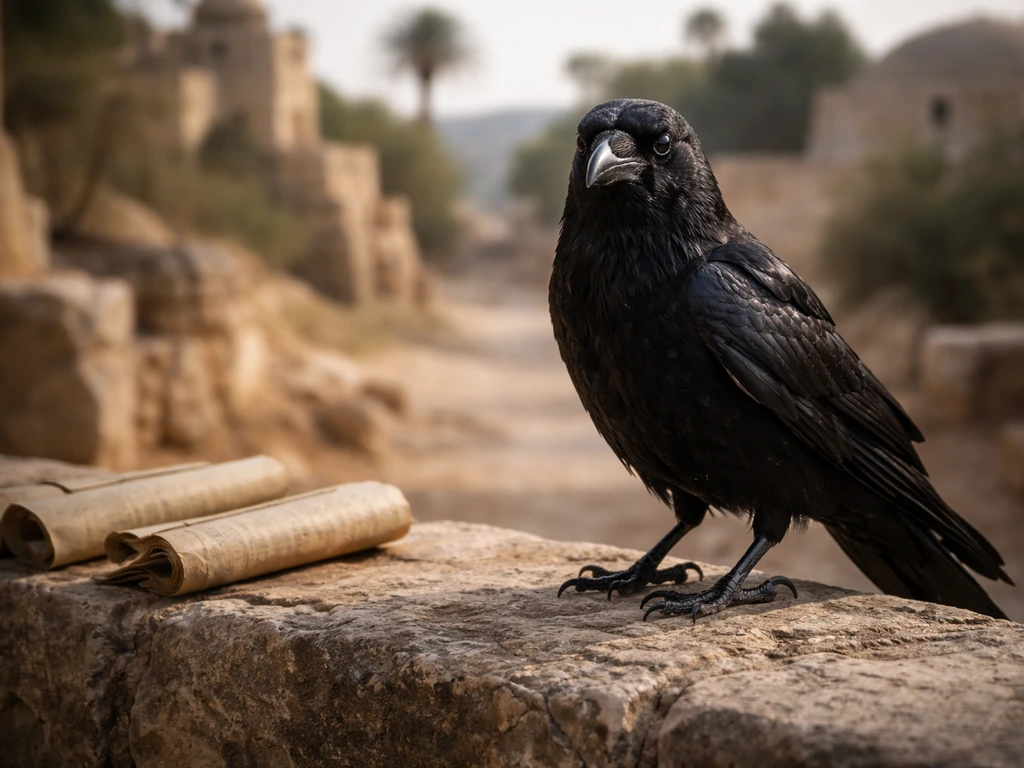
That said, the passages where this bird appears carry real, substantive spiritual themes: divine provision, survival, judgment, and God's care for even the birds the ancient world considered unclean. This is closely tied to the raven bird meaning in the Bible, where the bird image points to God’s provision and care spiritual themes: divine provision, survival, judgment, and God's care. Those themes are worth taking seriously.
Why crows and ravens get mixed up in the Bible
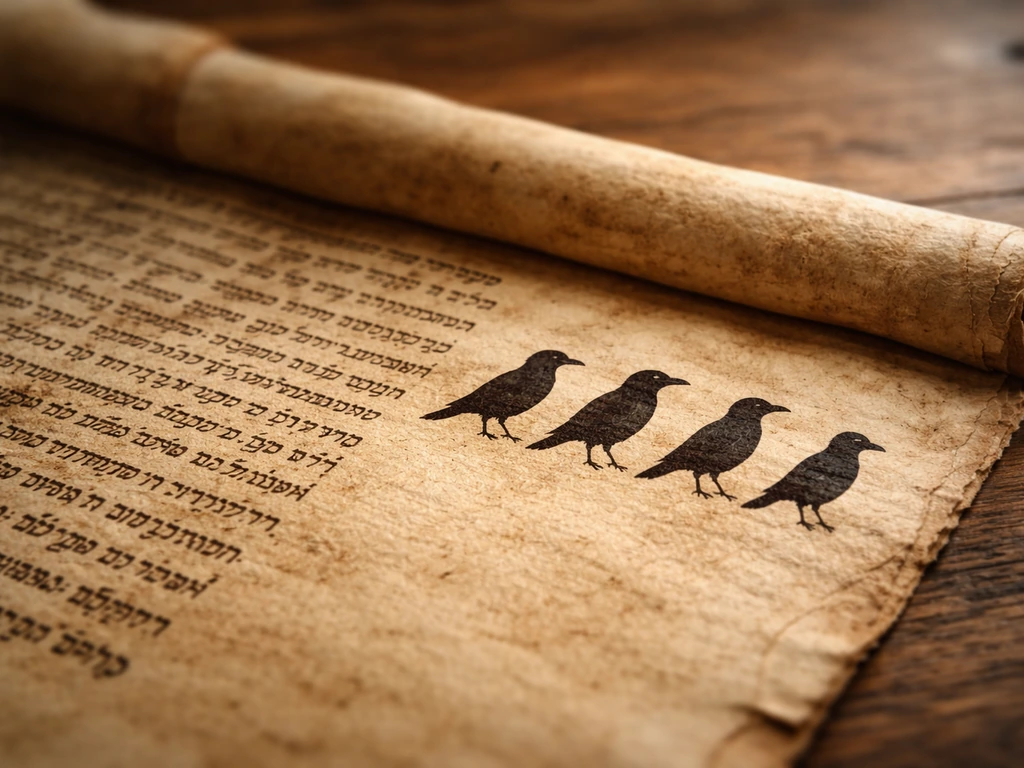
The core of the confusion is a single Hebrew word. The term 'oreb (עֹרֵב) covers the entire corvid family, which includes ravens, crows, rooks, and jackdaws. Ancient Hebrew did not draw the sharp species line that modern English does. So when translators sit down with Genesis 8:7 or Job 38:41, they make a judgment call: raven or crow? Most modern translations choose "raven" because it is the larger, more dramatic bird and fits the wilderness context better. But older translations and some contemporary ones, particularly when rendering Leviticus 11:15, use "crow" or "every kind of crow," reflecting the passage's focus on the broader family rather than one species.
This matters for interpretation because popular culture has loaded the crow and the raven with very different associations, the crow often signaling death or bad luck in folklore, the raven carrying more literary gravity thanks to Poe and Norse myth. The Bible is not doing either of those things. It is working with one Hebrew concept, and that concept carries its own distinct freight, separate from the folklore overlay most modern readers bring to it.
The key Bible passages and what actually happens in them
Genesis 8:7: The raven sent from the ark
After the flood waters begin to recede, Noah sends out a raven ('oreb) before he sends the dove. The raven's behavior here is where translations diverge in a way that shapes interpretation dramatically. Many English Bibles say the bird "flew back and forth" until the waters dried up, suggesting restless survival behavior. The Greek Septuagint tradition, however, renders this as the bird going out and not returning, emphasizing a clean departure.
In the Greek (Septuagint) tradition for Genesis 8:7, the raven’s action is rendered as “it went out and did not return,” which can shape how readers hear the bird’s “did not return” emphasis “it went out and did not return”. One reading gives you a bird that orbits the ark without finding a landing place; the other gives you a bird that simply left and did not come back.
The dove, sent next, becomes the contrast bird, the one that returns with the olive branch. Whether the raven is a scout, a wanderer, or a symbol of the unredeemed world that finds its own footing outside the ark depends heavily on which translation you are holding and what you do with that textual tension.
1 Kings 17:4–6: Ravens feed Elijah in the desert
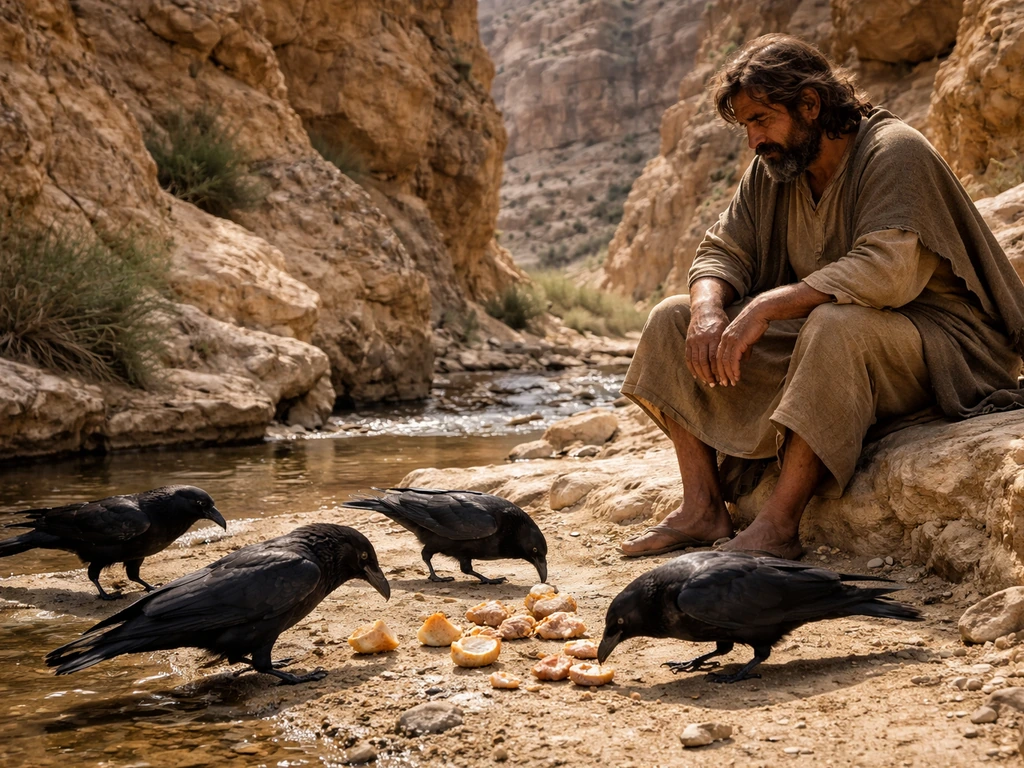
This is the most theologically loaded corvid passage in the entire Bible. God tells Elijah to hide at the Kerith Ravine, and ravens bring him bread and meat twice a day. Ravens, remember, are classified as unclean birds under Mosaic law. God does not use a culturally respectable messenger here. He uses the very bird that ancient Israelites were told not to eat, the wilderness scavenger, to provision his prophet. The theological point is not subtle: God's provision does not depend on clean instruments. The bird the religious system marked as impure becomes the vehicle of divine care. This is one of the most striking uses of bird imagery in the entire Hebrew Bible.
Job 38:41 and Psalm 147:9: God feeds the raven's young
Both of these passages occur in contexts of God describing the scope of divine care over creation. In Job 38:41, God asks Job rhetorically who provides for the raven when its young cry out. In Psalm 147:9, the same image appears: God feeds the young ravens when they call. The raven is not chosen here because it is noble or beautiful.
It is chosen because it was considered a bird of desolation, a creature associated with abandoned places and death. The point is that even this bird, at the margins of the created order, is fed and sustained by God. Jesus echoes this directly in Luke 12:24 when he tells his listeners to consider the ravens, which neither sow nor reap yet are fed by God.
Leviticus 11:15 and Deuteronomy 14:14: The crow in the unclean list
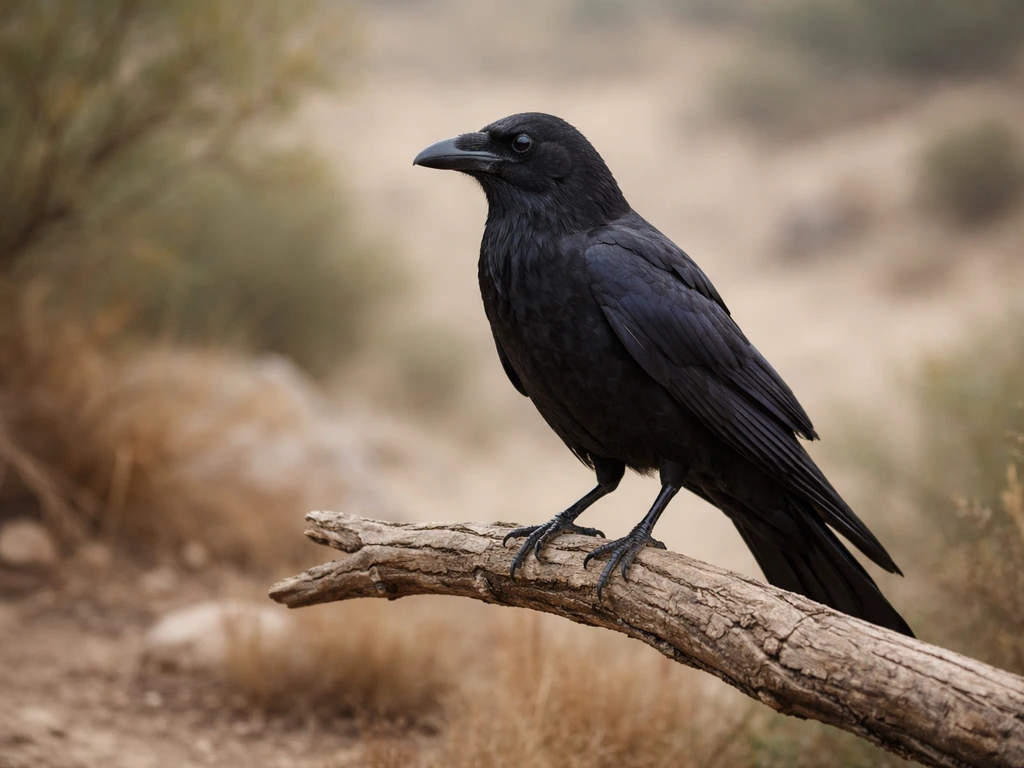
These passages list the corvid family among the birds Israelites were not permitted to eat. This is not a moral condemnation of the bird. The unclean designation in Mosaic law was about ritual purity and dietary practice, not about the bird being evil or cursed. The raven or crow was unclean because it ate carrion.
The same law applies across the entire corvid family, which is why the NET Bible renders Leviticus 11:15 as "every kind of crow. In Leviticus 11:15, this rendering reflects the underlying Hebrew 'oreb often translated with debate between “crow” and “raven. ” [NET Bible renders Leviticus 11:15 as "every kind of crow"](https://www. biblegateway.
com/passage/? search=Leviticus+11%3A13%E2%80%9319&version=NET). " The passage places the crow in a specific legal category without assigning it moral character.
The spiritual themes the Bible actually builds with crows and ravens
When you pull back and look at all these passages together, four consistent themes emerge.
- Divine provision through unexpected means: The Elijah narrative and the raven passages in Job and Psalms all make the same argument. God provides through channels that break human expectations of appropriateness. The unclean bird becomes the deliverer.
- Survival and wildness: The raven in Genesis is a wilderness creature that can survive without the ark's shelter. It finds its footing in a devastated world. That is not presented as evil, just as a different mode of being, one outside the protected structure of the covenant community.
- God's care for the margins: The raven is consistently at the edge of the system: unclean, undomesticated, associated with desert and ruin. Yet God feeds it, uses it, and points to it as evidence of his attentiveness to all creation.
- Judgment imagery: In Isaiah 34:11, the raven is among the birds that inhabit the ruined land of Edom after divine judgment. Here it functions as a marker of desolation, not as an agent of evil, but as a natural inhabitant of abandoned places. The crow or raven signals what happens when a place is emptied of human life.
What the crow's biblical meaning is, and what it is not
The Bible does not assign crows or ravens the role of death omens, bad luck symbols, or occult messengers. That set of associations comes from a mix of European folklore, medieval superstition, and literary tradition (Edgar Allan Poe's "The Raven" did more to shape the modern crow-as-omen idea than any biblical text). If someone tells you seeing a crow means a family member will die or that a crow on a roof is a curse, that is folklore, not biblical teaching.
What the Bible does do with the corvid is more interesting and less dramatic: it uses the bird as a test case for God's provision and care. The crow is not a symbol of evil. It is a symbol of the unexpected messenger, the creature at the margins that God notices and uses. That is a meaningfully different frame, and it is worth holding onto when you encounter one of these birds in daily life.
Symbolism is a legitimate lens for finding meaning, but the goal is reflection, not prediction. The biblical framing invites you to ask what the encounter opens up spiritually, not to treat a crow sighting as a divine sign with a fixed meaning. There is an important difference between using a symbol as a mirror for reflection and treating it as a message with guaranteed content.
How to actually interpret a crow encounter today

If you have seen a crow recently and found yourself wondering what it means, the most honest answer is: it means what you allow it to open in you, filtered through whichever tradition you are working from. From a biblical perspective, here are the reflection questions worth sitting with.
- Is there a way that God or life is providing for me right now through an unexpected or "unclean" channel, something I might be dismissing because the source seems wrong?
- Am I in a survival season? The raven in Genesis finds its footing in a devastated landscape. What does it look like for me to navigate a hard environment with that kind of adaptability?
- Where am I at the margins of something? The raven passages consistently place this bird at the edge of systems. Is there something I am overlooking at the margins of my own life or community?
- What do I believe about provision? The Job and Psalms passages use the raven to make a point about God's attention to even the least-regarded creatures. What does that say about how you are regarded?
Practical actions matter here too, not just reflection. If you are drawn to the symbolism, go read 1 Kings 17 in context. Sit with Elijah's situation, not just the birds. Read Luke 12:24 and notice what Jesus draws from the raven image. These passages are doing active theological work, and reading them in full gives the encounter much more texture than a symbol search will.
How to study the passages yourself without getting lost
One of the most valuable things you can do when exploring biblical bird symbolism is cross-check the original language against your English translation. Here is a short process that actually works.
- Look up the passage on a site like BibleHub or Bible Gateway and switch between at least three translations (ESV, NIV, NET, and the older KJV are a useful spread). Notice where they differ.
- Click the Hebrew or Greek lexicon for the key word. For any corvid passage, look for 'oreb (עֹרֵב). The lexicon entry will show you the full range of uses across the Bible.
- Read the surrounding chapter, not just the verse. The raven in 1 Kings 17 only makes sense in the context of Elijah's flight and God's series of provision events. Genesis 8's raven only makes sense in the arc of the flood narrative.
- Check a reliable commentary. Matthew Henry's commentary is free online and is good at explaining cultural and theological context. For more scholarly depth, the New International Commentary series is useful.
- Note what the passage is arguing, not just what the bird is doing. The bird is usually illustrating a larger theological point. Identify that point first, then work back to what the bird contributes to it.
The translation variation in Genesis 8:7 is a great case study here. Some Bibles say the raven "went to and fro" and others say it "went out and did not return." Those are genuinely different images. The Septuagint's emphasis on the bird not returning changes the contrast with the dove. Getting comfortable with that kind of textual uncertainty is part of reading the Bible well, and it keeps you from building too rigid a symbolic reading on a single English word.
Crow and raven vs. other birds in biblical and broader bird symbolism
It helps to place the corvid in the wider context of biblical bird symbolism and compare how differently the Bible treats its birds, since the contrast sharpens what the raven or crow actually represents.
| Bird | Biblical role | Primary symbolic theme | Clean or unclean? |
|---|---|---|---|
| Raven / Crow ('oreb) | Feeds Elijah, sent from ark, used in judgment imagery | Provision through unexpected means, survival, margins | Unclean |
| Dove (yonah) | Returns to ark with olive branch, descends at Jesus's baptism | Peace, covenant, the Holy Spirit | Clean |
| Eagle / Vulture (nesher) | Carries Israel on eagle's wings (Exodus), judicial metaphor | Strength, divine protection, renewal | Unclean |
| Sparrow (tsippor) | "Not one falls without God knowing" (Matthew 10:29) | God's attention to the smallest and least valued | Clean |
| Stork (chasidah) | Listed among unclean birds, associated with migration | Faithfulness (its Hebrew name means "loyal one") | Unclean |
The dove is the bird most directly contrasted with the raven in Genesis 8, and the contrast is worth sitting with. In the Bible, the dove is closely tied to peace, renewal, and God’s presence. The dove returns, brings good news, and becomes associated with peace and the Holy Spirit throughout Scripture. In that same Genesis 8 contrast, the dove bird is linked to renewal and peace rather than fear dove returns, brings good news.
The raven goes out and lives on its own terms in the wilderness. Neither bird is condemned in the text. They represent different modes of relating to the created order and to the divine economy. For a fuller look at that contrast, the biblical meaning of the dove deserves its own read, and it holds up as a genuinely different symbolic strand.
It is also worth noting how closely the raven and the biblical crane or stork were both categorized as unclean birds whose symbolic use in the text is nevertheless surprisingly positive. The Bible consistently subverts the expectation that the ritually unclean is spiritually worthless. That is one of its most recurring moves, and the corvid is central to it.
The bottom line: if you are looking for the biblical meaning of the crow, what you are really looking at is the raven tradition, and that tradition is built around a strikingly countercultural idea. The bird the law excludes is the bird God uses to feed his prophet and to illustrate his care for creation's margins. That is not an omen. That is a theological argument, and it is one worth carrying with you the next time a crow catches your eye.
FAQ
If the Bible says “crow,” is it literally the same kind of bird as a modern crow?
In most Bible passages, “crow” is a translation of the Hebrew word that covers corvids (the same family as ravens, rooks, and crows), so the Bible is usually talking about the broader corvid category rather than signaling a unique “crow omen.” The theological emphasis comes from the context (provision, care, survival, judgment themes), not from species-specific folklore associations.
How should I interpret the raven or crow in Genesis 8 compared with the dove?
Yes. The dove and the “raven/corvid” imagery in Genesis 8 is intentionally contrasted. The dove returns with a sign of renewal (olive leaf), while the corvid portrayal highlights absence, separation, or persistent wandering depending on the translation. If your English Bible and the Greek tradition differ on whether the bird returns, that difference changes how you read the contrast with the dove.
Does the Elijah passage mean ravens (or crows) are spiritually “good” or “holy”?
God using ravens to feed Elijah is not moral approval of the bird in the sense of calling it “good,” it is a demonstration that God’s provision is not constrained by what humans label as clean or respectable. If the bird was considered unclean under Mosaic dietary rules, that makes the point sharper: God can provide through what the law classifies as impure.
Why does the Bible call some birds “unclean” if it later uses them in positive ways?
“Unclean” in Leviticus is about ritual/dietary categories (what Israelites were permitted to eat), not about the bird being cursed, evil, or an instrument of the occult. The corvids are unclean because they eat carrion, so the Bible’s later use of them focuses on God’s care working through the margins, not on condemning the bird.
What should I do if I see a crow and want a “biblical meaning” for it?
A common mistake is to treat a crow sighting as a fixed forecast. The biblical pattern you see is reflection, not prediction. If you want to apply the encounter, ask what it invites you toward (trust in God’s provision, attention to creation’s margins, humility about superstition), rather than trying to assign a specific outcome.
How can I avoid misreading because my translation says “crow” but another says “raven”?
When translations choose “raven” or “crow,” you can end up with different images, especially in Genesis 8. A practical way to handle this is to compare a couple reputable translations and note whether the corvid is described as returning, “going to and fro,” or “not returning,” then read the surrounding narrative to decide what the passage is emphasizing.
Is it worth checking original-language details, or can I trust my English Bible?
Yes, cross-checking helps with interpretation. The article’s example of the Genesis 8 variation shows why: “went to and fro” versus “went out and did not return” affects the storyline contrast with the dove. If your goal is “crow bird meaning in the bible,” this kind of textual awareness keeps symbolism from becoming overly rigid.
How do I know whether my interpretation is biblical symbolism or just folklore overlay?
If you’re deciding what to do with symbolism, use a guardrail: the Bible’s themes here are about God’s attention to creation and provision, not about death omens or curses. So if your interpretation points toward fear-based predictions, reassess and bring it back to the biblical emphasis (God feeds and notices, even where you might not expect it).
What’s the best next step if I want more than a short explanation?
To explore this deeply, read the full contexts around the bird references, especially the Elijah narrative (1 Kings 17) and Jesus’s teaching (Luke 12:24). Those passages frame the bird imagery as an argument for God’s care, so reading the whole section helps you move from “symbol hunting” to understanding the point being made.
Next Article
Dove Bird Good or Bad Meaning Spiritually and Biblically
Dove bird good or bad meaning spiritually and biblically: peace, purity, Holy Spirit, plus context-based negative readin