Hummingbirds don't appear in the Bible by name. But that hasn't stopped millions of people from finding deep spiritual meaning in an encounter with one, and there are genuinely good biblical reasons to do so, as long as you know how to frame it. The most honest and useful way to approach hummingbird biblical meaning is this: the Bible gives us a rich framework for reading nature as a window into God's character, providence, and care. Hummingbirds, with their specific physical traits, map remarkably well onto several of those biblical themes. What you're doing isn't fortune-telling. You're using a bird encounter as a prompt for scriptural reflection, and that's entirely consistent with how Jesus himself pointed to birds when teaching about trust, provision, and God's attention to small things.
Humming Bird Biblical Meaning: Discernment and Symbol Guide

Why people link hummingbirds to biblical meaning
The connection people feel between hummingbirds and faith isn't random. It comes from a long tradition, well documented across many cultures, of treating animal encounters as meaningful rather than purely mechanical. In Christian history, nature has always been read as a secondary text alongside Scripture. Medieval theologians called this the "book of nature." Early church writers saw animals as living illustrations of spiritual truth. So when someone spots a hummingbird hovering outside their window on a hard day, the instinct to ask "what does this mean?" is deeply human and, in the right framework, spiritually legitimate.
The problem is that a lot of what circulates online about "hummingbird biblical meaning" is actually pulled from spirit animal traditions, omen-reading frameworks, or New Age symbolism, then dressed up in biblical language. Many of those sources acknowledge right in the same breath that there is no actual hummingbird verse in Scripture. That's an important starting point: the symbolism is derived by analogy from the bird's real physical traits, not from a chapter-and-verse claim. Knowing that lets you engage the topic honestly instead of feeling misled when you go looking for the verse and don't find it.
What the Bible actually says about birds and guidance

Even without a hummingbird verse, the Bible has a lot to say about birds specifically, and nature broadly, as vehicles for understanding God. In the Bible, birds often symbolize God’s care, providence, and attention to even small details birds symbolize God’s care. Jesus uses birds in some of his most direct teaching on anxiety and trust. In Matthew 6:26 he tells his listeners to look at the birds of the air: they don't sow or reap, yet God feeds them. In Luke 12:6-7 he notes that not one sparrow is forgotten before God. The logic is not "the bird is a sign of something specific coming." The logic is: if God attends to small creatures, how much more does he attend to you? Nature is being used as a living sermon about God's care, not as a coded prediction system.
Other passages reinforce this. Psalm 84:3 uses sparrows and swallows finding a home near God's altar to express longing for God's presence and security. Job 38:41 and Psalm 147:9 both ask rhetorically who provides food for birds, the answer being God himself. These texts frame every bird encounter, including a hummingbird visit, as an occasion to think about providence, gratitude, and trust rather than as a message with a specific fortune attached to it.
Scripture is also direct about where the line is. Deuteronomy 18:10-14 specifically warns against interpreting signs and omens, treating those practices as incompatible with faithful reliance on God. Deuteronomy 18:10-14 forbids divination and interpreting omens, and warns against consulting the dead or mediums, showing how seriously Scripture treats fortune-seeking practices Deuteronomy 18:10-14 specifically warns against interpreting signs and omens. The point isn't that nature is spiritually meaningless. The point is that reading a bird sighting as a guaranteed prediction about your future, or as a coded divine message that bypasses prayer and Scripture, crosses into territory the Bible explicitly discourages. The corrective isn't to ignore the encounter. It's to orient it correctly: away from anxiety and fortune-seeking, toward trust.
Hummingbird traits that map to biblical themes
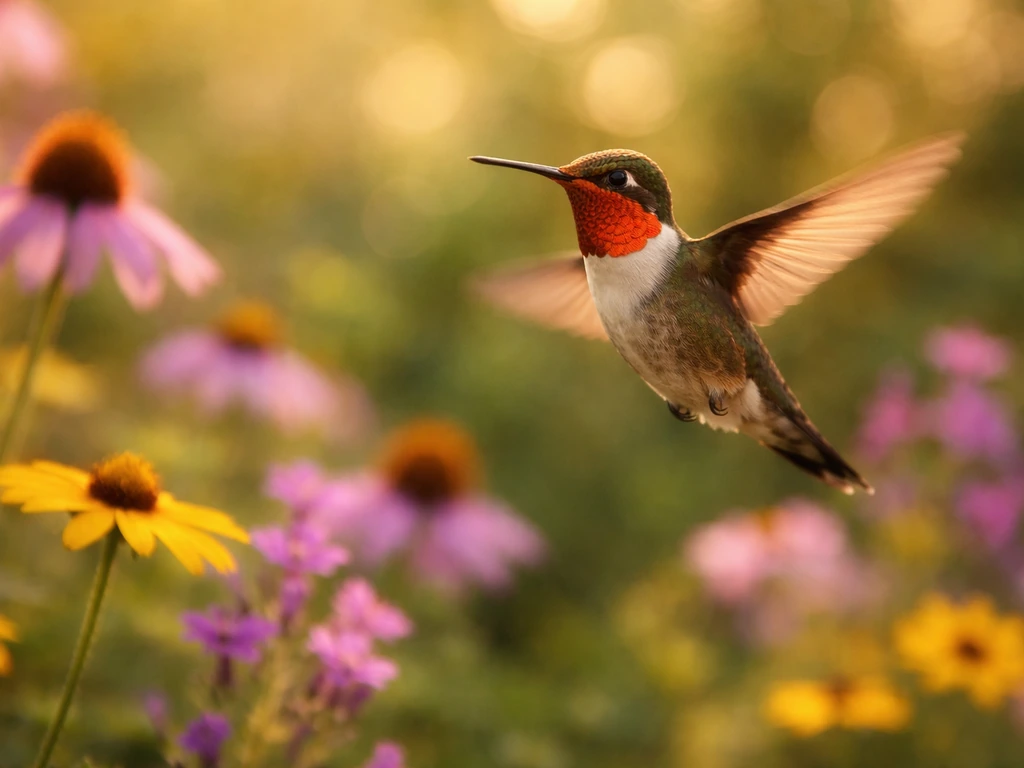
This is where the symbolism gets genuinely interesting. Hummingbirds have a specific, unusual set of physical characteristics, and several of them correspond to well-developed biblical concepts in ways that feel less like projection and more like illustration.
Smallness and God's attention to the overlooked
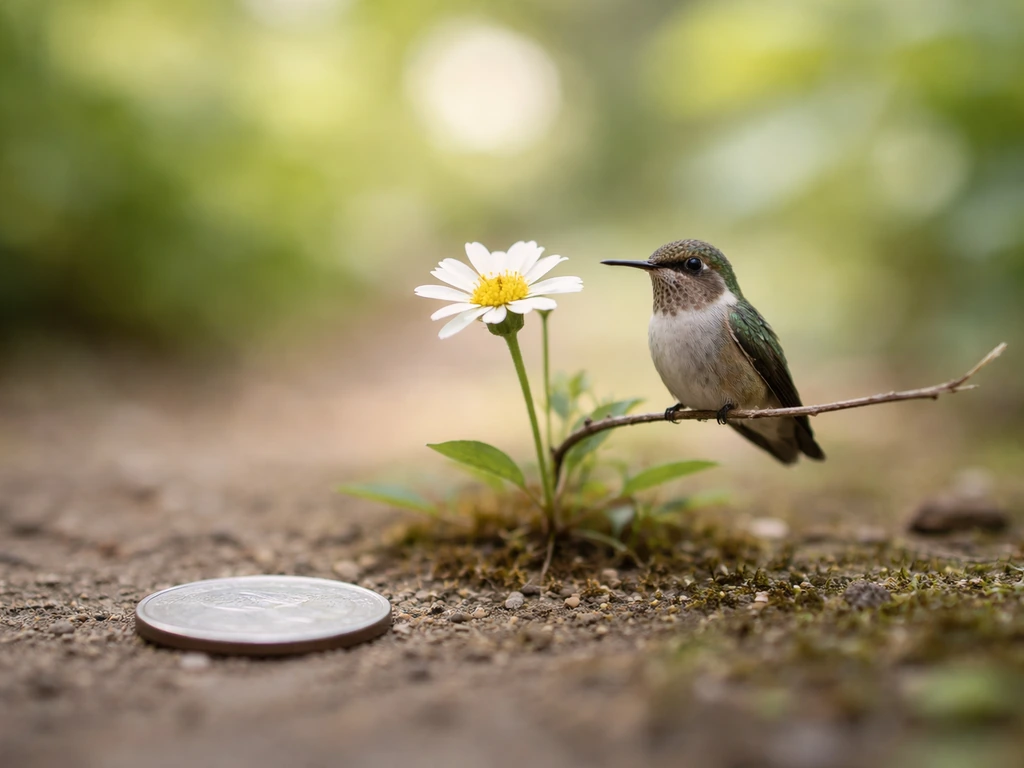
A hummingbird weighs roughly 2 to 6 grams, less than a nickel. It is one of the smallest birds in the world. And yet it is vividly present, impossible to ignore when it appears. This maps directly to the biblical pattern Jesus highlights: God notices the small thing. He knows when the sparrow falls. If you feel overlooked or underestimated, the hummingbird's smallness paired with its unmistakable presence is a legitimate visual prompt for that teaching.
Hovering and God's sustaining presence
Hummingbirds are the only birds that can sustain true hovering flight, beating their wings 50 to 80 times per second to remain perfectly still in the air. In Hebrew, the word often translated as the Spirit of God "moving" over the waters in Genesis 1:2 (merachefet) carries the image of hovering or brooding. This isn't a stretch: the image of something powerful remaining present and attentive, not passing through but pausing deliberately, connects to the idea of God's Spirit as a sustaining, attending presence rather than a distant one.
Nectar and spiritual sustenance
Hummingbirds feed exclusively on nectar and small insects. They are drawn to sweetness and they need to feed constantly, visiting hundreds of flowers a day to sustain their rapid metabolism. This is a vivid picture of the soul's need for continuous nourishment. Psalm 34:8 says "taste and see that the Lord is good." The hummingbird's relationship to nectar, going directly to the source of sweetness and feeding from it repeatedly, echoes the biblical idea of delight in God's Word and presence as the thing that actually sustains you.
Joy, delight, and resilience
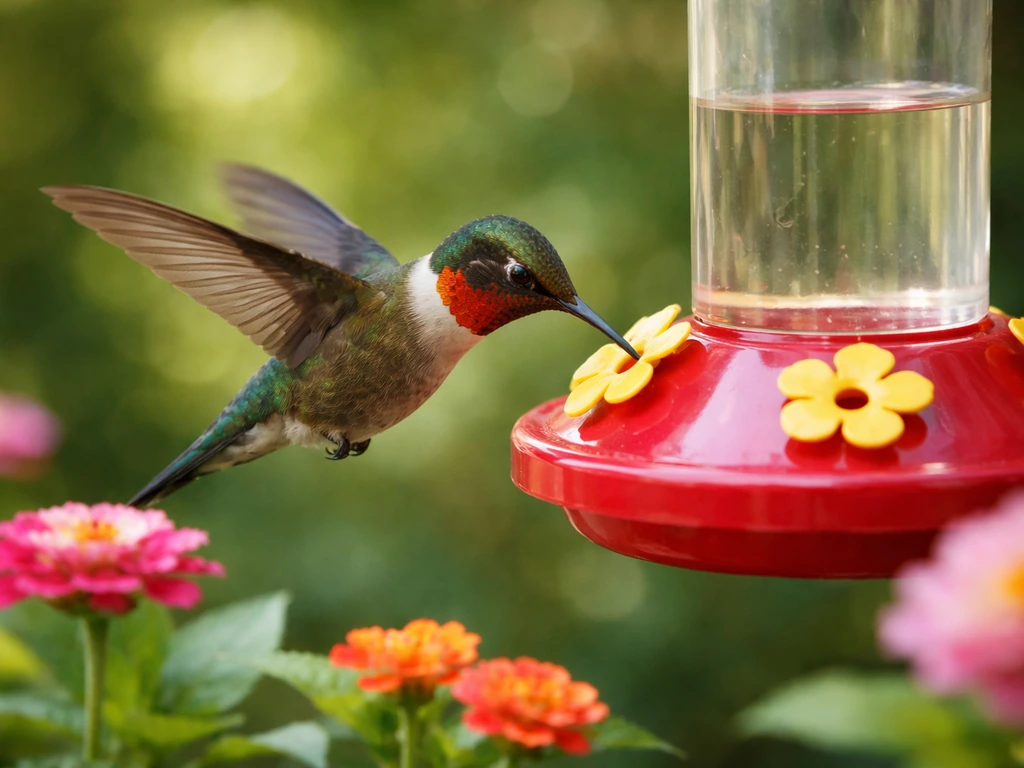
Hummingbirds are visually associated with joy across almost every culture that has encountered them. Their iridescent feathers, their quick darting motion, their apparent playfulness at feeders: all of it reads as vitality and delight. The biblical concept of joy (the Hebrew simcha, the Greek chara) is not a passive emotion but an active orientation toward God's goodness even under difficulty. Nehemiah 8:10 puts it plainly: "the joy of the Lord is your strength." Hummingbirds are also remarkably resilient: some species migrate over 500 miles of open ocean, a feat that seems impossible for a creature that tiny. That combination of fragility and endurance maps well onto the biblical idea of strength made perfect in weakness (2 Corinthians 12:9).
Renewal and new life
Hummingbirds molt, shedding and replacing their feathers in a cycle of renewal. Many biblical-symbolism frameworks connect this to the Christian theme of transformation and new life, particularly the language of Isaiah 40:31 where those who wait on the Lord "will renew their strength" and "mount up with wings like eagles." The specific bird in that verse is the eagle, but the principle, that trusting God produces a kind of physical and spiritual renewal that defies expectation, applies to the hummingbird's own cycle of shedding and re-emergence.
How to interpret a hummingbird sighting with discernment
The method matters as much as the meaning. Here is a practical framework for handling different kinds of hummingbird encounters in a way that's grounded rather than superstitious.
| Scenario | What it might prompt you to reflect on | Biblical anchor |
|---|---|---|
| A single sudden encounter (one sighting, unexpected) | Pause and notice: what were you thinking about just before? Is there a theme of trust, worry, or provision in your current season? | Matthew 6:26: let the bird redirect you toward trust, not prediction |
| Repeated sightings over days or weeks | Look for a pattern in your life, not a guaranteed promise. What invitation keeps appearing alongside this? Gratitude, renewed hope, or patience? | Luke 12:6-7: God's attentiveness is consistent, not seasonal |
| Hummingbird approaches or hovers near you directly | Take it as a prompt for presence: stop, be still, pay attention to what God may already be speaking through Scripture or circumstances | Psalm 46:10: "Be still and know" |
| Hummingbird enters your home or garden | In many traditions this signals blessing or welcome; in a biblical frame, treat it as an invitation to gratitude for provision and home | Psalm 84:3: even small birds find shelter near God |
| Hummingbird in a dream | Dreams require extra caution: examine what feelings the dream produced. Did it increase faith and peace, or anxiety and dependency on a sign? | Deuteronomy 18:10-14: discernment requires checking the fruit of the impression |
The key discernment question for any of these scenarios is the same one that applies to impressions and nudges generally in the Christian tradition: does this move you toward faith, gratitude, and trust in God, or does it move you toward anxiety, dependency on signs, or obsession with a predicted outcome? The former is spiritually healthy. The latter is where things drift into omen-territory the Bible warns against. If you find yourself checking repeatedly for hummingbirds to confirm a decision or a promise, that's a signal to step back into Scripture and prayer directly.
Common interpretations, what to be careful about, and what responsible looks like
The most common things people are searching for when they look up hummingbird biblical meaning tend to cluster around a few themes: the hummingbird as a messenger from God or a deceased loved one, the hummingbird as a sign that something good is coming, and the hummingbird as confirmation of a specific decision or direction. Each of these deserves an honest look.
The messenger claim
The idea that hummingbirds bring messages from loved ones who have died is widespread in both Native American and broader spiritual traditions. It is meaningful and comforting for many people, and it's worth acknowledging that it comes from real cultural frameworks with their own integrity. But it is not a biblical claim. The Bible does not describe the spirits of the deceased communicating through birds. If a hummingbird encounter brings you comfort and prompts you to remember someone you've lost, that's a real human experience worth honoring. Just be precise about what it is: a meaningful personal resonance, not a biblical doctrine.
The "something good is coming" promise
This is the interpretation that needs the most caution. The hummingbird has no predictive function in Scripture because nothing in nature does, at least not in the fortune-telling sense. Using a hummingbird sighting as confirmation that a job offer is coming, a relationship will work out, or financial relief is on the way is reading the encounter as an omen, which Deuteronomy 18 explicitly places outside the boundaries of faithful practice. The encounter can legitimately prompt hope, renewed trust, and prayerful expectation. But "I saw a hummingbird today so X is guaranteed" is a different claim entirely, and an unsupportable one.
What responsible interpretation actually looks like

- You name the traits of the hummingbird (small but noticed, hovering, sustained by sweetness, resilient, joyful) and ask which of those qualities speaks to your current situation
- You move from the encounter into Scripture: does the impression you feel align with what the Bible actually teaches about God's character and how he works?
- You treat the sighting as an invitation to pray, give thanks, or refocus, not as a standalone confirmation of a specific outcome
- You check the fruit: does reflecting on this increase your peace and trust, or your anxiety and sign-dependency?
- You hold it loosely: a hummingbird encounter can be a meaningful moment without needing to be a divine telegram
What to actually do when a hummingbird appears: prayer, reflection, and next steps
This is the part most articles skip, and it's the most practically useful. Here is a straightforward sequence for turning a hummingbird encounter into something spiritually productive.
- Write it down immediately: note the date, what you were doing or thinking before the sighting, and how you felt during it. Patterns across multiple encounters are far more meaningful than a single data point, and you won't remember the details accurately if you don't record them.
- Identify which hummingbird quality resonates most right now: Is it the smallness (feeling unseen)? The resilience (you're exhausted but still going)? The hovering (a sense of waiting or stillness)? The joy (something has felt missing)? The specific resonance tells you more than the encounter itself.
- Take that quality directly into prayer. If it's resilience, pray through Philippians 4:13 or Isaiah 40:31. If it's joy, pray through Psalm 16:11 or Nehemiah 8:10. Let the bird's trait be a doorway into Scripture, not a replacement for it.
- Check your circumstances honestly: is there a concrete situation in your life where that theme is most active right now? Often the "message" isn't mysterious at all. God's Spirit may be highlighting something you already know needs attention.
- Choose one practical action: gratitude (write three things you're thankful for in this season), repentance (if the encounter surfaced conviction about something neglected), encouragement (reach out to someone who might need to hear exactly the thing the sighting prompted in you), or renewed patience (decide to wait one more week before forcing a decision you've been anxious about).
- Come back to the notes in two weeks. If the theme that surfaced during the sighting is still present, still unresolved, or has clarified, that continuity is worth paying attention to far more than the initial encounter.
If you've been wrestling with questions about how birds function as signs more broadly in Scripture, the topic connects naturally to bigger questions about biblical bird symbolism generally, or what it means to encounter birds in dreams through a biblical lens. If you are specifically asking about the bird in dream biblical meaning, use the same Scripture-first approach: focus on how God calls you to trust, not on predicting outcomes. Those are related threads worth exploring if this one resonates. But start here, with the hummingbird in front of you: small, quick, hovering, feeding on sweetness, and somehow crossing hundreds of miles of open water on wings that beat faster than you can see. If you're wondering what is a humming bird a sign of in a more specific way, the Scripture-first guidance above helps you keep it grounded in trust rather than fortune-telling. If you are wondering what a bird symbolizes in the Bible, the key is to look at how Scripture uses birds to teach trust, provision, and God’s attention to small details. That's not a bad picture of what faith in a providing God actually looks like. If you are also curious about the biblical meaning of oriole bird, you can apply the same Scripture-first approach used for hummingbird meaning and avoid omen-style prediction.
FAQ
What is the most biblically safe way to interpret a hummingbird encounter without turning it into an omen?
Use it as a prompt to pray and to thank God, then ask how the encounter should change your posture (trust, gratitude, obedience) rather than your timeline. A safe practice is to write one relevant scripture and one specific action you will take in the next 24 hours, instead of trying to predict an outcome.
How can I tell the difference between a meaningful spiritual prompt and superstition?
A meaningful prompt tends to produce humility, steadier trust, and movement toward Scripture. Superstition often produces anxiety, bargaining behavior (doing things to trigger “signs”), or repeated checking to get certainty. If you feel compelled to seek another hummingbird to calm down, that is a warning sign.
Is it biblical to think a hummingbird is a message from a deceased loved one?
The Bible does not teach that deceased people communicate through birds, including hummingbirds. You can still honor the comfort of the memory it triggers, but frame it as personal resonance, not as doctrine or a new revelation that overrides prayer and Scripture.
If I saw a hummingbird right before good news, does that confirm my decision is guaranteed?
No. Even if the timing feels meaningful, biblical guidance warns against treating nature as coded prediction. Instead of “guaranteed,” treat it as permission to hope, then continue making decisions through wisdom, counsel, and prayer.
What should I do if the “sign” interpretation is making me anxious or controlling?
Pause the sign-seeking cycle. Go back to prayer for your actual need, read a passage about trust and providence, and set a boundary like “I will not search for confirmation signs for 7 days.” If anxiety persists or intensifies, consider speaking with a pastor or trusted spiritual mentor.
Can hummingbird symbolism be used in worship, art, or teaching?
Yes, as long as you present it as an analogy that points to biblical themes (God’s care for small things, sustaining presence, gratitude), not as a verse-based claim. State clearly that there is no hummingbird-specific biblical text, and keep the focus on what Scripture teaches.
Does the “hovering” detail imply the Holy Spirit is “hovering over me” specifically?
You can use the imagery to meditate on God’s sustaining presence, but avoid claiming a unique supernatural message. A grounded approach is to pray, “Lord, teach me to trust your presence today,” rather than concluding you received a specific directive from the bird.
What if a hummingbird appears repeatedly around my home, feeder, or workplace?
Repeated visits can be a sign of your environment being attractive (flowers, nectar feeders, insects), not a spiritual countdown. If you want to reflect spiritually, do it without turning your location into a “control panel,” and make sure practical steps (feeding schedules, cleanliness, and safety) are also addressed.
Is it okay to ask for guidance from God using a hummingbird as part of my prayer?
It is okay to bring your questions to God, but ask directly through prayer and Scripture rather than using the bird as a yes-or-no mechanism. If you try to “test God” for confirmation via sightings, that can drift into omen-style thinking.
How should I respond when someone else uses hummingbird meaning to make predictions?
You can respectfully agree on the value of reflection, then clarify the boundary: keep it from becoming fortune-telling. Suggest focusing on biblical trust themes and encourage them to avoid claims like “this guarantees X,” because those go beyond what Scripture supports.