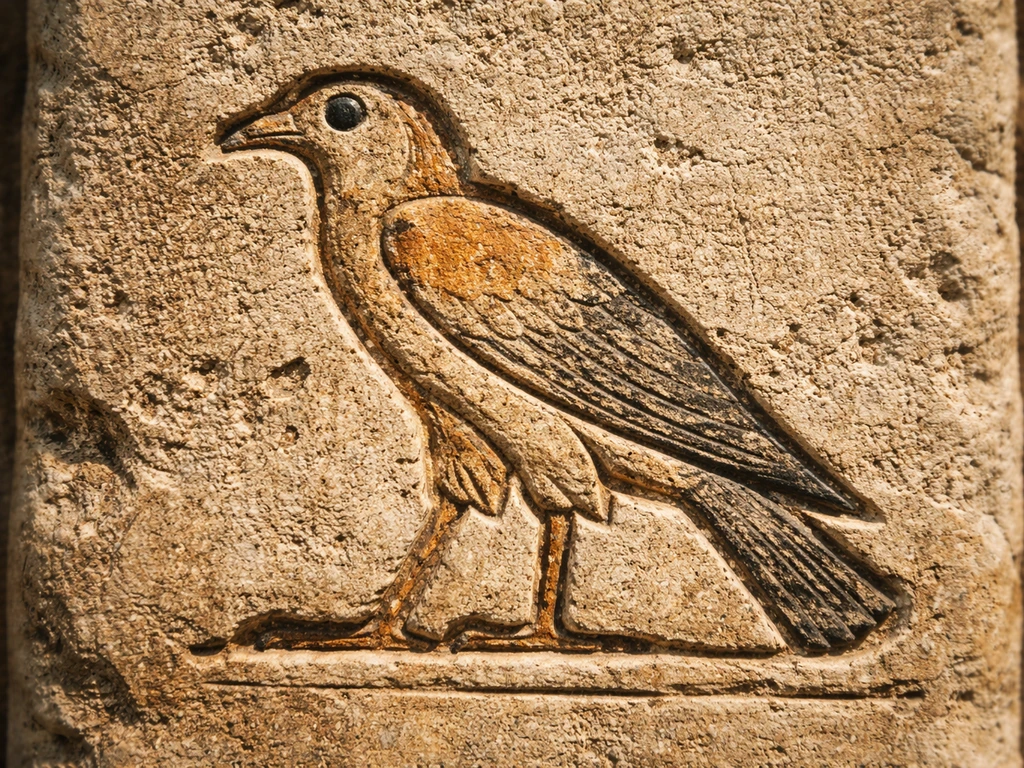
Horus is most commonly represented as a falcon, specifically the peregrine or lanner falcon. Every major museum collection that holds Horus statuary, reliefs, or amulets describes the bird the same way: a falcon, often depicted in full bird form or as a falcon-headed man, wearing the double crown of Upper and Lower Egypt and a rearing cobra called the uraeus. That combination of bird plus royal regalia is the clearest signal you have found a Horus-falcon image rather than a generic raptor or another falcon-associated deity.
What Bird Is Horus? Falcon, Meaning, and Symbolism

Eleanor Hartwell
23 Apr 2026
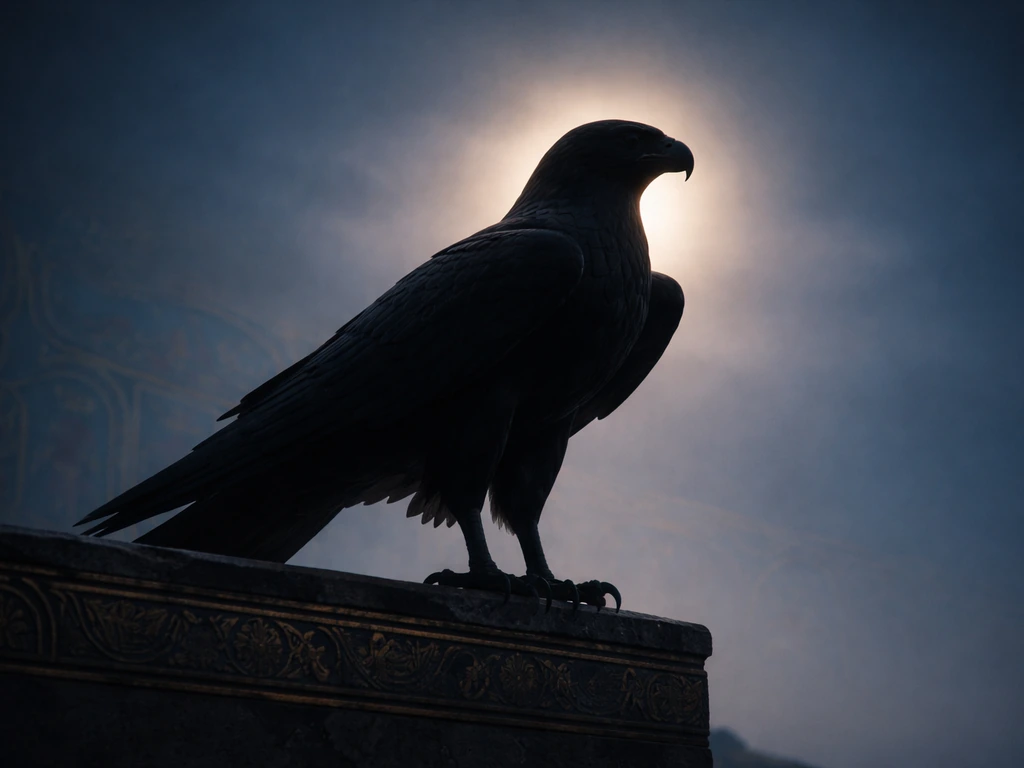
Who Horus actually is in Egyptian tradition
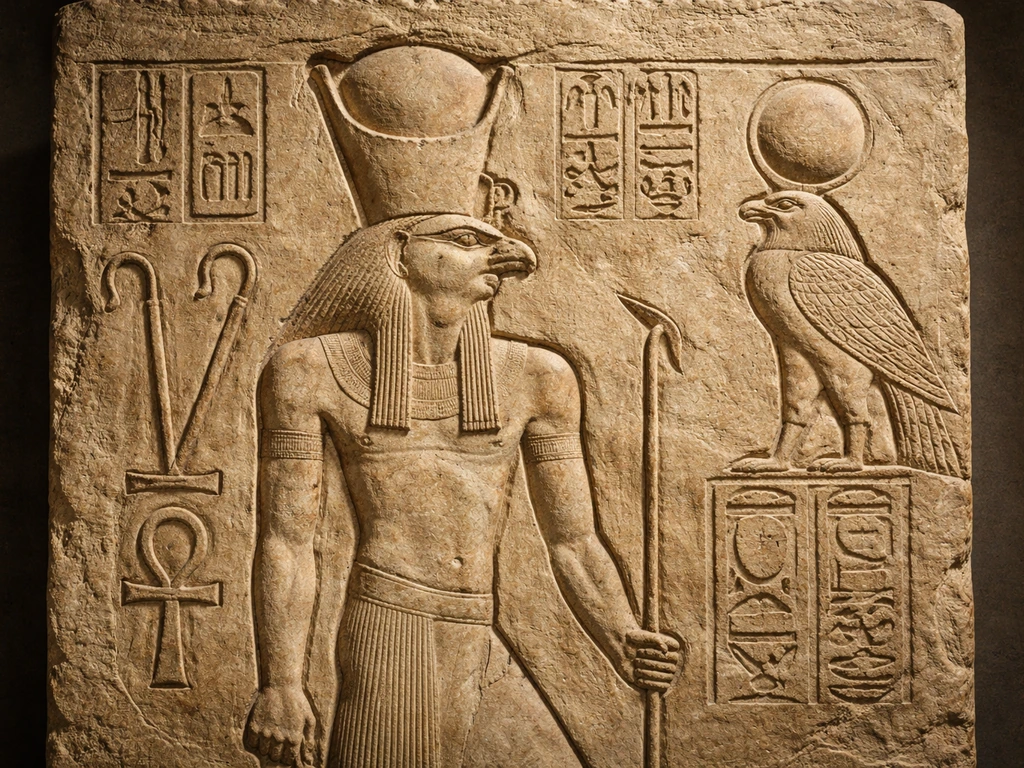
Horus is one of the oldest and most layered gods in the Egyptian pantheon. He was the god of the sky, of kingship, and of divine order, and his importance ran so deep that every Egyptian pharaoh was considered the 'Living Horus' during their reign. The Detroit Institute of Arts describes it plainly: Horus was the sky god whose earthly representative was the king himself, ruling on behalf of the gods. When a pharaoh died, he became Osiris; when his successor took the throne, he became Horus again. That cycle gave Horus a permanent and central role in Egyptian political theology, not just mythology.
Horus appears in Egyptian records from at least the Early Dynastic period, and by the time the great temples were built, his falcon-topped serekh, the rectangular frame used to write royal names, had become inextricably tied to the idea of royal legitimacy. The Saqqara bird is commonly discussed in connection with ancient Egyptian burial and religious iconography, but its exact purpose is debated by scholars what was the saqqara bird used for. A related question is which bird was used to carry messages in ancient Egyptian life and myth. Academic sources note that the Horus-falcon atop the serekh 'becomes inextricably linked' to royal titulary from that period forward. He was not just a bird symbol borrowed from nature; he was a theological argument about who held the right to rule.
The bird most linked to Horus: falcon, not hawk
The short version: Horus is a falcon. If you see him described as a hawk in older texts, that is a translation artifact, not a different bird. In hieroglyphic writing, the sign used to write Horus's name (Gardiner G005) depicts a falcon, and Wiktionary's technical note on that sign identifies it as 'variously identified as a lanner falcon or peregrine falcon,' functioning as the logogram for the Egyptian word ḥr, which became the name Horus. Modern ornithology distinguishes hawks from falcons in ways ancient Egyptian scribes did not, so earlier English translations often used 'hawk' as a catch-all for any bird of prey. Contemporary museum descriptions consistently use 'falcon.'
The Menil Collection describes Horus as able to be 'represented as a man, a hybrid falcon-man, or simply a falcon.' The Metropolitan Museum of Art's audio guide for their famous statue of Horus protecting King Nectanebo II calls the work a representation of 'the falcon.' The Harvard Art Museums catalog entry for a Horus falcon in the double crown even describes specific facial patterning conventions that museum curators use to identify the bird as a Horus-falcon rather than another species, including what they call the 'feathered eye and moustachial stripe.' These are real, observable markings you can look for in sculpture and relief.
Why different sources seem to describe different-looking birds
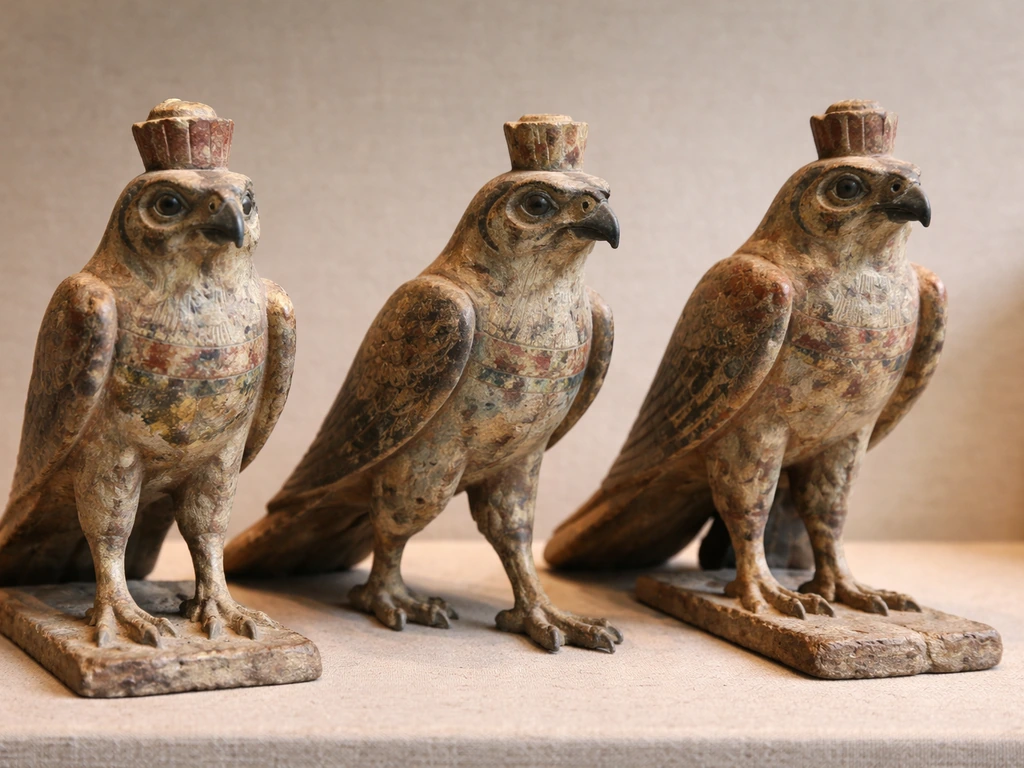
If you have been searching around and keep finding Horus linked to slightly different bird descriptions, there are a few reasons for that. First, the hawk-vs-falcon translation issue already mentioned means older books frequently say 'hawk of Horus' where modern scholars would say 'falcon.' Second, Horus himself absorbed a number of local cults across Egypt, and some of those regional Horus variations have subtly different iconography. The Walters Art Museum makes an important curatorial point worth knowing: 'many local gods are represented as falcons,' and without a crown or inscription, 'identification is impossible.' Not every falcon in Egyptian art is Horus.
Third, scholars studying the actual bird species depicted in Egyptian Horus imagery note that artists drew on real falcon traits but combined them in idealized ways. Research published in the Journal of Ancient Egyptian Interconnections analyzed depicted traits and found influences from the peregrine and kestrel with some lanner characteristics, suggesting artists were working from observation of multiple real species rather than copying one exact bird. The result is that ancient Horus falcons look like a composite raptor, which can confuse modern readers expecting a perfect match to a field guide entry.
If you encounter a source that describes Horus as an ibis or a jackal, you have likely blended him with Thoth (ibis) or Anubis (jackal), two other major Egyptian deities. The site's sibling topics on Egyptian bird symbol meaning and what Egyptian god is a bird can help you sort those out if you are working across the wider Egyptian pantheon. If you are comparing deities by bird type, this helps answer what Egyptian god is a bird in the first place. Egyptian bird symbol meaning can help you interpret other birds in Egyptian art beyond Horus and place them in the right cultural context.
What the Horus falcon symbolizes spiritually
The symbolism built around Horus and his falcon form is remarkably consistent across thousands of years of Egyptian art and text. It clusters around five core ideas.
- Kingship and divine authority: The Detroit Institute of Arts states directly that 'the Falcon of Horus wearing the double crown of Upper and Lower Egypt is an image of divine kingship.' The pharaoh's legitimacy to rule was visually encoded in the falcon image.
- Protection: Horus is repeatedly shown with wings spread in a sheltering posture, most famously in the statue at the Met where the falcon's wings wrap around the king's head. The falcon does not simply represent power; it actively guards.
- Sight and clarity: Falcon vision is extraordinary in nature, and that biological reality fed directly into Egyptian symbolism. The Eye of Horus became one of Egyptian civilization's most enduring icons, representing 'well-being, healing, and protection' according to standard reference sources.
- Healing: The Eye of Horus (also called the Wedjat eye) was used as an amulet specifically for healing and restoration. Its connection to Horus links the falcon image directly to recovery and wholeness.
- Sky and cosmic order: As the sky god, Horus was understood to contain the sun and moon as his two eyes. The falcon in flight was not just a bird crossing the sky; it was the embodiment of the sky itself moving with intention.
What makes these meanings so durable is that they are not arbitrary. They are grounded in the actual behavior and physical presence of falcons in the Nile Valley. Peregrine falcons are apex aerial predators with extraordinary eyesight, capable of seeing prey from heights and diving at speeds that no other creature in that landscape could match. To ancient Egyptians watching them soar over the river and desert, the falcon was an obvious candidate for a god who sees all, protects the vulnerable, and moves between the human world and the divine one.
How to work with Horus and falcon symbolism in everyday encounters

If you are drawn to Horus symbolism in a personal or spiritual context, the most honest starting point is to treat the encounter with a real falcon, a found feather, or a repeated image of this bird as an invitation to reflect rather than a directive to follow. This is what most serious practitioners of bird symbolism actually do: they use the encounter as a prompt, not a command.
Seeing a falcon in the wild, especially during a moment of decision or uncertainty, has traditionally been read as a sign to expand your perspective. The falcon's literal vantage point, soaring above the landscape with clarity the ground-level viewer does not have, maps naturally onto the idea of stepping back, seeing a situation from a higher angle, and trusting your perception even when others cannot see what you see. If the kingship symbolism resonates with you, that can also be read internally: Horus represents the part of yourself that has the authority and responsibility to lead your own life with integrity.
The Eye of Horus connection is especially useful when the themes in your life involve healing, either physical or emotional recovery, or a need for protection. Many people working with Egyptian symbolism carry or display the Wedjat eye specifically for that reason. If you are doing this intentionally, knowing that its root is the falcon-eyed Horus rather than a generic amulet gives the symbol more depth and a more grounded history to draw on.
A few practical ways to bring Horus-falcon symbolism into your reflective practice:
- When you spot a falcon or hawk in the wild, pause and note what question or situation is on your mind. The traditional reading invites you to consider whether you are seeing the full picture or only part of it.
- If you find a raptor feather (where legally permitted to keep it), treat it as a prompt for reflection on protection: who or what are you guarding, and who is guarding you?
- Working with an Eye of Horus image during meditation or journaling is a legitimate use of this symbolism with a direct historical basis in Egyptian healing ritual.
- If you are drawn to Egyptian art and want a daily touchstone, look for reproductions of the double-crown falcon rather than generic raptor imagery. The specificity matters when the symbolism matters to you.
How to confirm you are looking at a Horus-falcon reference
This is where it gets genuinely practical. Because many Egyptian gods appear as falcons, and because not every falcon image is labeled in the original context, knowing what to look for saves you from over-attributing or misreading a symbol.
| What to look for | What it signals |
|---|---|
| Double crown (pschent) on the falcon's head | Strong indicator of Horus, specifically royal Horus; the Met, the DIA, and the Art Institute all cite this as the primary visual marker |
| Uraeus (rearing cobra) on the crown or forehead | Confirms royal deity status; combined with double crown, narrows identification to Horus strongly |
| Falcon-headed man wearing double crown | Classic Horus-as-falcon-man hybrid; very common in relief and painting |
| Stylized eye with downward teardrop marking and curl | Eye of Horus (Wedjat); associated with healing, protection, and the falcon's divine sight |
| Falcon atop a rectangular frame (serekh) | Specifically the royal Horus-falcon used in pharaoh name cartouches; hieroglyphic context |
| Falcon with wings spread sheltering a smaller figure | Protective Horus; common in statuary like the Nectanebo II piece at the Met |
| Falcon with no crown and no inscription | Cannot be confirmed as Horus per curatorial guidance; could be another falcon-deity |
In hieroglyphs specifically, the Horus falcon sign (G005) is used as both a logogram for the name Horus and as part of compound royal titles. If you are reading a hieroglyphic inscription and want to understand the bird signs involved, the related topics on hieroglyphics bird meaning and bird hieroglyph meaning go deeper into how these signs function within the writing system itself. Bird hieroglyph meaning for falcon signs becomes clearer when you connect the writing-system logogram to how Horus was represented in royal contexts. If you are specifically studying the Horus falcon sign in inscriptions, hieroglyphics bird meaning can help you interpret what those bird symbols were doing in the text.
For art and statuary, the Walters Art Museum's curatorial warning is worth repeating as a guiding principle: without a crown or an inscription, identification is genuinely uncertain. That is not a failure of research; it is an honest acknowledgment that ancient Egyptian artists sometimes depicted falcons in contexts where the specific deity was understood by the worshipper without needing a label. When you are working from a reproduction or a general image search, look for the double crown first. If it is there, you are almost certainly looking at a Horus reference. If it is absent, treat the attribution as a hypothesis rather than a fact.
The reward for doing this careful reading is that the symbolism becomes more meaningful, not less. Knowing that the falcon with the double crown in front of you is specifically Horus, god of kingship and sky and healing, rather than just any bird of prey, gives you a sharper lens for whatever reflection or interpretation you are working through. That kind of precision is what separates a genuine engagement with Egyptian bird symbolism from a surface-level association, and it is what makes the tradition worth taking seriously. A syrinx is the specialized vocal organ in birds, located in the lower throat, and it helps explain how birds produce sound syrinx definition bird.
FAQ
If I see “hawk of Horus” in a source, does that mean it is a different bird than the Horus falcon?
Sometimes Horus gets described as a hawk in older English translations, but in Egyptian writing and museum cataloging the diagnostic cue is the Horus falcon sign plus the royal context (especially the double crown and, in many scenes, the uraeus). If a source uses “hawk” but also shows the double crown or a clear Horus-headed figure, it is usually still referring to Horus’s falcon depiction.
How can I tell whether a falcon in Egyptian art is really Horus and not another falcon deity?
Not automatically. Egyptian art includes many falcon gods and local religious associations, so a plain falcon image without an identifying crown, inscription, or specific Horus-related markers should be treated as “falcon” rather than “Horus.” A practical check is to look for the double crown and any linked royal elements, not just the overall bird silhouette.
What should I assume if a site says Horus is an ibis or a jackal?
The common confusion comes from mixing deities by bird type. If the bird is an ibis, the likely match is Thoth, and if it is a jackal, it is typically Anubis. Horus is the falcon, so when the bird species changes, it often signals a different god rather than a different version of Horus.
In a sculpture or relief where the label is missing, what visual clues should I check first for Horus?
When you are looking at a reproduction or photo, prioritize “hard” identifiers first: the double crown and any inscriptional context. If those are missing, facial detailing conventions (like the “feathered eye” and moustachial stripe mentioned by museum curators) can help, but they are easier to use on close-ups of sculpture or relief than on small thumbnails.
Why do some Horus falcon images look like a composite bird rather than a perfect match to one modern species?
Yes, you may encounter composite or idealized birds that do not match one modern species exactly. That does not automatically mean the artwork is “wrong,” it likely reflects ancient artists combining observable traits from multiple raptors into a stylized Horus form.
If I’m reading hieroglyphs, how do I know when the falcon sign means Horus’s name versus something broader in royal titles?
If you are trying to interpret an inscription, use the sign behavior, not just the bird’s look. The Horus falcon sign (G005) can function as a logogram tied to the name “Horus” and also appears in royal titulary contexts, so the same sign can be doing different jobs depending on surrounding text.
How can I use Horus-falcon symbolism in a personal practice without turning it into a “must do” rule?
In personal or spiritual practice, the article’s safest approach is reflective rather than directive. A practical way to do this is to treat the encounter (a wild falcon sighting, a found feather, or repeated imagery) as a prompt to journal a decision, a fear, or a leadership question, instead of treating it as a prediction that you must follow literally.
Is the Eye of Horus mainly a protection symbol, or should I connect it to different themes too?
If you are drawn to the Eye of Horus, the common pitfall is treating it as a generic protection icon. A more grounded approach is to tie your intention to Horus’s falcon role and its associated themes (vision, safeguarding, healing), since that link changes how the symbolism feels and guides your reflection.
What is the quickest way to avoid over-attributing every Egyptian raptor image to Horus?
A frequent beginner mistake is assuming all Egyptian “bird of prey” references are interchangeable. If the scene or object is not clearly labeled, you can still make a careful attribution by searching for the double crown, uraeus-related elements, or explicitly Horus-related writing. Without those, keep your conclusion tentative.
Next Article
Hieroglyphics Bird Meaning: How to Identify Egyptian Bird Signs
Identify Egyptian bird hieroglyphs by shape and context, then decode their sound, determinatives, and symbolism.