If you searched 'Guinness bird meaning,' the bird you're almost certainly thinking about is the toucan. The phrase traces back to one of the most famous advertising campaigns in history: Guinness beer used a toucan as its mascot from the 1930s onward, and the image became so iconic that 'Guinness bird' became a casual shorthand for the species. Once you know you're dealing with a toucan, a whole symbolic tradition opens up around communication, creativity, and the power of standing out. Here's how to identify the bird, understand what it means across cultures, and figure out what to do with that meaning today.
Guinness Bird Meaning: Identify the Bird and Its Symbolism

Eleanor Hartwell
23 May 2026
What people usually mean when they say 'Guinness bird'
The phrase 'Guinness bird' doesn't come from any single folklore tradition or field guide. It almost always refers to the toucan made famous by Guinness advertising. Starting in the 1930s and continuing for decades, Guinness ran campaigns featuring a cartoon toucan, and the bird became inseparable from the brand in popular culture. You'll also see 'Guinness bird' pop up as a crossword clue, where the answer is consistently 'toucan,' defined as 'a brilliantly colored arboreal fruit-eating bird of tropical America having a very large thin-walled beak.' Australian customs notices have even used the literal phrase 'GUINNESS – bird, toucan' in their documentation. So when someone says they saw or dreamed about the Guinness bird, they're almost always pointing at a toucan, whether they encountered one in real life, spotted one in an image, or had it surface in a puzzle or meme.
There's one other possibility worth mentioning: some people search the phrase because they came across a Guinness World Records entry about birds, since 'Guinness' can trigger associations with record-breaking animals. If that's your situation, the symbolic framework is a little different, but the identification step below will still help you narrow down which species you actually want to interpret.
How to confirm you're looking at a toucan
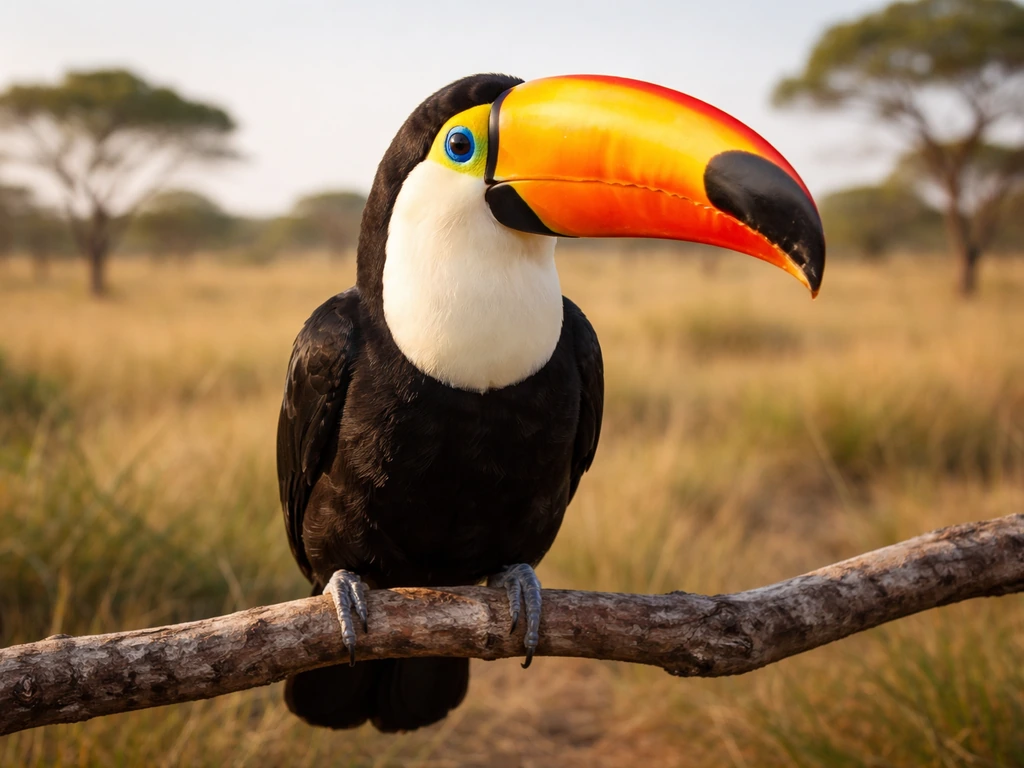
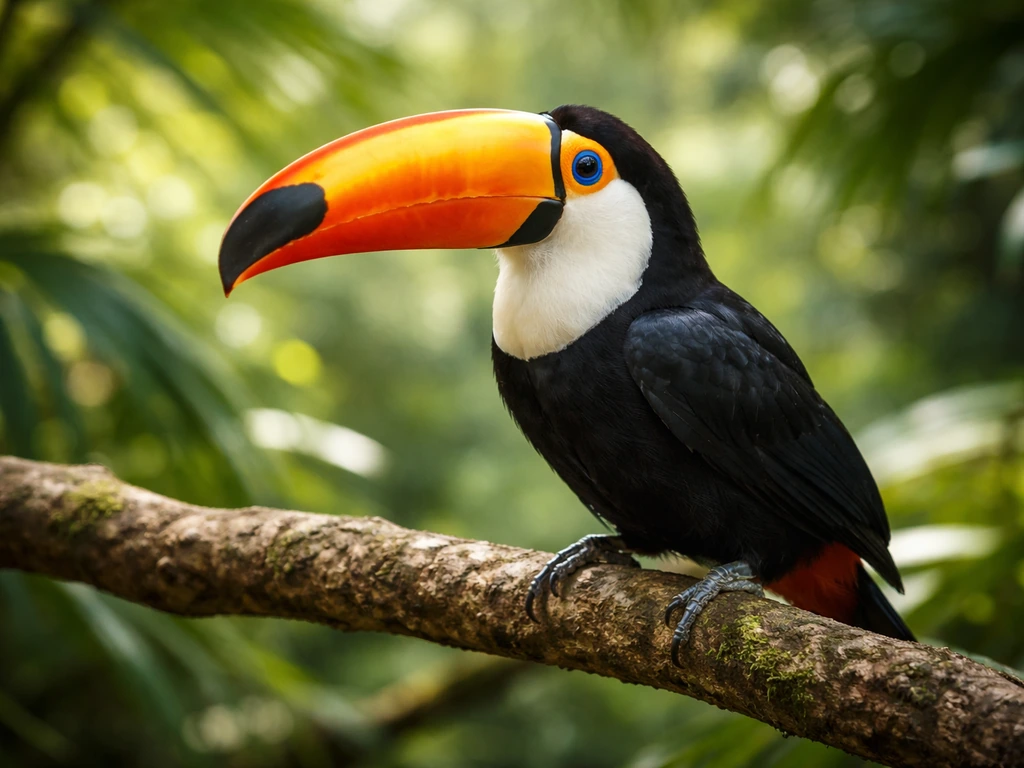
Toucans are hard to mistake once you know what you're looking for. The toco toucan, the most recognized species and the one closest to the Guinness mascot's look, can grow up to about two feet tall with a wingspan of roughly two feet. Its most striking feature is an enormous, boldly colored bill that looks almost cartoonishly oversized relative to its body. The plumage is predominantly black with a bright white throat and chest patch, and the bare skin around the eyes is often vivid orange or yellow. The Guinness mascot leaned into this contrast heavily.
In the wild, toco toucans blank" rel="noopener noreferrer">favor open savanna landscapes with scattered trees rather than dense jungle, which surprises a lot of people who assume they're deep-forest birds. They're arboreal, meaning they live and nest in trees (usually tree hollows), and they're primarily fruit-eaters. If someone in South America or a zoo setting describes seeing a large, clownish-billed black-and-white bird with a colorful beak in an open wooded area, that's almost certainly a toco toucan. If you're working from a picture or a crossword rather than a live sighting, the distinctive bill and color pattern make identification straightforward.
Quick identification checklist
- Very large, colorful bill (often orange, yellow, and black) that seems disproportionate to the body
- Black-and-white or black-and-cream plumage on the toco toucan; other toucan species have more varied coloring
- Body size around two feet; larger than a crow, smaller than a hawk
- Arboreal behavior: perching and moving through trees, not ground-foraging
- Native range is tropical and subtropical South America; also found in zoos and wildlife sanctuaries worldwide
- Open woodland or savanna habitat, not typically dense rainforest canopy
What the toucan symbolizes
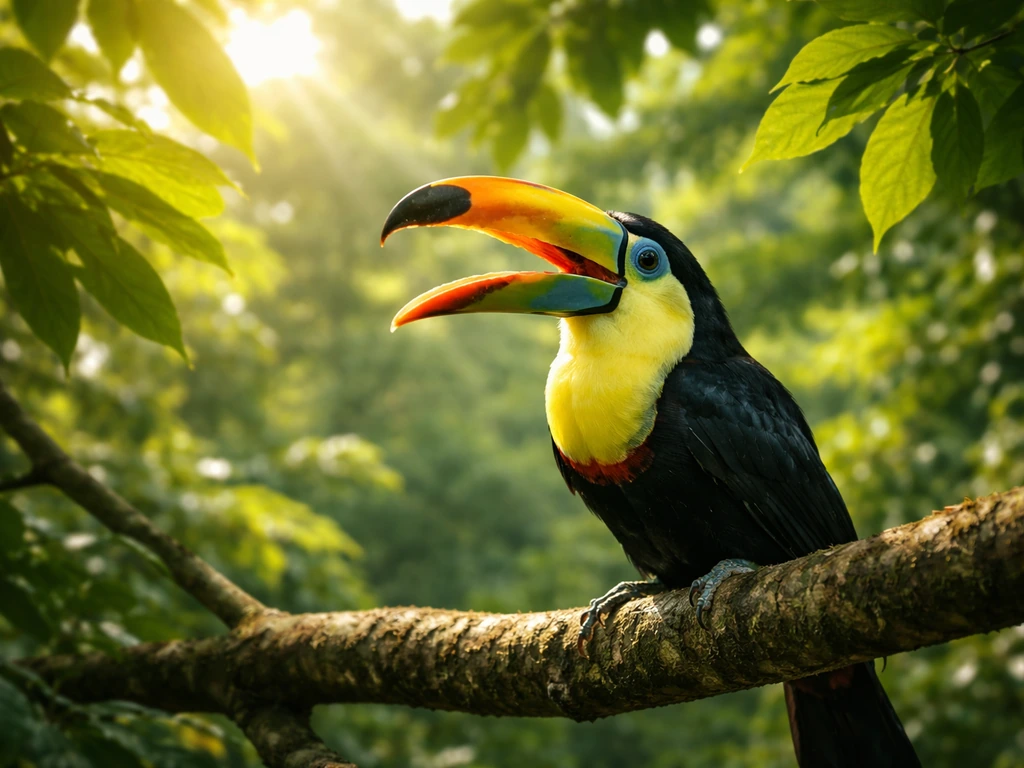
The toucan's symbolic reputation in modern interpretive traditions centers on communication, creativity, and visibility. The logic is intuitive: this is a bird that cannot be subtle. Its bill alone announces its presence. In contemporary spiritual frameworks, that translates into themes around finding your voice, showing up authentically, and not shrinking from being seen. The bill is also the toucan's primary tool for reaching fruit that other animals can't access, which lends itself to symbolism around resourcefulness and adapting your natural gifts to get what you need.
Playfulness is another consistent thread. Toucans are social birds, and their calls carry across open landscapes to locate family members, warn about predators, and share information about food sources. They're not solitary or silent. That behavioral reality maps neatly onto symbolic themes of community, connection, and the value of speaking up rather than staying quiet. If you encountered a toucan (or the image of one) at a moment when you're wrestling with whether to speak your mind, express something creative, or step into a more visible role, that pattern is worth sitting with.
Feathers, flight, and nesting: the deeper layers
Beyond toucan-specific symbolism, birds carry universal themes across virtually every culture that has ever tried to make sense of them. Flight represents freedom, transcendence, and the ability to move between worlds or perspectives. Finding a feather has been interpreted across dozens of traditions as a message from a spiritual realm or an ancestor, a small reminder that you're being watched over. The toucan's feathers, in particular, are vivid and unmissable, which amplifies the 'notice this' quality of the encounter rather than offering quiet reassurance.
Nesting carries its own symbolic weight. Toucans nest in tree hollows, often taking over cavities made by other birds. That behavior shows up symbolically as adaptability, making a home in unexpected places, and finding shelter within existing structures rather than building from scratch. If you're in a period of transition or trying to establish stability using resources you didn't originally create, the toucan's nesting habit is a surprisingly apt mirror.
The toucan's flight style is direct and decisive rather than soaring or hovering. Where some birds circle and wait, toucans move purposefully between trees. Symbolically, that suggests forward motion and commitment to a direction, even if the journey is short and the destination practical rather than grand.
Spiritual significance across cultures and traditions
The toucan's strongest cultural roots sit in Mesoamerican and South American traditions. In Maya and Aztec cosmologies, colorful tropical birds were associated with the divine, with royalty, and with the mediating forces between the human world and the spiritual one. If you’re also exploring other luck-linked bird meanings like myna bird good luck, Maya context can help you compare how different cultures frame birds as signs. Vibrant plumage carried prestige; feathers from brilliantly colored birds were woven into ceremonial regalia and offerings. While the toucan doesn't hold the same singular mythological weight as the quetzal in these traditions, it inhabits the same symbolic category: a creature whose appearance marks it as something beyond ordinary.
In Native American traditions more broadly, birds are often understood as messengers. The specific meaning shifts by species and by the circumstances of the encounter, which is why context matters more than any fixed 'this bird means X' formula. An encounter that feels abrupt or jarring tends to read differently from one that feels calm and close. Celtic traditions similarly treated bird encounters as communications from the Otherworld, with the bird's behavior and the observer's state of mind both factoring into interpretation. If you're specifically looking for Celtic bird meaning, focus on how the bird encounter feels and what you notice about the moment. The key insight that runs across these frameworks is that the bird doesn't arrive with a pre-stamped message. It arrives as a prompt for the observer to pay attention.
It's worth noting that symbolic meaning is rarely uniform even within a single tradition. As with owl symbolism, where the same bird is revered for wisdom in Greek and Roman contexts but treated as an omen of death in others, the toucan's meaning shifts depending on who's interpreting it and what framework they're using. In its owl leaflet, the Idaho Department of Fish and Game notes that Mayans considered the owl a symbol of death and destruction, showing how meanings can vary across cultures blank" rel="noopener noreferrer">Owls. Modern spiritual traditions tend to emphasize the toucan's positive, communicative qualities. If you're drawing on a specific cultural tradition that's personally meaningful to you, that framework should take precedence over generic internet symbolism. The parallels to flamingo symbolism and bird-of-paradise symbolism are also worth exploring if color and tropical vibrancy are central to what caught your attention. If you are specifically looking for flamingo symbolism and good luck, it can be helpful to compare how color and tropical birds are interpreted in different traditions.
Comparison: toucan symbolism versus similar tropical birds
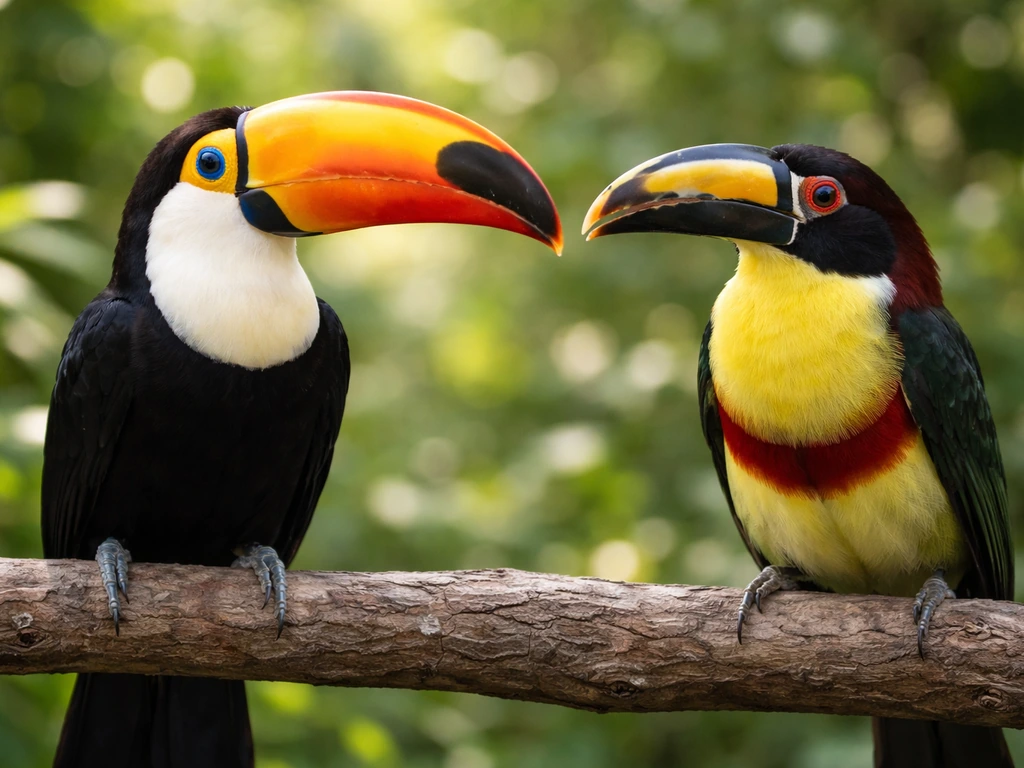
| Bird | Core symbolic themes | Cultural emphasis | Encounter tone |
|---|---|---|---|
| Toucan | Communication, creativity, visibility, resourcefulness | Mesoamerican, contemporary spiritual | Playful, bold, direct |
| Flamingo | Grace, balance, standing out, social connection | Egyptian, modern New Age | Elegant, communal |
| Bird of Paradise | Beauty, abundance, spiritual realm, good fortune | Pacific/Southeast Asian, New Age | Transcendent, rare |
| Myna bird | Vocal expression, adaptability, mimicry, learning | South/Southeast Asian, Hindu | Clever, chatty, social |
If you're drawn to the toucan specifically because of its boldness and communication themes, that profile is distinct from the more grace-oriented flamingo or the otherworldly bird of paradise. The toucan is fundamentally a social, vocal, present-tense bird. Its symbolism is about what you're doing and saying now, not about retreat or transcendence.
What to do with this today: journal, reflect, and apply it safely
The most useful thing you can do right now is write down the encounter or the moment that brought the toucan to your attention. Not to analyze it yet, just to record it. What were you doing? What were you thinking about before you saw the image or the bird? What was the first feeling that came up? Journaling doesn't require you to have any conclusions. It just gets the raw material out of your head and onto a page where you can look at it more clearly.
From there, a few reflection questions tend to be genuinely useful rather than vague. Ask yourself whether there's something you've been holding back from saying or expressing. Ask whether you've been making yourself smaller in a situation where you could afford to be more visible. Ask whether a creative project or idea has been sitting unfinished because it feels too bold or too different. These aren't prescriptions; they're prompts. The toucan's symbolic profile happens to fit these questions well, but only you can determine whether they resonate.
Practical reflection steps you can take right now
- Write down exactly what you saw, heard, or encountered and when. Include the mood you were in and what was on your mind at the time.
- Note the first word or feeling that came up when you saw the toucan or heard the phrase 'Guinness bird.' That first instinct is data.
- Ask: is there something I've been reluctant to say, share, or show right now? Sit with the question for a few minutes before writing an answer.
- Look at the practical circumstances of your life this week. Is there a creative project, a conversation, or a decision where more boldness or visibility would serve you?
- Write a short pros-and-cons list for the thing you've been hesitant about. Sometimes the symbolic prompt is most useful as a reason to finally think through something clearly.
- If you saw a real toucan in the wild: observe from a distance, don't approach, and avoid using calls or attractants to draw the bird closer. Responsible observation protects both you and the animal.
One important caution: bird symbolism is a lens for reflection, not a forecast or a prescription. Treating a single bird encounter as a fixed directive can slide into the same cognitive trap as catastrophizing, where one signal gets inflated into a certainty about what must happen next. The Cleveland Clinic's work on cognitive distortions is useful here: grounding and mindfulness practices, journaling, and examining your thoughts rather than treating them as facts are all healthier approaches than locking in on a single interpretation. The toucan appeared. Something about it caught your attention. That's worth exploring. It doesn't obligate any specific action, and it doesn't override practical judgment.
Bird symbolism works best when it functions as a mirror rather than a map. The toucan, with its impossible bill and its refusal to blend in, tends to reflect something back to the people who encounter it: a reminder that standing out isn't a flaw, that communication has power, and that your natural gifts might be bigger and more useful than you've been willing to admit. If that resonates, start there.
FAQ
How can I tell if “Guinness bird meaning” is about a toucan versus something else I saw online?
Check the image or context. The Guinness advertising shorthand almost always maps to a toco toucan, but if the photo shows a different bill shape or color pattern, treat it as a separate species and interpret symbolically from that specific bird rather than from the Guinness brand reference.
What if the “Guinness bird” I saw wasn’t in a dream or puzzle, it was in a real place that seems off for toucans?
In places outside the toucan’s typical habitat, sightings are often zoo escapes, aviary displays, wildlife-rehabilitation facilities, or misidentification. In those cases, focus on the personal meaning of the moment, but don’t assume the encounter is “for you” in a literal forecasting way.
Is there a difference between the toco toucan and other toucans for symbolism?
Yes. The article emphasizes the toco toucan because it matches the mascot look, but other toucan species can differ in coloration and sometimes habitat preferences. If you know the exact species from a guide or reliable caption, align symbolism to what stands out in that species rather than defaulting to the mascot’s details.
What should I do if multiple interpretations feel conflicting (for example, communication versus “messenger” themes)?
Use a single integration question: “What is the most actionable insight for me right now?” If both themes point to the same behavior change (speak up, share an idea, reconnect socially), keep the overlap and drop the extra layers that don’t change how you’ll act.
Can seeing the Guinness bird meaning in a crossword or meme change how I should interpret it?
Yes. Puzzle and meme contexts are usually indirect cues, so treat them as prompts for reflection rather than an “event.” The symbol works best when you tie it back to your current concern, for example an unfinished creative task or a conversation you’re avoiding.
How do I avoid over-assigning meaning to the toucan encounter?
Set a boundary: decide you will only treat symbolism as a mirror, not a prediction. A practical method is to write one sentence describing the feeling, then stop there. Only add interpretations if they still feel true after a day or two of grounded reflection.
If I find a feather, does that automatically mean it’s the same “Guinness bird” meaning?
Not automatically. A feather could come from many bird species, and location matters. If it is clearly not a toucan feather (which is uncommon outside collections or specific facilities), interpret the “notice this” theme, but don’t force the toucan-specific ideas onto it.
How do I journal about the encounter in a way that leads to clarity instead of vague feelings?
Record three concrete details first: what you were doing, what you noticed first about the bird (the bill, color, behavior), and the emotion in your body (tight chest, excitement, calm). Then ask one decision-focused question, “What would expressing myself look like this week?”
What if I don’t feel the “positive, communicative” symbolism at all?
That can happen, and it’s useful data. If you feel resistant, embarrassed, or uneasy, try interpreting the symbolism as a reflection of avoidance or fear rather than insisting it must be uplifting. The question becomes, “What am I protecting myself from?”
Is there a way to connect toucan symbolism to cultural traditions without treating them as a fixed rulebook?
Use cultural themes as optional lenses, not universal commands. If a tradition is personally meaningful to you, let it guide your reflection, but keep the final meaning anchored to your lived context and consent, not to the idea that one culture’s interpretation overrides yours.
Could the Guinness bird meaning be related to “luck” as some searches suggest?
It can be interpreted that way, but in the article’s emphasis the toucan is more about visibility and communication than guaranteed fortune. If luck is what you want, focus on “opportunity signals,” meaning whether you’re noticing a chance to act, rather than expecting outcomes to be fixed.
Next Article
Myna Bird Good Luck: Meaning, Signs, and What to Do Today
Myna bird good luck signs, meanings, and grounded steps to interpret sightings, calls, or nests for fortune and protecti