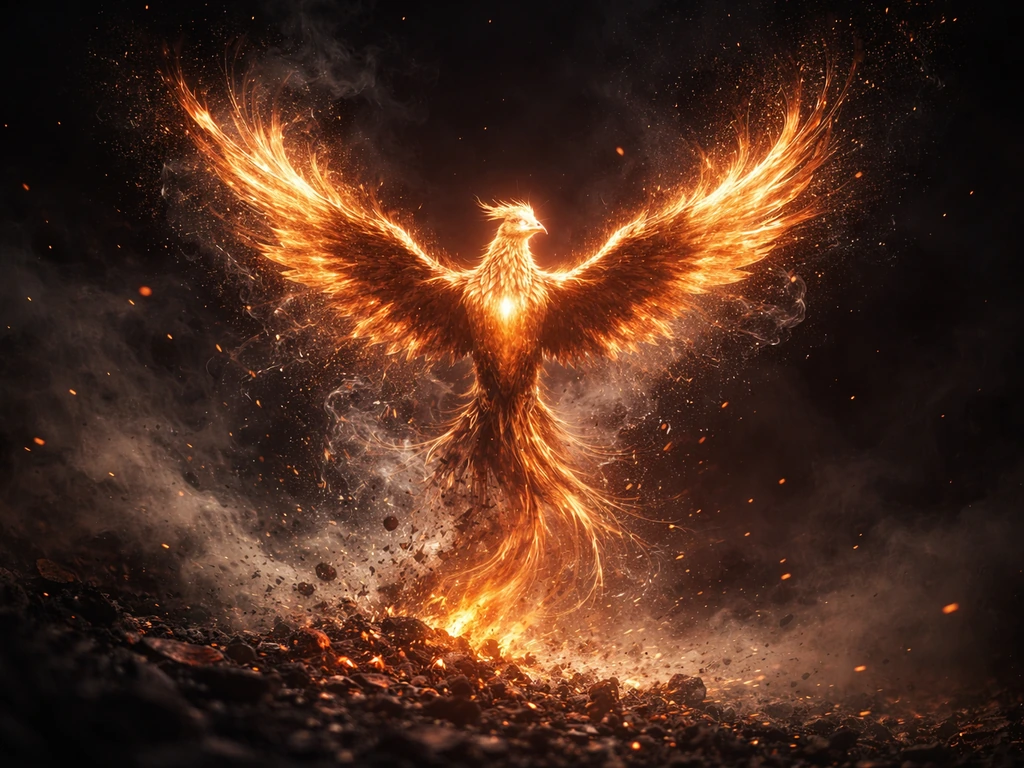
The phoenix is a mythical bird that dies in a burst of fire and is reborn from its own ashes, making it one of the most enduring symbols of transformation, renewal, and survival after total destruction. It does not represent a minor reset or a small change. It represents the kind of ending that feels like annihilation and the kind of beginning that only becomes possible because something was completely consumed first. That is what makes the ashes matter: without them, there is no new bird.
Phoenix the Bird Reborn From Ashes: Meaning and Guide

Eleanor Hartwell
29 Apr 2026
What the Phoenix Actually Means and Where the Idea Comes From
The word "phoenix" comes from the Greek "phoinix," and the creature appears in classical literature as early as the 5th century BCE. Herodotus, writing in his Histories (Book 2, chapter 73), describes a sacred bird in Arabia that travels to the Sun's temple at Heliopolis in Egypt every five hundred years, bringing the remains of its father enclosed in an egg of myrrh.
His account is already treating the phoenix as a bird associated with cycles, solar worship, and ritual handling of the dead. What is striking is that Herodotus himself is somewhat skeptical, reporting what people say rather than claiming he has seen the bird himself. He describes it as having feathers of gold and red, which later readers often connected to flame.
Tacitus, writing several centuries later in his Annals, gives the commonly accepted cycle as five hundred years, though he notes some accounts stretch it to 1,461 years, a figure tied to the Egyptian Sothic or Canicular astronomical cycle. The Latin poet Lactantius, in his poem De ave phoenice, gives a fuller picture of the fiery death: the bird's body dissolves into burnt ashes before the new phoenix emerges. That poem became enormously influential, shaping how later Christian and medieval writers understood the creature. It is worth knowing this layered history because the phoenix story you encounter today is not one single ancient source. It is a tradition that accumulated details across centuries.
The ashes themselves carry the symbolic weight. In almost every tradition that uses this imagery, the fire is not punishment. It is necessary. The old form cannot survive; it must be given up completely before anything new can emerge. This is why phoenix symbolism resonates so strongly with people who have been through severe loss, illness, the end of a relationship, a career collapse, or any experience that felt like it left nothing behind. The symbol says: this complete destruction is not the end of the story.
Phoenix Symbolism Across Cultures and Spiritual Traditions
The phoenix as a specific symbol carries a recognizable core across traditions: cyclical renewal, triumph over death, solar energy, and the idea that transformation requires sacrifice or loss. But it is worth being precise about which tradition you are drawing from, because the details shift considerably.
| Tradition | Bird/Figure | Core Meaning | Rebirth-from-Ashes? |
|---|---|---|---|
| Greek/Roman | Phoenix (Phoinix) | Cyclic renewal, solar devotion, immortality | Yes, central to the myth |
| Egyptian | Bennu bird | Solar rebirth, primordial creation, Osirian renewal | Not explicitly; fire/ashes added by later Greek writers |
| Chinese | Fenghuang | Harmony, virtue, imperial order, good omens | No; different mechanism entirely |
| Slavic | Firebird (Zhar-Ptitsa) | Magic, quest, divine light | No; fire-associated but not self-immolating |
| Persian/Islamic | Simurgh / Anqa | Wisdom, divine knowledge, cosmic age | Varies; some overlap with longevity themes |
| Christian (early) | Phoenix (adapted) | Resurrection, eternal life, Christ's rising | Yes, adapted directly from Greco-Roman imagery |
The Chinese Fenghuang is often called a "Chinese phoenix" in Western writing, but scholars are clear that the similarity is superficial. The Fenghuang is tied to harmony, moral order, and good governance, not to a death-and-rebirth-from-ashes cycle. Similarly, the Slavic Firebird shares the fire and light imagery but is a magical creature associated with quest narratives, not self-immolation and renewal. If you are seeking the specific "reborn from ashes" meaning, you are working within the Greco-Roman and early Christian tradition primarily, with Egyptian solar-rebirth themes as important background. If you mean the phoenix specifically as the bird reborn from ashes, this Greco-Roman and early Christian tradition is the closest match.
The Phoenix in Religion and Myth: Egyptian Roots, Greek Fire, and Christian Resurrection
The Egyptian Bennu Bird
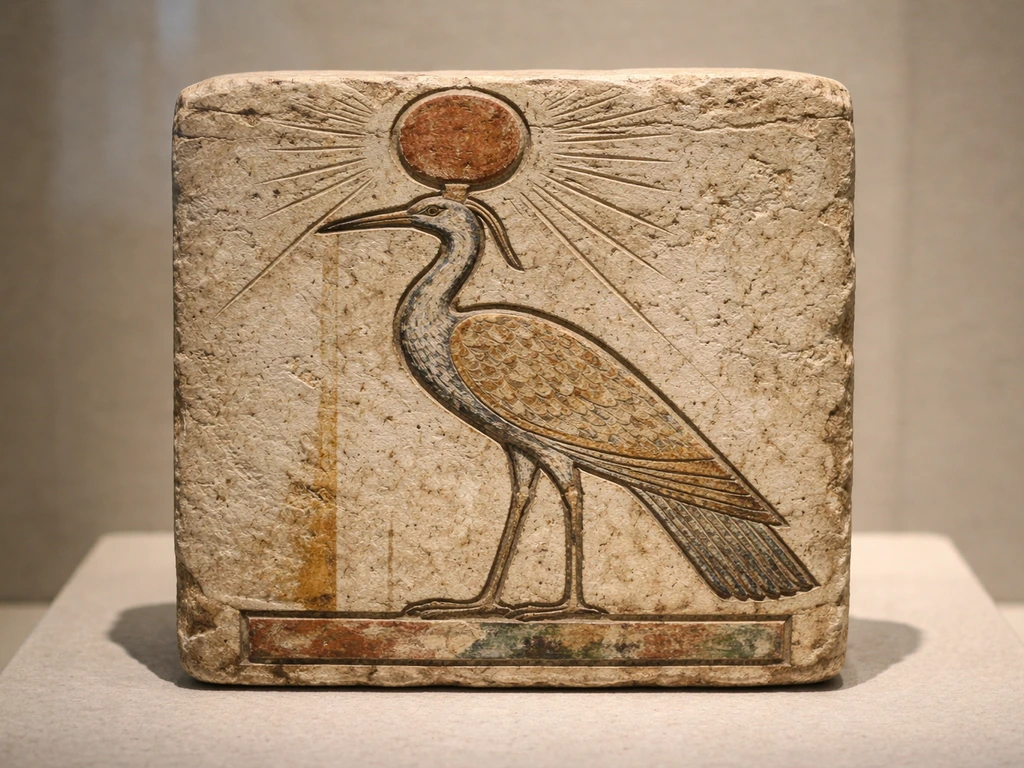
The Bennu is an Egyptian deity associated with the sun god Ra and with Osiris, the god of resurrection and the afterlife. It appears in Egyptian texts including the Book of the Dead, where the deceased declares they have flown up out of primeval matter and stand before Ra in a transformed state. The Bennu was connected to the benben stone, a sacred pyramid-shaped object at Heliopolis that symbolized the first moment of creation, the primordial mound rising from the waters. This solar, creative, and renewal-linked imagery clearly fed into how Greek writers later understood the phoenix they encountered in Egyptian religious practice.
Importantly, Egyptian sources do not describe the Bennu dying in flames and rising from ashes. That specific mechanic, the fire and the pyre, is a later development that appears in Greek and Latin retellings. The Egyptian contribution is the framework of solar cycles, death-and-renewal, and the sacred location of Heliopolis as a site of cosmological significance. If you feel drawn to the Egyptian spiritual current, the Bennu offers a slightly different resonance: creation from primordial stillness, the self-emerging quality of the divine, and resurrection through alignment with solar cycles.
The Greek and Roman Phoenix
The Greek and Roman tradition is where the famous fire-and-ashes story solidifies. Ovid and Claudian both describe the phoenix building a funeral pyre, burning, and rising renewed. Claudian's account includes the detail that the phoenix gathers its father's ashes and commits them to the flames before its own renewal, creating a poignant image of honoring death as part of the cycle of rebirth. Lactantius's De ave phoenice gave the narrative an elegiac, almost liturgical tone, describing the bird as eternally renewed through death and framing it as serving the sun in a kind of priestly function. This version of the phoenix is an agent, not a victim. It chooses the fire.
The Christian Phoenix
Early Christian writers adopted the phoenix almost immediately as a symbol of resurrection. The bird that dies and rises in a specific cycle was an obvious parallel to Christ's death and resurrection, and the phoenix appeared in early Christian art, funerary inscriptions, and poetry. De ave phoenice itself occupies an interesting space: scholars debate whether its author was writing explicitly as a Christian or whether the text simply lent itself to Christian interpretation.
Either way, by the early medieval period the phoenix had become a fully established symbol of resurrection, eternal life, and the soul's triumph over death in Christian visual and literary culture. A peer-reviewed article in “El ave fénix…” discusses how phoenix symbolism moved from ancient Mediterranean contexts into early medieval or Christian art as a didactic image of resurrection [fully established symbol of resurrection, eternal life, and the soul's triumph over death in Christian visual and literary culture](https://www. ull. es/revistas/index.
php/cemyr/article/view/17a).
What It Means When Phoenix Imagery Shows Up in Your Life
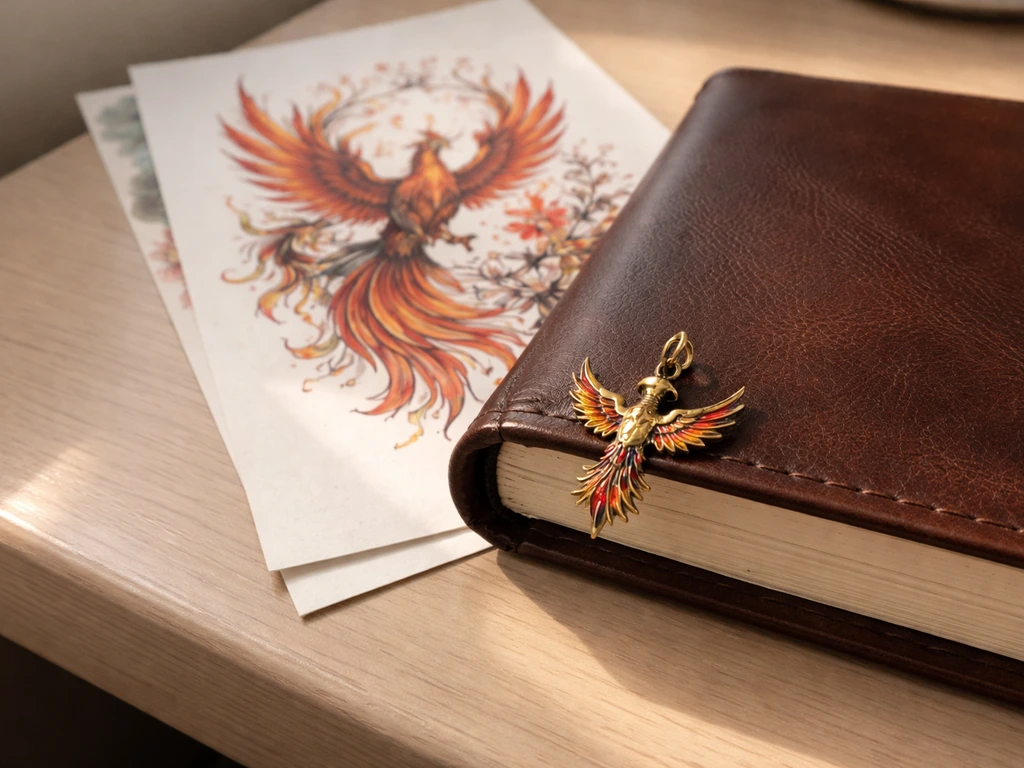
When you keep encountering the phoenix, whether in art, a piece of jewelry you are drawn to, a book that falls open to a phoenix passage, a tattoo you cannot stop thinking about, or a dream where a bird of fire appears, it is worth treating that as a prompt for reflection rather than a literal prediction. Here is what the symbol most commonly maps onto in human experience.
- Major endings and transitions: divorce, job loss, the death of a loved one, a serious illness, the end of a long chapter. The phoenix appears when the destruction feels total.
- Identity transformation: moments when who you were no longer fits, and you are in the raw, uncertain space between selves.
- Recovery from addiction, trauma, or breakdown: the lived experience of hitting bottom and beginning to rebuild is exactly what the phoenix myth encodes.
- Creative or spiritual rebirth: finishing a long stagnant period and feeling something new emerging, often from the wreckage of an old creative or spiritual identity.
- Grief that is also releasing: the sense that mourning something is, simultaneously, making room for something new.
In dreams specifically, a phoenix typically appears when your psyche is processing a threshold moment. If you dream of fire that does not harm you, a radiant bird, or rising from wreckage, the interpretive question to ask is not "what is going to happen to me" but rather "what am I currently releasing, and what is trying to emerge?
If you are thinking about the famous question, what fabled bird rose from the ashes of its nest, this is the tradition the phoenix draws on. " Dream symbols are not fixed lookup tables. They carry meaning in relation to your specific life, your history, and what is emotionally alive for you right now. A phoenix dream during a period of creative stagnation means something different than a phoenix dream in the middle of grief.
Encountering phoenix imagery in everyday life, in synchronicities or repeated encounters with the symbol, works the same way. The value is not in the encounter itself but in what it prompts you to notice. Think of it as a question the world is asking you: where in your life is something in the process of burning down that you have been trying to save? And what might be possible on the other side of letting it go completely?
How to Use Phoenix Symbolism in Your Spiritual Practice
Working with the phoenix as a symbol is most effective when it is active, not passive. Reading about the bird is a start, but the tradition it comes from is fundamentally about engagement: ritual, devotion to cycles, honoring what is completed. Here are concrete practices aligned with that tradition.
Journaling Prompts

- What in my life right now feels like it is burning down? Am I trying to save it, or am I allowing it to complete its transformation?
- What version of myself am I grieving? What was good about that version, and what is worth honoring before I let it go?
- If I trusted that something new would emerge from the current destruction, what would I stop protecting?
- Where in my past have I already lived through a phoenix cycle, even if I did not name it that at the time? What actually emerged on the other side?
- What would it feel like to tend the ashes rather than escape them? What slow, patient work is this moment asking for?
Reflection and Meditation Practice
A simple practice: sit with something you are currently losing or releasing. This could be a relationship, a belief, an identity, a version of your life. Light a candle if that feels right. Spend five to ten minutes writing or meditating on what that thing genuinely meant to you, what it gave you, what was good about it. Then consciously acknowledge that it is completing. You are not rejecting it. You are honoring it as the necessary material for what comes next. This is not a spell or a guarantee. It is a way of moving through transition with intention rather than resistance.
Simple Ritual Aligned with the Phoenix Tradition
The classical phoenix stories all involve fire and the sun. A practice that honors this: write down what you are releasing on a piece of paper. Take it outside in daylight, ideally somewhere you can see the sky. Read it aloud, acknowledging what it was and what it cost. If you have a safe way to burn the paper, do so, watching the smoke carry it upward in the direction of the sun. If burning is not practical, bury it or tear it and scatter it into moving water. The point is the physical act of release. The body understands completion through action in a way that thinking alone does not provide.
Working with Phoenix Imagery in Your Space
Placing phoenix imagery where you will see it during a period of transition can function as a daily reminder of the interpretive frame you are choosing. This is not about magical causality. It is about keeping a useful lens in view. A phoenix image on your desk or altar, a feather in a color that resonates with the tradition (gold and red are the classical colors), or a piece of writing about the cycle placed somewhere you read it regularly, these are tools for remembering the larger arc when the middle of transformation feels only like loss.
Common Misunderstandings About Phoenix Symbolism
Phoenix symbolism is powerful precisely because it does not promise comfort. There are a few ways people misread it that are worth naming directly.
- The phoenix is not a guarantee of a good outcome. The symbol says transformation is possible after destruction. It does not say what the new form will look like, how long it will take, or that the process will be painless. Reading it as a promise of success is a misuse of the symbol.
- Seeing phoenix imagery does not mean your destruction is finished. The symbol can appear at any point in the cycle, including the middle of the burning. Do not rush the process because you spotted a phoenix image and decided the hard part is over.
- The ashes are not a metaphor for a minor setback. Phoenix symbolism is calibrated for genuine upheaval. Applying it to ordinary stress dilutes its meaning and can actually obscure what the symbol is pointing to when real transformation is happening.
- Phoenix symbolism is not about toxic resilience. The cultural cliche of "bounce back faster" misreads the tradition. The phoenix does not rush. The cycle in classical sources is five hundred years. There is real time in the metaphor, real waiting, real stillness in the ashes.
- Claiming phoenix symbolism as prediction or divine guarantee crosses into magical thinking. The distinction between symbolic interpretation and believing that seeing a phoenix image will cause a good outcome in your life is an important one. The symbol is a lens, not a mechanism.
Dream interpretation deserves its own caution. Multiple scholarly traditions acknowledge that dreams reflect the dreamer's psychological and emotional landscape, not literal future events. A phoenix dream is not telling you that you will literally lose everything and rebuild. It is reflecting something about your inner relationship to change, loss, and emergence. Work with it as a mirror, not a forecast.
How the Phoenix Connects to Broader Bird Symbolism
The phoenix sits within a much wider family of bird symbolism that this site explores across cultures. Understanding those connections can deepen how you work with the symbol.
Flight, one of the universal themes in bird symbolism, is central to the phoenix. The bird flies to Heliopolis in Herodotus's account. It rises from the ashes. The upward movement is not incidental. Flight in bird symbolism almost universally represents the soul's capacity to transcend, to move between earthly and higher planes, to carry prayers or intentions upward. The phoenix embodies this more dramatically than almost any other bird precisely because its flight follows the deepest possible descent into the earth as ash.
Feathers carry similar weight. The phoenix's gold and red feathers are described specifically in early accounts, and in many traditions feathers found in unexpected places are understood as messages or signs from the spiritual realm. Finding a feather during a period of difficult transition can be read through a phoenix lens: a reminder that the flight is still possible, even when the fire is still burning.
Nesting, another universal theme, connects to the phoenix through the pyre itself. The phoenix builds its own nest of spices and aromatic wood (in later accounts) and that nest becomes its funeral pyre and its cradle. The nest in bird symbolism represents home, safety, and the place of new life. The phoenix collapses those meanings together in a striking way: the place of safety is also the place of transformation, and what feels like destruction of the nest is actually its highest purpose.
If you are drawn to the specific question of which bird rises from ashes, or exploring the fabled bird that rose from its nest, or comparing the legendary phoenix that rises across different mythological framings, those are all variations on the same core question this guide addresses, approached from slightly different angles. The common thread is the ashes, and what the ashes mean: not failure, but the precondition of something entirely new.
Other birds on this site offer their own forms of renewal and resilience. The swallow returns every year from a long migration, a quieter form of cyclical rebirth. The hummingbird, despite its tiny body, survives conditions that seem impossible for something so fragile. Cardinals are widely read as signs of continued presence after death, a different kind of comfort when loss feels permanent. The phoenix is the most dramatic version of these themes, but you can find its essence threaded through the symbolism of many birds if you look for the quality of persistence through transformation.
FAQ
Is the phoenix the bird that is reborn from ashes only a myth, or does it have real spiritual meaning?
It is a mythic image, but many traditions treat it as a spiritual symbol, meaning it can be used as a way to reflect on transformation rather than as literal prophecy. If you are using it for healing, focus on what you are ready to release and what you want to grow next, since the symbol works best as an interpretation tool.
How do I tell whether my “phoenix” dream is about grief versus creative change?
Use the emotional tone and the outcome. If the dream centers on mourning, funerals, or loss, it is more likely processing grief and letting something end. If it centers on making, building, performing, or creating something new, it often points to creative emergence, especially after a period of stagnation.
What if the phoenix dream involves fear, burns, or harm to me?
That usually means the psyche is resisting change, not that something bad is guaranteed. Try asking, “What am I trying to protect that cannot survive the transition?” Then look for one small, practical action that honors the release, such as closing an unfinished project or having a difficult conversation.
Does the “phoenix cycle” (like every 500 years) change how I should use the symbolism?
For everyday use, the exact cycle length matters less than the cycle idea itself. The practical takeaway is timing and completeness, meaning you do not rush rebirth. Let the “ash” phase be real, such as finishing grieving, making peace, or ending a pattern, before trying to relaunch.
I want the phoenix meaning specifically tied to “reborn from ashes.” How do I avoid mixing it with other bird myths?
Be cautious if your source material shifts toward governance, harmony, or quest magic, those themes can belong to different “phoenix-like” creatures. If you want rebirth-from-ashes resonance, look for fire, destruction of an old form, and renewal through surrender, often tied to Greco-Roman and early Christian retellings.
Can I interpret repeated phoenix sightings as a sign from “outside,” or should I assume it is my own mind?
You can treat it as a prompt either way. The symbol becomes most useful when you convert the “sign” into self-inquiry: identify the one area of life where you are trying to keep something that is already ending. That turns synchronicity into a workable decision rather than a guess.
What is the most common mistake when using phoenix symbolism for change?
Using it to bypass grief or responsibility. The phoenix requires a real completion, not a forced optimism. If you feel stuck, try the article’s release practices, but also add accountability steps, such as writing a goodbye email you do not send, or making a concrete boundary decision.
Are phoenix rituals or burning papers safe, and what should I do if I cannot burn anything?
Use safety rules based on your environment. If burning is not practical, tear the paper into small pieces and scatter them into moving water, bury them away from paths, or place them in a sealed container for disposal. The key detail is the physical act of letting go, not the flame itself.
How can I use phoenix symbolism with a busy schedule without turning it into a big project?
Use a short daily trigger: keep a phoenix image or note visible, then do one minute of reflection when you see it. Ask, “What is completing today?” and “What is one next step I can take toward the new phase?” Small consistency works better than occasional intense rituals.
Does phoenix symbolism work if my “rebirth” is slow or does not feel dramatic?
Yes. Not every transition includes sudden breakthroughs. A slow rebirth can still be a phoenix cycle if the old identity is genuinely changing over time. Track progress by noticing what you are no longer tolerating, what you are practicing, and what you are starting to value differently.
Next Article
What Fabled Bird Rose From the Ashes of Its Nest? The Phoenix
Find the answer: the phoenix rises from ash for mythic rebirth. Learn its symbolism of renewal, transformation, and how