
Micah 1:16 mentions the eagle, or more precisely, a large bird of prey that Hebrew calls נֶשֶׁר (nešer, Strong's H5404). Depending on the Bible version you are reading, it shows up as either 'eagle' or 'vulture,' and that difference is not a mistake. It reflects a genuine ambiguity in the Hebrew word itself. The verse uses this bird as a simile for mourning: Judah is called to shave her head as bare as the head of that bird. Once you know the Hebrew term behind it, the identification is easy to verify and the imagery snaps into focus.
Micah 1:16 What Bird Is Mentioned? Hebrew Answer and Check

Eleanor Hartwell
29 Apr 2026

The Exact Wording of Micah 1:16
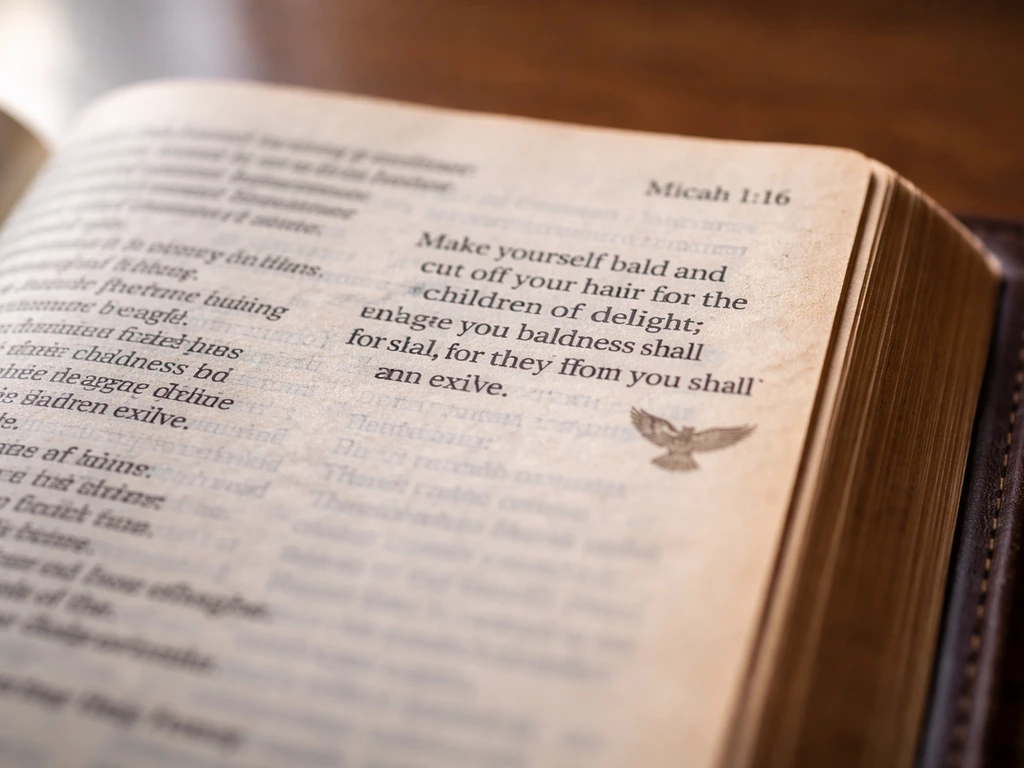
The full verse reads, in the KJV: 'Make thee bald, and poll thee for thy delicate children; enlarge thy baldness as the eagle; for they are gone into captivity from thee.' The bird reference sits squarely in the middle of that verse, in the phrase 'enlarge thy baldness as the eagle.' Every major English translation carries the same core image, even if the bird's name shifts. The verse is a command to mourn, and the bird provides the central visual comparison: the people of Judah are told to make themselves as bare-headed as this particular creature.
Eagle or Vulture? The Hebrew Term and Why Translations Differ
The Hebrew word is נֶשֶׁר (nešer), catalogued in Strong's Concordance as entry H5404 and glossed as 'the eagle (or other large bird of prey).' That parenthetical is doing real work. The ancient Israelites used nešer as a broad category term covering several large, imposing raptors, and different translators have landed on different English equivalents based on what they think best captures the imagery in context. Here is how the major versions translate the bird clause in Micah 1:16:
| Bible Version | Bird Clause Translation |
|---|---|
| KJV | enlarge thy baldness as the eagle |
| ESV | make yourselves as bald as the eagle |
| NASB | Extend your baldness like the eagle |
| CSB | make yourself as bald as the eagle |
| NIV | make yourself as bald as the vulture |
| NRSV | make yourselves as bald as the vulture |
The split is clean: older, more formal translations tend to say 'eagle,' while several modern translations say 'vulture.' Both choices are legitimate renderings of nešer. The NETBible translation notes describe the term as referring to 'the griffon vulture or eagle,' and translation commentators point out that the comparison to baldness actually favors the vulture. In a discussion on r/AcademicBiblical, commenters similarly debate whether “vulture” is a deliberate mistranslation of “eagle” and note that nešer is often connected to the griffon vulture in modern Hebrew usage the bird comparison actually favors the vulture. A true eagle has a fully feathered head, while the griffon vulture, common across the ancient Near East, has a bare, featherless head and neck. Bible.org notes identify the bird in view here as the 'white-headed griffin vulture,' describing it as appearing 'as if it were bald.' If the point of the simile is extreme baldness as a sign of grief, the vulture fits the visual more precisely than the eagle does.
How to Confirm the Identification Yourself

This is one of those cases where going to the underlying Hebrew resolves the confusion immediately. The fastest workflow I have found is a two-step check using free online tools.
- Go to Blue Letter Bible or BibleHub and pull up Micah 1: 16. Switch to the interlinear or Hebrew text analysis view. You will see נֶשֶׁר tagged in the verse, linked directly to Strong's H5404.
- Click through to the H5404 lexicon entry. Blue Letter Bible shows every verse in the Old Testament where nešer appears, with context. You will see the word used for majestic flight (Psalm 103:5), for the eagle-like speed of enemies (Deuteronomy 28:49), and here in Micah for a bald-headed creature of mourning.
- Check the NETBible note for Micah 1: 16 specifically. It explains the translation choice between 'eagle' and 'vulture' and confirms both come from the same Hebrew root, with a preference for 'vulture' in this verse because of the baldness imagery.
- Cross-reference with a study Bible or commentary note, such as Bible.org or a JFB-style commentary, which typically flag that nešer here probably means the griffon vulture rather than a true eagle.
That four-step check takes about ten minutes and leaves you with a sourced, verified answer rather than a guess based on one translation.
What the Bird Is Actually Doing in Micah's Message
Micah 1:16 sits inside a longer lament section running roughly from verse 10 to 16, a passage filled with grief imagery, wordplay on town names, and commands to perform public mourning. The section builds toward exile: the verse ends with 'for they are gone into captivity from thee.' Within that sequence, the bird simile is doing specific symbolic work. The prophet is not invoking the eagle's strength or its association with divine power, which are the images you encounter elsewhere in scripture. Many readers also wonder specifically whether Turkey is mentioned as a bird in the Bible, but the relevant verses focus on different kinds of raptors bird provides the central visual comparison. Here, the nešer appears as a creature with a visibly bare, exposed head, and that bare head is the entire point.
Shaving the head was one of the most recognizable mourning gestures in the ancient Near East, a public, physical declaration of grief and loss. Micah takes that human practice and intensifies it by pointing to an animal whose head looks permanently stripped. The command 'make yourselves as bald as the vulture' is a call to wear grief visibly and completely, matching the nakedness of exile with a nakedness of body. When God sends a red bird, the point is often a vivid sign meant to call attention to grief, warning, or a new moment of understanding. The bird becomes a living emblem of stripped-down loss. There is nothing triumphant about nešer in this verse; the symbolism is entirely about exposure and sorrow. That is a meaningful contrast to other biblical appearances of the same bird, where it represents soaring renewal or divine swiftness, which shows how deeply context shapes what a bird image means in any given passage.
This kind of grief-laden bird imagery connects to a broader pattern of birds marking significant moments in the biblical narrative. If you have read about what bird God provided for the Israelites in the wilderness, or explored the symbolism of the great speckled bird in the Bible, you will notice that nešer carries entirely different weight in those passages compared to what it does in Micah's lament. The same word, used in mourning versus provision versus prophecy, carries completely different symbolic freight. In the wilderness, God also provided meat for Israel through quail what bird did god provide for meat in the wilderness.
Your Practical Next Steps for Cross-Checking This Today

If you want to walk away with a fully verified answer you can trust and a method you can reuse for any biblical bird question, here is the practical sequence:
- Read Micah 1: 16 in at least three versions side by side. Bible Gateway lets you do this in one window. Note which say 'eagle' (KJV, ESV, NASB, CSB) and which say 'vulture' (NIV, NRSV) to understand the translation landscape before drawing a conclusion.
- Use Blue Letter Bible's interlinear for Micah 1: 16 to confirm the Hebrew word is נֶשֶׁר (H5404). This takes any guesswork out of the identification.
- Read the H5404 lexicon entry in full. Pay attention to the range of verses where nešer appears. Notice how some contexts favor 'eagle' (power, speed, soaring) and others, like this one, favor 'vulture' (bare head, mourning).
- Read the NETBible note for Micah 1: 16. It directly addresses the eagle vs. vulture question and explains why 'griffon vulture' is the more contextually accurate identification here.
- Read Micah 1: 10 through 16 as a unit. The lament sequence gives you the literary context that confirms the baldness image is about grief and exile, not strength or divine power.
- If you want a secondary confirmation, check a commentary entry: Bible.org's Micah 1 notes and the JFB-style commentary both discuss the specific bird and the mourning connection in plain language.
The bottom line is that blank" rel="noopener noreferrer">both 'eagle' and 'vulture' are defensible English translations of the Hebrew nešer, but in Micah 1:16 specifically, the vulture identification is stronger because the entire simile depends on the bird's bare head. So what bird did God provide for the Israelites, and how does that compare to the mourning image in Micah 1:16? If you are asking a modern, simple question like what is God's favorite bird, the Bible does not name one favorite, but it does use specific birds to teach particular lessons in each context both 'eagle' and 'vulture'. The Hebrew does not leave you with two birds. It gives you one word that covers a range of large raptors, and the context tells you which end of that range the prophet had in mind. In this case, it is the bald, exposed-headed vulture, not the feather-crowned eagle. That same kind of question, “why is Turkey the thanksgiving bird,” has a different origin story that does not come from Micah’s bird imagery.
FAQ
Does Micah 1:16 mention a specific bird species, or just a general kind of bird?
No. In Micah 1:16 the Hebrew term נֶשֶׁר (nešer) is a category word for a large raptor, and the verse’s mourning simile centers on the bird’s bare, exposed head. It does not identify a specific species the way modern bird guides do.
Why do some translations say “vulture” instead of “eagle” for Micah 1:16?
If your Bible reads “vulture,” it is still grounded in the same Hebrew word. The key detail is the simile for baldness, so translators that emphasize the bird’s bare head tend to choose “vulture” (often a griffon vulture type) rather than “eagle.”
Is Turkey mentioned as a bird in Micah 1:16?
Turkey is not the bird named in Micah 1:16. The “bird” issue people sometimes connect to Turkey is from unrelated topics, because Micah’s wording points to a nešer, a raptor linked with exposed head imagery in a mourning context.
What does “make yourself bald” mean in Micah 1:16, is it literal shaving?
“Shave” is not only literal hair trimming. In context, Micah is describing a public mourning posture, so translators may render the action as making the head bare or expanding baldness to show grief openly, matching ancient mourning customs.
How can I tell which bird identification is the right one when different versions disagree?
Look for more than the single English word. Check the surrounding commands in Micah 1:10 to 16, then ask what physical trait the simile is using. In this verse, the decisive trait is the look of extreme baldness, which is why the “vulture” angle is stronger for many readers.
If nešer can mean both “eagle” and “vulture,” how do I know which one Micah intended?
If you are comparing across translations, treat “eagle” and “vulture” as two ends of the same Hebrew range. The Hebrew word functions like “large bird of prey,” and the verse context narrows it to the bird whose head appearance matches the mourning image.
Does the meaning of nešer stay the same in every Bible passage?
Yes, context changes meaning. Elsewhere in scripture, the same type of raptor imagery can highlight different themes, such as speed, power, or providence. In Micah’s lament, the focus is not victory but exposure and grief, so you should not import a “triumphant eagle” idea into this verse.
Is there a simple rule for interpreting nešer when the Bible uses it with a comparison?
Use a quick decision rule: when a verse uses nešer specifically to compare to human baldness, prioritize identifications with a bare or nearly bare head. If the verse does not use a head-baldness simile, you would reassess, because then other traits may drive the translator choice.