The raven in the Bible is not simply a symbol of evil or a bad omen. Depending on which passage you read, it represents obedience to God's provision, divine care for creation, judgment on the wicked, and even a kind of stubborn freedom. The bird appears in at least five distinct biblical contexts, and each one gives it a different shade of meaning. If you want to understand what the raven truly signifies in Scripture, you have to look at those contexts one at a time rather than flattening everything into a single, modern folk interpretation.
Raven Bird Meaning in the Bible: Verses, Symbolism, and What It Means

Eleanor Hartwell
29 May 2026
Where the raven actually appears in the Bible
The Hebrew word behind every biblical raven is עֹרֵב (orev, Strong's H6158), and it shows up across both the Torah and the Wisdom literature. The Hebrew word עֹרֵב (orev) is translated “raven/ravens” and appears in multiple passages such as Genesis 8:7, Leviticus 11:15, Deuteronomy 14:14, Job 38:41, and Proverbs 30:17. Here are the major passages you need to know:
- Genesis 8: 6–7: Noah sends the raven out of the ark first, before the dove. It flies back and forth until the waters dry up.
- Leviticus 11: 15: "Every raven after its kind" is listed among the birds Israel was forbidden to eat, classifying it as ceremonially unclean.
- Deuteronomy 14: 14: The clean/unclean bird list is repeated, and the raven is again named explicitly.
- Job 38: 41: God asks Job, rhetorically, who provides food for the raven when its young cry out to Him. The answer is God himself.
- Psalm 147: 9: The same theme, God feeding the young ravens when they call.
- Proverbs 30: 17: A disturbing image of ravens picking out the eye of one who mocks a father, used as a warning about disrespecting parents.
- Isaiah 34: 11: Ravens and owls inhabit the ruins of Edom as imagery within a judgment oracle against that nation.
- 1 Kings 17: 4–6: God commands ravens to bring Elijah bread and meat during his hiding at the brook Cherith.
That is a wider range of appearances than most readers expect. The raven is not a background character in Scripture. It shows up in creation narratives, in law codes, in wisdom poetry, in prophecy, and in miracle accounts. That spread alone tells you the bird carries layered meaning rather than a single fixed label.
What each biblical passage actually says about raven symbolism

The Noah's Ark raven: explorer, not omen
Genesis 8:6–7 is the most famous raven passage, and it is also the most misread. Noah opens the ark window after forty days of waiting and sends out the raven. The text says it "kept flying back and forth until the waters had dried up from the earth. " Notice what the raven does not do: it does not return with a report, and it does not bring a sign like the dove does.
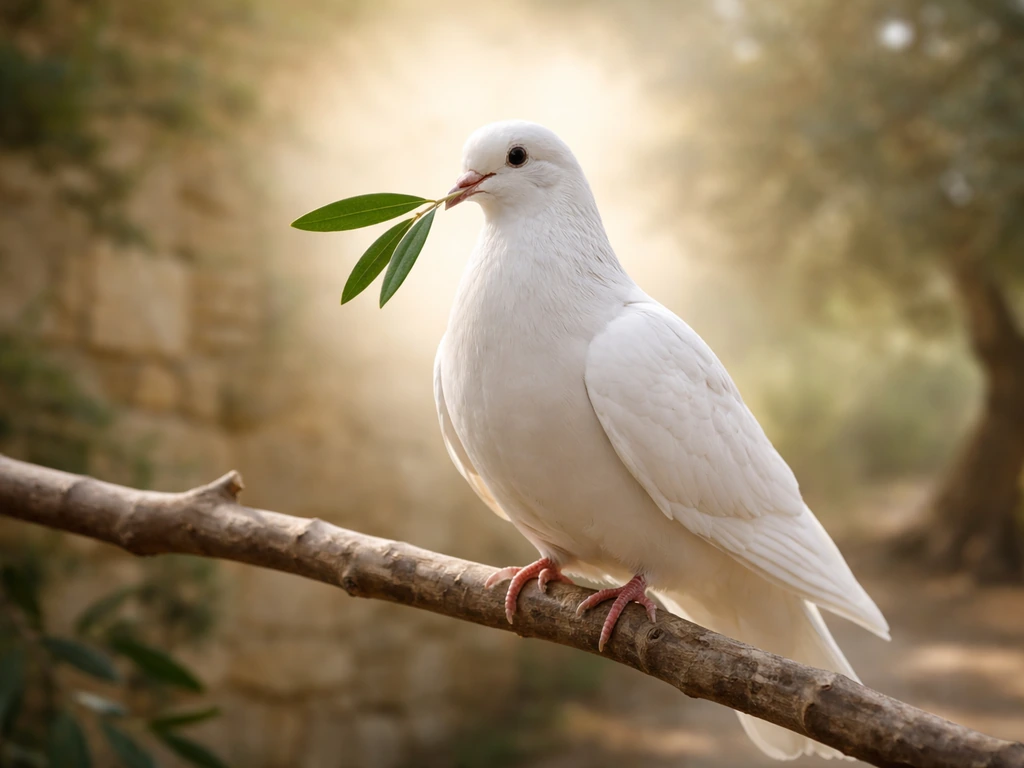
The dove in Genesis 8 carries a different kind of meaning, often framed as good news rather than bad omen dove does. It simply keeps moving over the face of the waters, restless and self-sustaining, because as a scavenging bird it can eat what floats on the surface. Noah then pivots to sending the dove, whose return with an olive branch becomes the famous symbol of peace and assurance. The raven's role here is not evil.
It is simply different. It was the first creature sent out into the post-flood world, a kind of scout whose behavior told Noah something by its absence of information: the world is not yet hospitable enough for a reliable land-based messenger.
The unclean classification: a food law, not a moral verdict
Leviticus 11:15 and Deuteronomy 14:14 place the raven in the list of forbidden foods for Israel. This is a dietary and ritual purity distinction, not a moral statement about the bird's character. Many animals on that list, including the eagle and the stork, are used positively elsewhere in Scripture. The unclean designation means Israel was not to eat the raven, likely because ravens are scavengers and carrion eaters. The category does not mean God views the raven as wicked, only that it falls outside the dietary boundaries set for the covenant community.
God feeding the ravens: a symbol of divine care
Job 38:41 and Psalm 147:9 use the raven in a strikingly tender way. God, speaking from the whirlwind, asks Job who provides food for the raven's young when they cry. It is a rhetorical question designed to show Job the vast scope of God's providential care over all creation, including creatures humans might consider unclean or undesirable. If God tends to the raven's nestlings, the argument goes, how much more does he attend to the whole of creation? This usage gives the raven a genuinely positive symbolic weight: it represents the breadth of God's mercy, not exclusion from it.
Elijah's ravens: instruments of divine provision
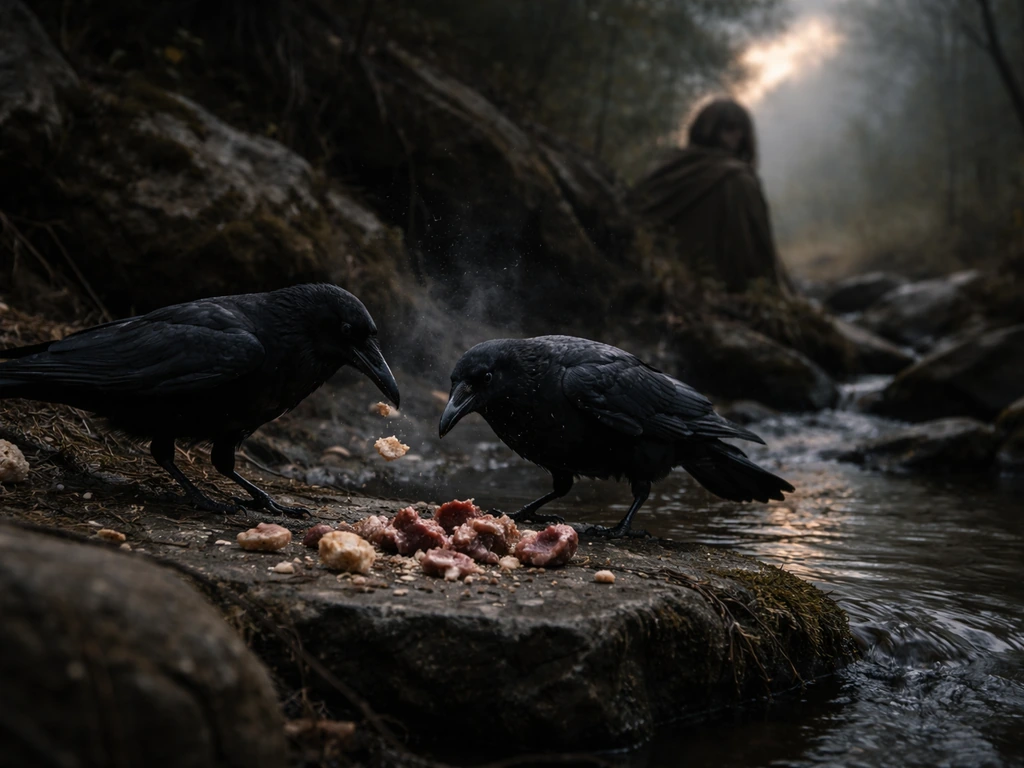
The 1 Kings 17 account is perhaps the most theologically striking of all. God commands ravens to bring Elijah bread and meat twice a day while the prophet hides at Cherith during a drought. Ravens as a species are not known for sharing food. They are hoarders and opportunists. So the miracle here is precisely that God overrides the raven's natural instinct to make it an instrument of prophetic sustenance. The symbolism is clear: God can use the most unlikely, even ceremonially unclean, creature to accomplish His purposes. This passage alone should caution anyone against assuming the raven is simply a dark symbol in the Bible.
Isaiah's desolation oracle: the raven as wilderness marker
Isaiah 34:11 places owls and ravens in the ruins of Edom as part of a judgment oracle. "The owl and raven will nest there" signals that a once-inhabited, powerful nation has become a wasteland. Here the raven functions as an indicator of desolation, not because the bird is evil, but because its natural habitat is wild, remote, uninhabited places. When ravens move in, human civilization has moved out. It is an ecological observation turned into prophetic imagery.
Raven vs. other birds in Scripture
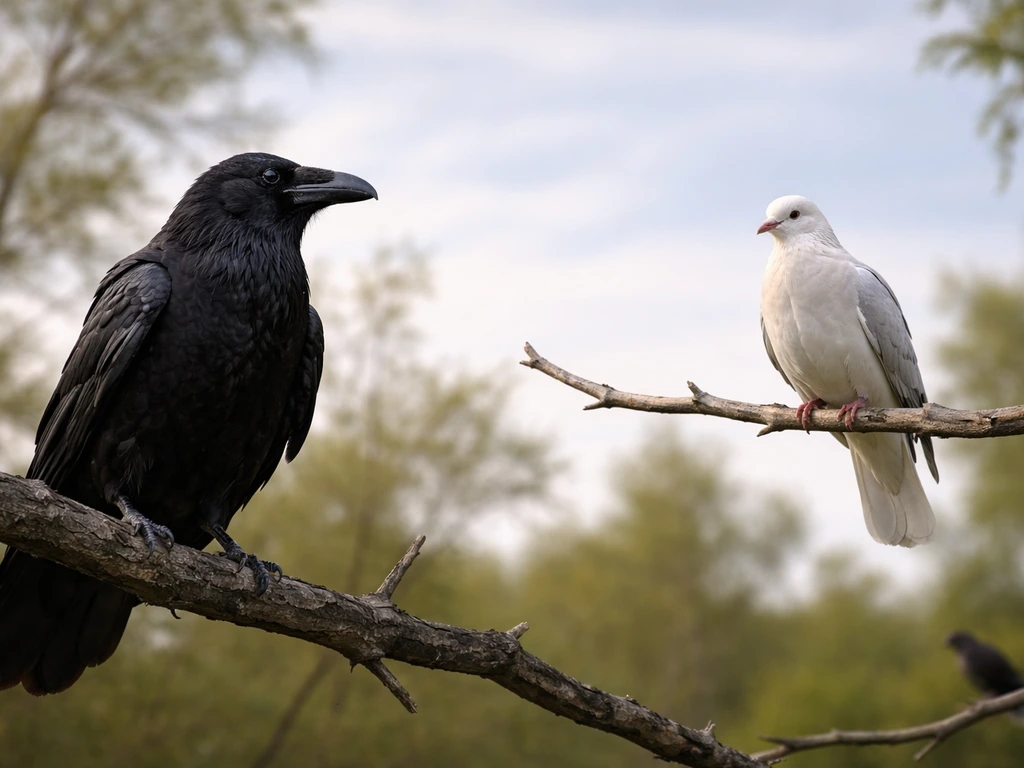
Understanding the raven gets clearer when you place it alongside other biblical birds. The contrast with the dove in Genesis 8 is the most immediate. Where the raven wanders without return, the dove comes back, then comes back with evidence, then finally does not return because the land is ready. The dove's behavior is communicative and relational. The raven's behavior is independent and survival-driven. Neither is evil. They simply represent different modes of engagement with an uncertain world. The dove ends up carrying enormous symbolic weight in Scripture and beyond, including its role at Jesus's baptism, and that is worth exploring separately alongside raven symbolism.
The crow is the raven's closest biblical neighbor in terms of species and is addressed in its own biblical context. If you are also asking about a crow bird meaning in the bible, the closest parallel is how the crow is treated in its own biblical context alongside the raven. Ravens are larger, more solitary birds than crows, but the Hebrew orev was sometimes used as a broad family term.
In Scripture, the crow does not appear as a distinct character in the way the raven does, making the raven unique as a named bird across multiple narrative and poetic genres. The crane, another bird with its own biblical symbolism, appears in prophetic literature in a very different register, associated with migration and the keeping of seasons rather than with wilderness or provision.
The biblical meaning of the crane bird is often tied to how God orders seasons and migration, which adds a different lens to Scripture’s use of birds.
Common misconceptions about ravens in the Bible
The biggest mistake readers make is importing Edgar Allan Poe's "The Raven" or Norse mythology's Odin-raven associations into their Bible reading. Those traditions are real and fascinating, but they are not Scripture. When someone says "the raven is a symbol of death in the Bible," they are almost always drawing on literary or cultural folklore, not on the actual biblical texts. The raven in the Bible is never explicitly called a symbol of death, darkness, or Satan. That association comes from outside the canon.
A second misconception is reading the unclean classification in Leviticus as a moral condemnation. As noted above, "unclean" in the Mosaic law is a ritual and dietary category, not an ethical judgment. The raven being unclean means Israel could not eat it. It says nothing about the raven's spiritual status in God's creation, which the Job and Psalm passages make clear is cared for directly by God.
A third error is reading the Genesis 8 raven as a failure or a negative contrast to the dove. The text never says the raven failed. Noah sent it out as a first step. It did what ravens do. Noah simply needed a different kind of messenger next, one that would return. Reading failure into the raven's behavior is an editorial addition the text does not support.
How to read the raven verses correctly

- Identify the genre: Is the verse narrative (Genesis, 1 Kings), law (Leviticus, Deuteronomy), wisdom poetry (Job, Psalms, Proverbs), or prophecy (Isaiah)? Each genre uses birds differently.
- Ask what the raven is doing in context: Is it a literal bird in a story? A rhetorical example? An ecological marker of desolation? The function shapes the meaning.
- Separate the descriptive from the prescriptive: A raven appearing in a judgment oracle describes what desolation looks like. It does not prescribe that every raven sighting means judgment.
- Cross-reference before concluding: If one passage seems negative, check the other passages. The full biblical picture of the raven is more complex and positive than a single verse suggests.
- Filter out non-biblical sources: If an interpretation you have heard about ravens does not trace back to a specific Bible passage, it is probably coming from folklore, and that is fine to note, but keep it separate from biblical interpretation.
Feathers, flight, and the "unclean" label in broader biblical bird symbolism
Birds in general carry a strong symbolic load in Scripture, and the raven participates in several of those universal patterns. Flight is consistently associated in the Bible with freedom, divine messengership, and transcendence. The image of God hovering over the waters in Genesis 1:2 uses a word (merachefet) associated with a bird brooding over a nest. Eagles carry the righteous on their wings. The Spirit descends like a dove. Flight is almost always positive. Even the raven's endless flight in Genesis 8 has something of this energy: it is the first free creature over the renewed earth.
The "unclean" label attached to ravens in the Mosaic law is part of a larger system distinguishing birds of prey and scavengers from birds that were permissible to eat. Scholars note that the clean/unclean distinctions for birds in Leviticus 11 generally follow ecological and behavioral lines: birds that eat carrion or hunt other creatures tended to be classified as unclean. This is not a spiritual hierarchy so much as a practical and ritual one. The raven's scavenging nature put it in that category, but the same scavenging capacity made it the perfect instrument for God to use in Job's wilderness and Elijah's brook: it could find and bring food where a more fastidious bird could not.
Seeing a raven today: how to think about it spiritually
If you have encountered a raven and are wondering what it might mean spiritually, the biblical framework gives you some genuine tools without requiring you to make dramatic claims. Start with what the bird actually is: ravens are highly intelligent, adaptable, and deeply connected to wild and untamed places. When one appears in your life, the biblical resonances worth sitting with include provision in unexpected places (the Elijah account), God's care for even the creatures humans overlook (Job and Psalms), and the capacity to survive and move through desolate seasons (Genesis 8 and Isaiah 34).
None of that means you should treat a raven sighting as a divine prophecy or a guaranteed sign. Scripture does not establish a system where specific bird sightings carry guaranteed spiritual messages for individuals. What it does establish is a world in which God's care permeates creation and in which birds can legitimately serve as instruments of divine purpose. Treating a raven encounter as an invitation to reflect on where you are experiencing unexpected provision, or on how God tends to overlooked and marginal places in your life, is a biblically grounded and spiritually honest response.
If you find yourself in a season that feels like wilderness or desolation, the raven's biblical associations are actually quietly comforting: God fed Elijah through ravens in the middle of a drought, and God asks Job whether he thinks the raven's cry goes unheard. The answer is that it does not. A raven encounter in a hard season can be a prompt to remember that provision can come from unexpected directions, and that God's attention extends even to the creatures we consider outside the inner circle.
What you can and cannot conclude from Scripture about the raven
| What the Bible supports | What the Bible does not support |
|---|---|
| The raven was the first bird sent from Noah's ark (Gen 8:7) | The raven symbolizes failure, evil, or bad news in that passage |
| Ravens are classified as unclean for eating under Mosaic law (Lev 11:15, Deut 14:14) | "Unclean" means morally evil or spiritually cursed |
| God directly provides for ravens and their young (Job 38:41, Ps 147:9) | Ravens are excluded from God's care or blessing |
| God used ravens as miraculous instruments to feed Elijah (1 Kings 17:4–6) | Ravens are always or usually omens of danger or death |
| Ravens inhabiting ruins signals desolation in prophetic imagery (Isa 34:11) | Seeing a raven predicts judgment on you or those around you |
| The raven is a real bird whose natural behaviors carry symbolic weight in context | Every raven sighting carries a personalized divine message |
The raven in the Bible is a richer, more varied symbol than popular culture suggests. It carries associations with independence, survival, divine provision through unlikely means, and the marking of desolate places, but never with evil or death as a fixed scriptural meaning. Reading the verses in their actual contexts consistently produces a more nuanced and, frankly, more interesting picture than the folk shorthand of "raven equals darkness." If you are drawn to the raven as a spiritual symbol, the Bible gives you plenty to work with, and none of it requires you to reach outside Scripture into folklore or superstition to find genuine meaning.
FAQ
Is “raven bird meaning in the Bible” always a sign of evil or death?
In the Bible, the raven is never labeled as a definitive sign of death, Satan, or “darkness” on its own. Specific meanings depend on the passage, for example provision in 1 Kings 17, divine care in Job and Psalms, and desolation imagery in Isaiah 34.
Why is the raven called “unclean” in the Bible, does that mean God dislikes it?
Leviticus 11 and Deuteronomy 14 use the raven within Israel’s food and ritual boundaries, meaning the community could not eat it. “Unclean” here is not an assessment of moral character, and other forbidden items are also found elsewhere in Scripture without implying they are evil persons or spirits.
Did Noah’s raven fail to do what it was supposed to do?
Noah sends the raven first, and the text describes the raven’s repeated movement rather than any failure. It functions as an initial reconnaissance that does not provide the “return with evidence” kind of communication the dove later gives when land becomes suitable.
What does the raven symbolize when God asks about feeding the raven’s young?
Ravens are used in Scripture to highlight God’s oversight of all creation, including creatures humans might find unpleasant or marginal. In Job 38:41 and Psalm 147:9 the emphasis is that God provides even for raven young, which turns the symbolism toward providence rather than rejection.
How should I understand Isaiah 34:11 without assuming the raven is a villain?
Isaiah 34:11 does not teach that ravens are inherently evil. The image is about a nation’s collapse into an uninhabited ruin, and ravens nest where wilderness conditions exist, so their presence signals emptiness and abandonment.
Can I treat a raven sighting as a guaranteed spiritual message for my life?
If you want a biblically cautious approach, don’t build a rule like “a raven sighting means X for me.” Scripture presents ravens as instruments within God’s purposes in the text, but it does not create a guarantee that modern encounters function like coded messages.
Why is it misleading to connect ravens in the Bible to Poe or Norse Odin associations?
A common mistake is to mix biblical imagery with pop culture, such as Poe’s “The Raven” or Odin lore. The article’s key safeguard is to anchor your conclusions in the specific biblical genres and contexts where the orev appears, rather than relying on external symbolic traditions.
How does the raven in Genesis 8 really compare to the dove?
The closest behavioral contrast is that the dove acts as a communicative messenger in Genesis 8, eventually returning with an olive branch, while the raven’s repeated flight is survival-driven and does not mirror the same “evidence-return” pattern.
How do I avoid forcing one single meaning onto every raven verse?
In Scripture, the raven is highlighted across multiple contexts (narrative, law, poetry, prophecy), but it is still portrayed through what it does in each setting. That means you should avoid forcing one theme (like “independence”) onto every occurrence and instead ask, “What is the raven doing in this passage?”
Next Article
Dove Bird Meaning in the Bible: Verses and Spiritual Takeaways
Biblical dove meaning with key verses, Noah to Jesus, covering peace, rest, Spirit, God’s approval, and practical takeaw