The wading bird held sacred in ancient Egypt is the ibis, specifically the sacred ibis (Threskiornis aethiopicus). This black-and-white, long-necked wader with its distinctive curved bill was the living embodiment of Thoth, the god of wisdom, writing, and cosmic order. If you are solving a crossword clue, researching Egyptian religion, or trying to understand what an ibis encounter means spiritually today, this is your answer, and the symbolism behind it runs remarkably deep.
Wading Bird Sacred in Ancient Egypt: Identify and Meaning

Eleanor Hartwell
14 May 2026

Pinpointing the sacred wading bird in ancient Egypt
When scholars or puzzle-makers refer to the wading bird sacred in ancient Egypt, they almost always mean the sacred ibis. The evidence is direct and consistent across Egyptology. Britannica identifies Threskiornis aethiopicus by name as the sacred bird of the ancient Egyptians, tied specifically to the cult of Thoth. The Walters Art Museum calls the ibis the "sacred bird of Thoth" in its own collection descriptions. Most strikingly, research published in the Journal of Archaeological Science: Reports found that sacred ibis mummies are the most plentiful animal mummies discovered at dedicated Egyptian burial sites, meaning the Egyptians did not just revere this bird symbolically, they preserved it by the thousands as religious offerings.
It is worth flagging the naming ambiguity, because writers do sometimes blur the lines. Egypt had other water-associated sacred birds, including the heron (specifically the Bennu, a mythological heron linked to Ra and solar rebirth), and the falcon, which was sacred to Horus. The phrase “Horus bird” is often used in modern discussions, but in ancient Egyptian symbolism it is the falcon associated with Horus the falcon, which was sacred to Horus.
If you have come across references to a sacred Egyptian bird in a different context, those are real traditions too. But the bird most consistently described as sacred, most widely mummified, and most directly tied to a specific deity through both art and temple inscription is the ibis. That is the identification this article treats as primary.
Why this bird was revered: religious role and associations
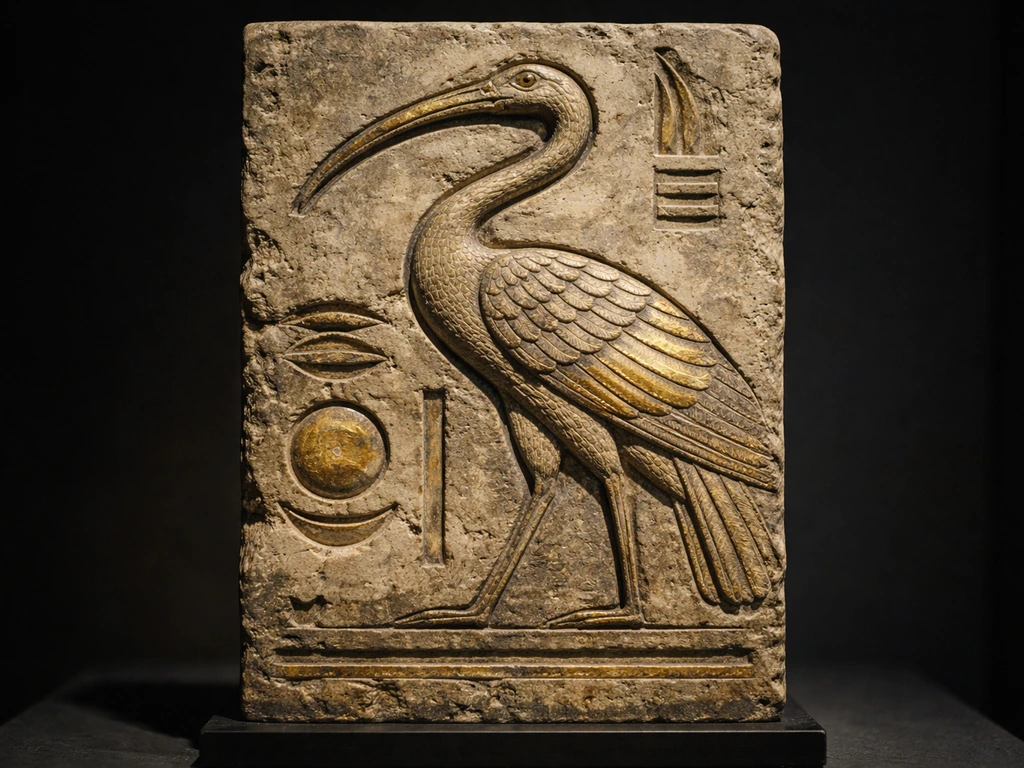
The ibis was not just a lucky mascot. It was the physical manifestation of Thoth, one of the most important gods in the Egyptian pantheon. Thoth governed wisdom, writing, mathematics, the moon, and the regulation of time itself. In the famous judgment scenes depicted in Books of the Dead, including the papyrus of Ani now held by the British Museum, Thoth appears as an ibis-headed figure standing beside the scales where a soul's heart is weighed against the feather of Maat (truth and cosmic order). His job in that moment is to record the verdict. He is the scribe of the gods, the one who ensures the entire system of divine justice functions correctly.
The Metropolitan Museum of Art describes an inlay piece showing Thoth as an ibis walking atop a standard, his curved beak resting against a Maat feather, visually linking the bird to justice itself. The Bibliotheca Alexandrina's antiquities holdings reinforce this: in Book of the Dead vignettes, Thoth in ibis-headed form consistently appears as the recorder of the heart-weighing outcome. At Dendera, a translated inscription from the reign of Ptolemy I documents a chapel dedicated to Thoth-ibis, with actual living ibises kept inside the temple enclosure. This was not purely metaphorical religion. The birds lived in the sacred space.
The practical ibis behavior probably reinforced the divine association. Ibises wade through Nile shallows with deliberate, measured movements, eating frogs, fish, and invertebrates. They arrive in numbers around flood season, the very moment when life returns to Egypt's fields. To ancient Egyptians watching the Nile floods bring fertility each year, these birds were heralds of renewal and order restored.
Symbolic meanings tied to wading birds in Egyptian culture
The ibis carried a layered set of meanings that overlapped in ways that felt mutually reinforcing to Egyptian religious thought. Here are the core symbolic themes:
- Wisdom and knowledge: As Thoth's embodiment, the ibis represented the accumulated wisdom of the gods, including literacy, mathematics, and the recording of history.
- Cosmic order (Maat): The ibis's role beside the scales of judgment linked it directly to Maat, the principle of truth, balance, and universal harmony.
- Writing and scribes: Thoth was the patron of scribes. Egyptians who worked with language and record-keeping placed the ibis-headed god at the center of their professional and spiritual identity.
- Rebirth and renewal: The ibis's appearance at Nile flood season tied it to the annual return of fertility and life, echoing broader Egyptian themes of cyclical death and renewal.
- The moon: Thoth governed the moon, and the ibis's curved beak was often likened to a crescent moon, making the bird a walking lunar symbol.
- Divine mediation: In the judgment hall, Thoth/ibis stands between the human soul and divine decision, representing the power to intercede, witness, and record truthfully.
It is also worth noting that the ibis existed in relationship to other Egyptian bird symbols. The falcon, associated with Horus, represented royal power and the sky. The Bennu heron was linked to solar creation. The ibis occupied a different register: it was the bird of the mind, of truth, of recorded order. These distinctions matter if you are exploring related Egyptian bird symbolism, including the meanings behind Egyptian bird hieroglyphs or the specific symbolism of the Horus bird. If you are looking for the Egyptian bird hieroglyph meaning of an ibis, the symbolism is closely tied to Thoth, wisdom, and recorded order meanings behind Egyptian bird hieroglyphs.
How to confirm the identification (quick evidence cues)
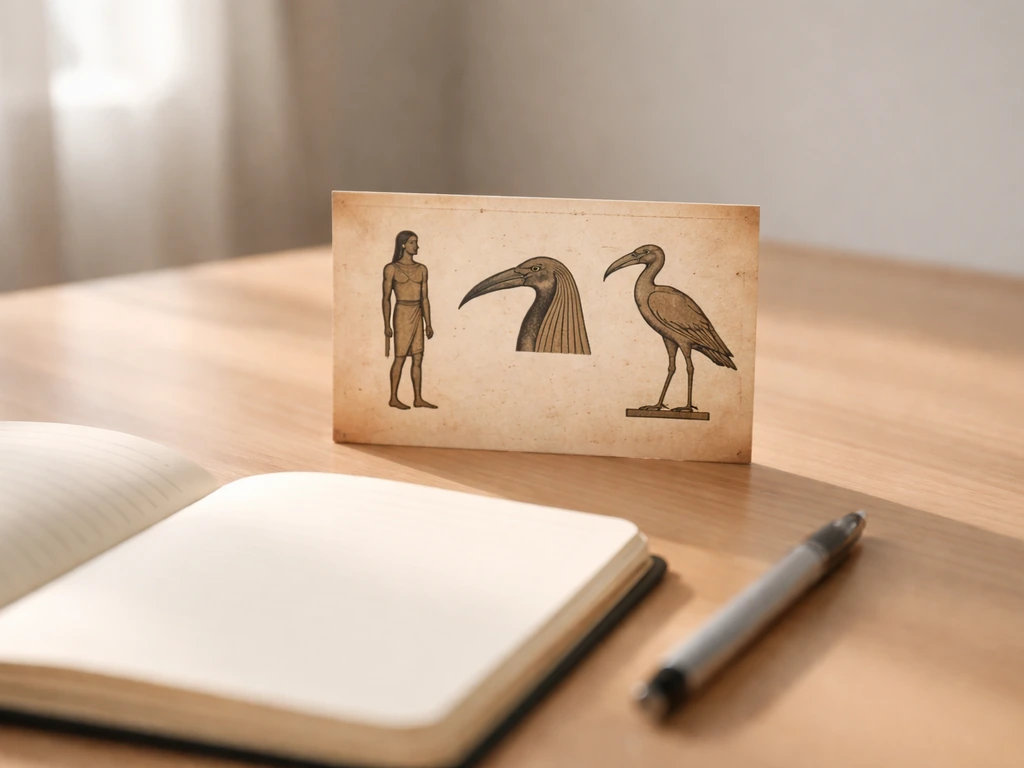
If you want to verify that a reference to an Egyptian sacred wading bird is the ibis and not another species, look for these markers:
| Evidence type | What to look for | What it confirms |
|---|---|---|
| Art and iconography | A deity with a human body and the head of a long-billed, curved-beak bird | Ibis as Thoth; most common in judgment and scribal scenes |
| Archaeological finds | Animal mummies at sites like Saqqara and Hermopolis (Thoth's cult city) | Sacred ibis mummies are the most abundant Egyptian animal mummy type |
| Hieroglyphic texts | The ibis glyph (Gardiner sign G25) used to write Thoth's name | Direct linguistic link between the bird and the deity |
| Temple inscriptions | References to a chapel or enclosure of Thoth-ibis with living birds inside | Actual ritual use of live ibises in temple precincts |
| Book of the Dead vignettes | Ibis-headed figure beside scales holding a scribal palette | Confirms Thoth's role as recorder in the divine judgment scene |
If the source you are reading mentions a heron instead, it is likely referencing the Bennu bird and solar mythology. If it mentions a falcon, it is in Horus territory. The ibis is almost exclusively the one identified explicitly as a wading bird tied to wisdom, writing, and divine judgment.
Modern spiritual interpretation and practical takeaways
Translating ancient Egyptian symbolism into a modern spiritual framework is genuinely useful, as long as you treat it as a lens rather than a prescription. The ibis carried meaning in Egypt because its behavior, appearance, and ecology fit the values Egyptians were trying to articulate. When you see an ibis today or encounter ibis imagery, here is how that symbolic vocabulary can speak to you. If you are wondering about a hamsa bird meaning, it helps to look at how different cultures assign symbolism to related feathered creatures. An african mask with bird on head meaning can draw on similar symbolism, linking the bird image to ideas of wisdom, order, and guidance.
Wading itself is the key behavior. The ibis does not rush. It steps through shallow water deliberately, probing with its curved bill, patient and precise. In a spiritual reading, this is the posture of discernment: moving carefully through uncertain terrain, not grasping, waiting for what is true to reveal itself. If you are in a period of decision-making or trying to sort through complicated information, the ibis as symbol encourages slow, methodical attention rather than impulsive action.
The ibis's connection to Maat, the feather of truth, is particularly relevant for anyone wrestling with honesty, whether in relationships, creative work, or self-examination. Ancient Egyptians believed the heart was weighed against that feather in judgment. The ibis witnessed every weighing. Encountering this bird, or working with its imagery in meditation or journaling, can be a prompt to ask: what am I carrying that needs honest examination? Am I recording my own story truthfully?
The lunar and cyclical dimension offers another angle. Thoth governed the moon and the calendar, making the ibis a symbol of time, rhythm, and patience with natural cycles. If you find yourself resisting timing that is out of your control, ibis symbolism gently redirects toward trust in the larger rhythm. The floods always came. The ibises always returned. Order reasserts itself.
Practically, if you want to work with ibis symbolism deliberately, a few approaches fit this tradition well. Keep a journal, since Thoth's gift was the written word, and writing is a direct way to honor the ibis's energy. Pay attention to situations requiring fairness or clear judgment and use the ibis as a mental anchor for staying measured rather than reactive. And if you encounter a wading bird in the wild, whether a heron, egret, or ibis, pause with it for a moment. That patient, deliberate stillness in the water is the oldest version of the message: move with care, observe what is true, and record it faithfully.
FAQ
If I see the words “sacred Egyptian wading bird” in a book, how can I be sure it means the ibis and not another bird?
Use “ibis-headed Thoth,” “Thoth’s sacred bird,” or “sacred ibis mummies” as your fastest confirmation signals. If the source never connects the bird to Thoth, writing, judgment, or heart weighing imagery, it is likely referring to a different sacred bird tradition or a modern reinterpretation.
What’s the difference between a “sacred heron” reference and the sacred ibis wading bird?
Herons in Egyptian religion often point to Bennu, a myth-linked bird associated with solar themes and rebirth, not to Thoth’s recording role. A Bennu reference will usually emphasize creation, the sun, or renewal rather than writing, measurement, or justice scenes.
How should I interpret modern phrases like “Horus bird” when I’m trying to identify the ancient wading bird sacred in Egypt?
“Horus bird” references should be treated as falcon territory unless the text specifically says ibis or Thoth. In practice, falcon imagery is tied to kingship and the sky, so if the bird is framed as royal power or Horus protection, it probably is not your wading ibis.
Were sacred ibises revered only symbolically, or were they preserved physically as offerings?
Yes, but Egyptology treats them differently. Sacred ibis mummies were commonly mass-produced as offerings, which means the animal identification matters, not just the idea. If a claim sounds purely metaphorical, check whether the source mentions embalming, mummy caches, or dedicated burial sites.
What visual details help me distinguish an ibis from other wading birds when reading Egyptian art descriptions?
If the bird is described with a curved bill and long legs, that supports ibis identification. Still, avoid over-relying on color alone, since ancient art can stylize birds for religious reasons. Prioritize consistent role markers (Thoth, writing, judgment, Maat link) over appearance details.
How can I apply ibis symbolism in a modern spiritual practice without turning it into superstition?
When translating symbolic “encounters” into journaling or meditation, keep it actionable but not deterministic. A helpful practice is to write one specific question tied to fairness or truth (for example, “What am I misrecording about this situation?”) instead of trying to predict events through the symbol.
What’s a common misstep people make when using ibis symbolism for “order” or “wisdom”?
A common mistake is mixing “order” themes broadly with Thoth’s specific domain of recording and lawful judgment. To stay aligned with the ibis tradition, focus on what should be documented accurately (facts, promises, decisions) and what should be weighed fairly (your side vs. the evidence).
If the ibis symbol is about careful wading, what’s a practical step-by-step way to use that during a tough decision?
In a decision-making context, use the ibis method as a routine: slow down, gather observations, then write a short “verdict” before acting. This mirrors the recorder role of Thoth and turns the wading posture (patient probing) into a concrete workflow.
Next Article
Hamsa Bird Meaning: What It Likely Refers To and How to Use It
Hamsa bird meaning clarified: protective Hand of Hamsa vs bird symbolism, how to identify the artwork and use it mindful