
The crane is the bird most consistently associated with Hermes in ancient Greek tradition, followed closely by the rooster. The crane's migratory instincts, its role as a messenger across vast distances, and its connection to the invention of the alphabet all tie it directly to Hermes' core domains: communication, travel, and transition between worlds. The rooster, as the herald of dawn, links to Hermes' role as a divine messenger who announces change. If you've come across the phrase 'sacred bird of Hermes' and want the clearest answer rooted in classical sources, start with the crane.
What Is Hermes Sacred Bird? Meaning, Myths, and Symbols

Eleanor Hartwell
3 May 2026
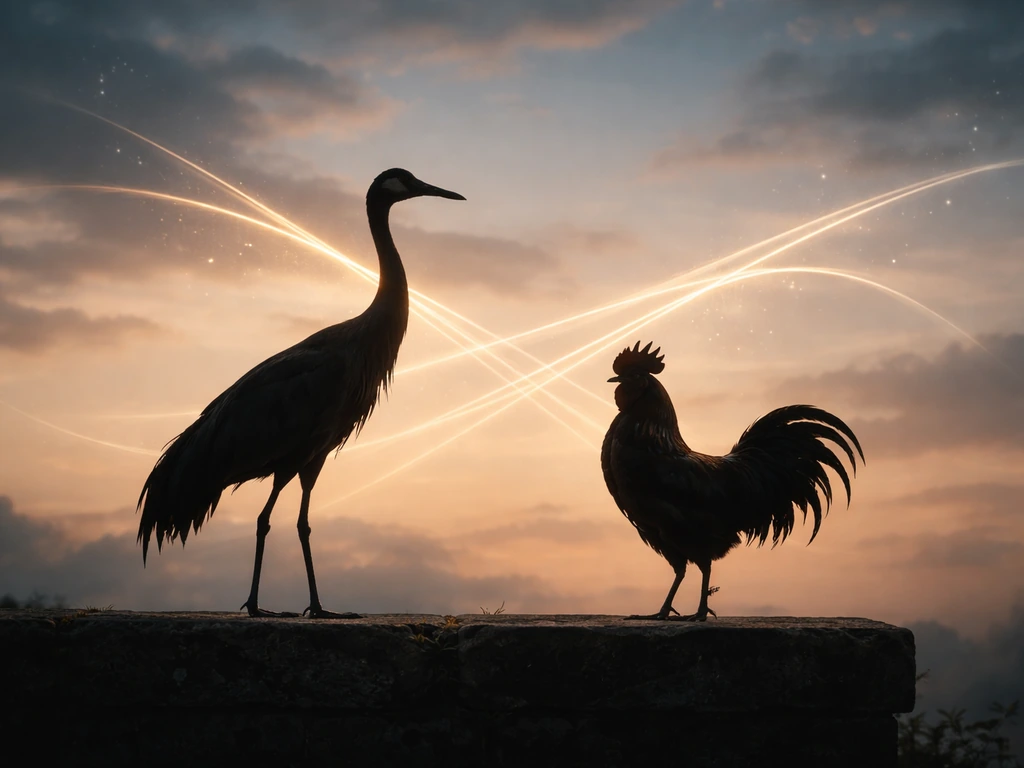
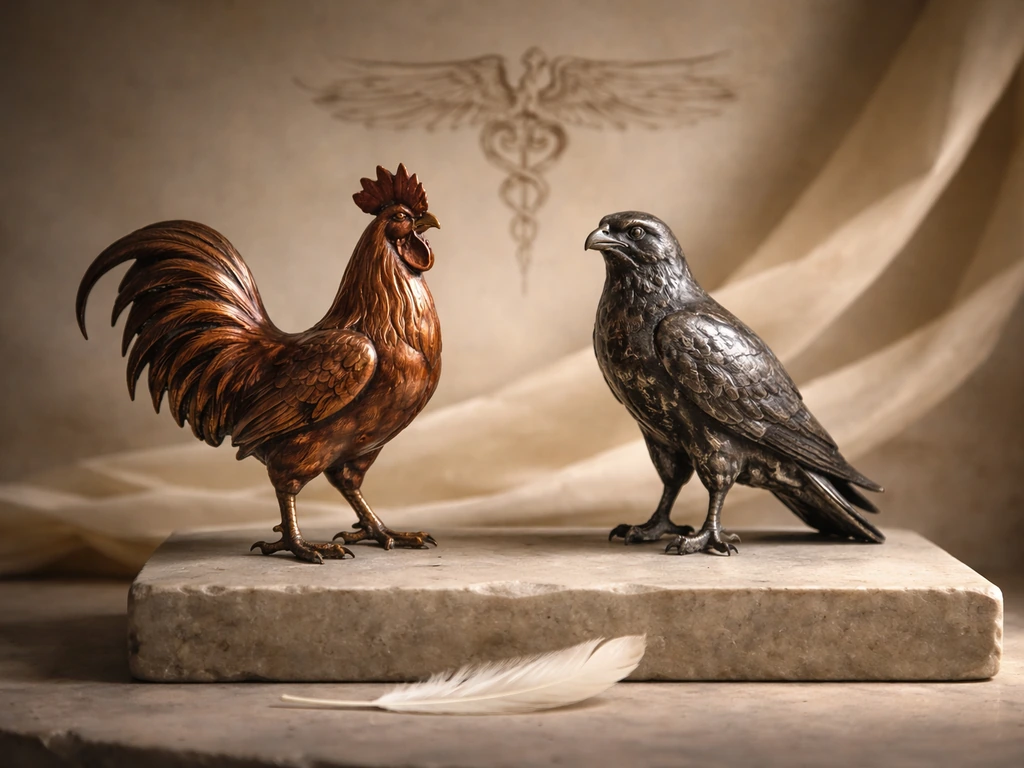
Hermes' sacred birds: crane and rooster
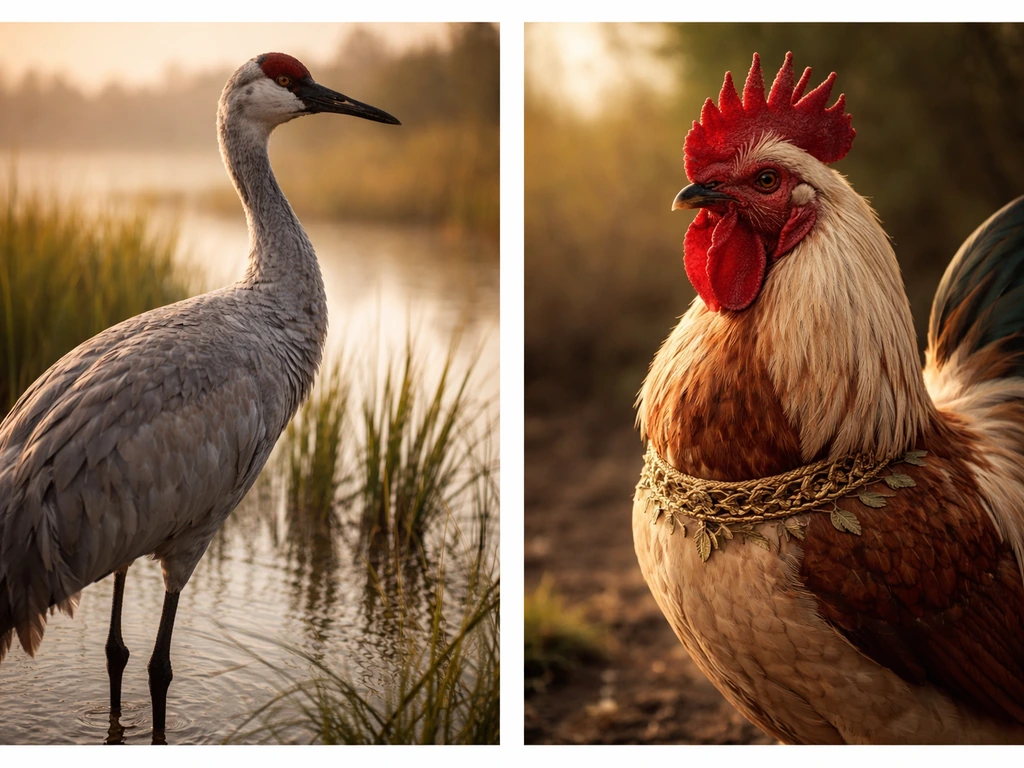
Ancient Greek sources place the crane in an especially privileged position near Hermes. The Greek myth that Hermes invented the alphabet was linked by some ancient writers (including Hyginus) to the observation of cranes in flight, whose V-shaped formations were said to have inspired the shapes of letters. That is a striking connection: the god of language and messages deriving his greatest gift from a bird. The crane was also associated with Hermes in his psychopomp role, guiding souls between the living and the dead, because cranes migrate seasonally across horizons no human can follow.
The rooster holds a different but complementary claim. By the classical period the rooster was firmly established as sacred to Hermes, and it appears in this role in Plato's Phaedo, where Socrates' last words famously ask that a rooster be sacrificed to Asclepius. The rooster's crow heralds transitions: day from night, waking from sleep, one world from another. For Hermes, who moves between realms as easily as the rooster moves between darkness and light, that symbolism is exact. Some ancient iconography shows Hermes holding or accompanied by a rooster for precisely this reason.
It is worth noting that Hermes' most famous animal companions in primary texts are actually the tortoise and the ram. The Homeric Hymn to Hermes describes the infant god finding a tortoise at the threshold of his cave, killing it, and fashioning its shell into the first lyre. That origin story places Hermes and the tortoise at the literal threshold of invention. But while the tortoise is central to Hermes mythology, it is not a bird, which is why the crane and rooster remain the answers most relevant to a question specifically about his sacred bird.
Greek Hermes vs. Roman Mercury: does it change the bird?
Hermes and Mercury are usually treated as the same deity mapped onto different cultures, and for practical symbolic purposes that is largely true. Mercury absorbed Hermes' attributes wholesale when the Romans adopted Greek mythology, including his role as messenger of the gods, conductor of souls, patron of commerce, and protector of travelers. The winged sandals (talaria), the caduceus staff, and the general imagery transferred almost unchanged.
Where the distinction matters is in emphasis. Roman Mercury became even more explicitly associated with commerce and trade guilds, which shifted some of his symbolic gravity away from the more cosmic, liminal qualities of Hermes. The crane's connection to the alphabet and soul-guiding feels more at home in the Greek Hermes tradition, while the rooster's mercantile and transitional symbolism fits comfortably in both. If you are working with art, tarot, alchemy, or Renaissance symbolism, you are almost certainly dealing with the Mercury figure, and the rooster appears frequently in those contexts.
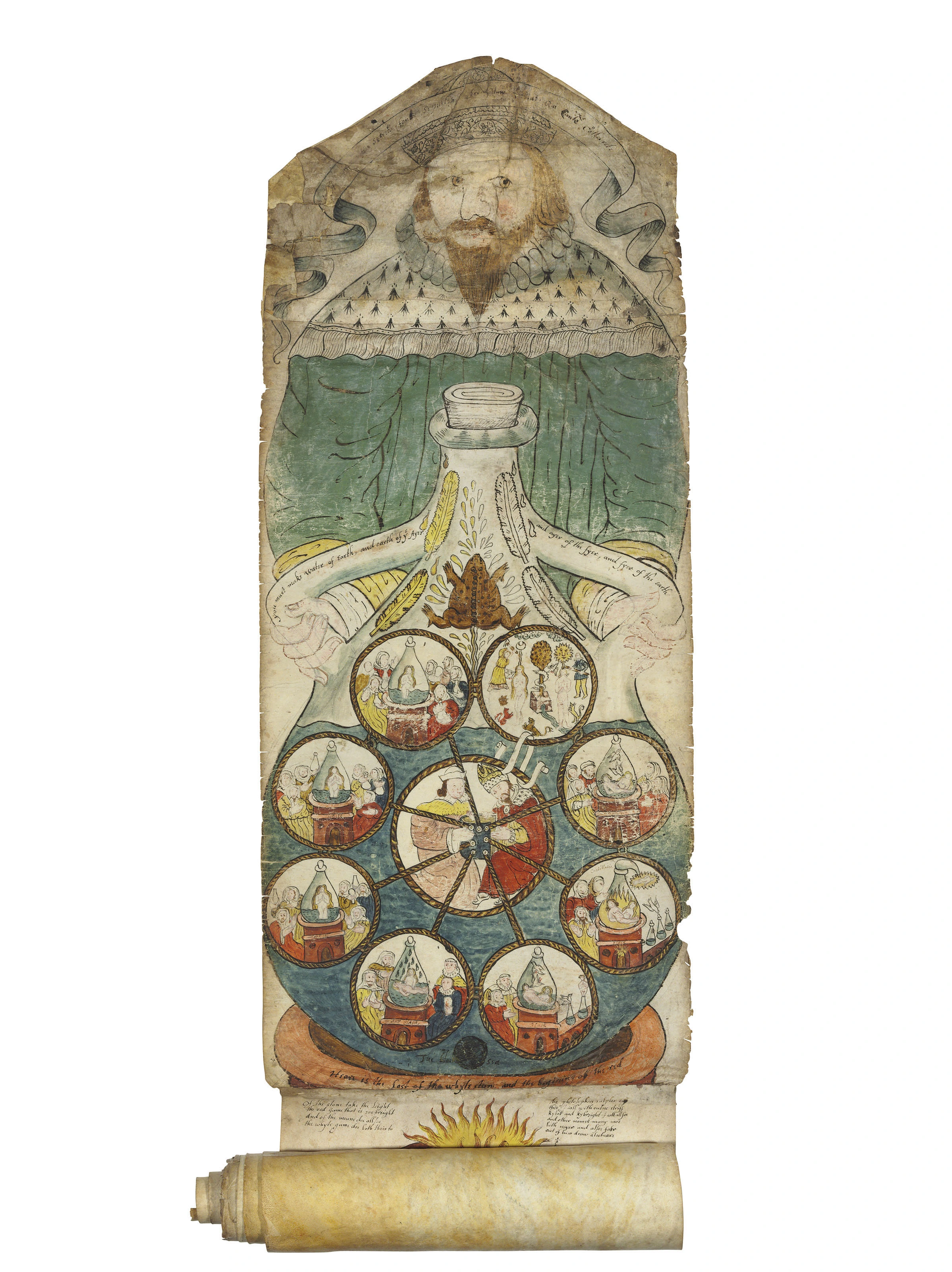
One famous alchemical text, the Ripley Scroll, contains the line 'The Bird of Hermes is my name, eating my wings to make me tame. This phrase is used most famously in Hermetic alchemy, where the imagery points to transformation rather than the classical sacred birds Bird of Hermes. ' This places a specific bird (often interpreted as an ouroboros-like self-consuming bird, linked to mercury the element) at the heart of Hermetic alchemical symbolism. That is a different tradition from classical Greek mythology, and conflating the two is one of the most common points of confusion when people research Hermes and birds.
Why these birds fit Hermes' domains so precisely

Hermes governs an unusually wide set of domains for a single deity: messages and communication, merchants and commerce, travelers and roads, thieves and cunning, transitions between life and death, dreams, and the boundaries between worlds. What is striking is how cleanly the crane and rooster map onto these different aspects.
| Hermes' Domain | Crane Connection | Rooster Connection |
|---|---|---|
| Messages and communication | Credited with inspiring the alphabet through flight patterns | Vocal herald whose call announces and summons |
| Travel and navigation | Migrates thousands of miles across continents | Marks the transition of time, orienting travelers |
| Thresholds and transitions | Moves between seasons and hemispheres | Moves between night and day, darkness and light |
| Soul-guiding (psychopomp) | Appears and disappears beyond the horizon | Announces dawn, the crossing from sleep to waking |
| Commerce and markets | Associated with writing, contracts, and records | Sacred offering in commerce and ritual exchange |
The crane's actual behavior reinforces its symbolic role. It is a bird famous for its intelligence, its elaborate dances, its long migrations, and its haunting, far-carrying call. Ancient Greeks watching cranes fly overhead in formation could not have missed the sense of purpose in their movement: these were birds that knew where they were going, even across the edge of the known world. In Aristotle’s History of Animals, cranes are included among the animals discussed in ways that reflect how groups behave, offering an early observational baseline for their behavior and movement in formation blank" rel="noopener noreferrer">Ancient Greeks watching cranes fly overhead in formation. That quality of purposeful, cross-boundary movement is exactly what Hermes does.
How the bird appears in art and myth
In Greek vase painting and sculpture, Hermes is most often depicted with his caduceus, winged sandals, and petasos hat, and when birds appear near him they are usually roosters. The rooster was a common sacrificial and symbolic animal in Greek religious art broadly, but its specific association with Hermes (and later Mercury) made it a visual shorthand for the god's presence.
In alchemical manuscripts from the medieval and Renaissance period, the 'Bird of Hermes' or 'Bird of Mercury' becomes a much more complex figure, often depicted as a bird consuming itself, or as a bird with features that blend species. These images are not about the classical Greek sacred bird; they are about mercury as a chemical element and the alchemical process of transformation. The imagery is powerful, but it belongs to a separate symbolic tradition from the crane or rooster of classical mythology.
The crane appears in art connected to Hermes most clearly through the mythological link to the alphabet, appearing in scenes depicting the god as inventor and culture-bringer. In some Greek traditions Hermes is also connected to the stork, another migratory bird with strong associations with messages and arrivals, which is probably why so many 'messenger bird' associations tend to cluster around the Hermes figure across traditions.
What it means to see these birds today

This is where mythology and lived experience meet, and I think it is worth being honest about how this works. Seeing a crane or a rooster is not a guaranteed message from Hermes. What symbolic frameworks give you is a lens, not a verdict. But if you are already in a period of transition, trying to make a decision, waiting to hear news, or navigating a threshold moment in your life, encountering one of these birds can serve as a useful prompt for reflection. In heraldry, a bird’s meaning can shift based on its species, posture, and color.
Cranes in the wild are not everyday sightings for most people, which is part of what makes them feel significant when they do appear. If you see a crane during a journey, at a crossroads, near water (cranes favor wetlands, marshes, and river edges), or during a time of major life change, the Hermetic symbolism is worth sitting with. The crane in this context is asking: what message are you carrying, and where are you taking it?
Roosters are more urban and suburban, which means the symbolism tends to surface through their distinctive call rather than a rare sighting. Hearing a rooster at an unexpected moment, especially at dawn or during a period of waiting, connects to Hermes' function as the announcer of transitions. Something is about to begin. Pay attention to what follows.
- Crane sighting during travel or a major decision: consider what message you need to send or receive
- Crane appearing near water or at dawn: a threshold is opening; Hermes-energy favors movement now
- Rooster call at an unexpected hour: take it as a signal to wake up to something you may be ignoring
- Rooster imagery in a dream: a transition is being announced; notice what is ending and what is beginning
- Recurring imagery of either bird in art, media, or daily life: your attention is being drawn toward Hermetic themes of communication, change, or soul-guidance
Common confusion worth clearing up
The biggest source of confusion around 'Hermes' sacred bird' is the alchemical tradition bleeding into classical mythology. When people search for the 'Bird of Hermes,' they often land on the Ripley Scroll reference, which describes a self-consuming bird as part of an alchemical metaphor. That bird is not the crane or the rooster of Greek mythology. It represents mercury (the element) in the process of purification, and its symbolism is about transformation through dissolution, not about messages or travel.
A second common mix-up involves Hera's peacock. In Greek mythology, Hera placed the hundred eyes of the giant Argus onto the peacock after Hermes killed Argus on Zeus's orders. In the myth, that hundred-eyed peacock becomes Hera’s symbol rather than Hermes’s sacred bird Hera placed the hundred eyes of the giant Argus. That story involves Hermes directly, but the peacock became sacred to Hera, not Hermes. The peacock's eyes are Hera's symbol. Hermes is the agent of action in that myth, not the bird's patron.
A third confusion comes from the eagle, which is Zeus's sacred bird and sometimes appears alongside Hermes (as his father's messenger). The eagle and the crane can look superficially similar in silhouette, and some early readers of Greek texts conflate them. The eagle belongs to Zeus; the crane belongs to the broader Hermetic complex of communication and liminality.
| Bird | Associated Deity | Common Confusion |
|---|---|---|
| Crane | Hermes (primary classical association) | Sometimes confused with stork or eagle |
| Rooster | Hermes / Mercury (classical and Roman) | Often listed under Asclepius due to Phaedo reference |
| Peacock | Hera (not Hermes) | Hermes kills Argus in the myth, but peacock goes to Hera |
| Eagle | Zeus | Appears near Hermes as Zeus's messenger, not Hermes' own bird |
| Alchemical 'Bird of Hermes' | Mercury (the element, not the deity) | Frequently conflated with the classical sacred bird tradition |
How to verify which bird is right for your context
The best way to anchor your research is to ask what tradition or purpose you are working within. If you are studying classical Greek mythology or preparing ritual work connected to Hermes the god, the crane and rooster are your primary birds, with the crane holding the strongest textual connection to his role as inventor and psychopomp. If you are working with alchemical symbolism, Hermetic philosophy, or the Renaissance magical tradition, the 'Bird of Hermes' from the Ripley Scroll tradition is the relevant reference. If you are working with Roman mythology, art history, or tarot (Mercury rules Gemini and Virgo in traditional astrology), the rooster and the caduceus-carrying Mercury figure are most relevant.
Practical next steps: journaling prompts and how to use the meaning
If you want to move from researching Hermes' sacred bird to actually working with that symbolism, the most useful thing you can do is bring it into a reflective practice. Hermes is a god of questions as much as answers: he is the one who guides, not the one who decides. That makes his bird symbolism particularly well-suited to journaling and threshold-work.
- Write about what message you are trying to send or receive right now. Is it going to the right destination? Is someone waiting for a communication from you that you have delayed?
- Think about a threshold you are standing at: a career change, a relationship shift, a move, a loss. Where do you feel the pull to cross over, and what is keeping you on this side?
- If you recently saw a crane or heard a rooster, note the exact context: where you were, what you were thinking, what question was active in your life at that moment. Does Hermes' domain of messages, travel, or transition resonate with any of it?
- Draw or find an image of the crane or the rooster. Sit with it for a few minutes and notice what qualities draw your attention: the call, the movement, the crossing of boundaries. Write about which of those feels most alive for you right now.
- Ask yourself: what needs to be announced in your life? What transition have you been refusing to name out loud? The rooster doesn't wait for you to be ready. It calls anyway.
Symbolic systems are most powerful when they become part of how you pay attention, not just what you believe. Whether you see Hermes as a literal deity, an archetypal pattern, or simply a useful mythological lens, the crane and the rooster are invitations to notice the messages already moving through your life, the thresholds already open in front of you, and the transitions you are being asked to cross.
FAQ
If I see a crane or hear a rooster, which one should I interpret as “Hermes’ bird”?
Use context. Crane sightings usually map to Hermes’ liminal, cross-boundary symbolism (transits, soul-guiding, message carrying over distance), especially if you are near wetlands or during travel. Roosters map more to immediate transitions (dawn, waking, starting a new phase), especially if the timing is dawn or you are in a waiting period. If the situation is indoors or unrelated to “threshold” moments, treat it as a prompt rather than a direct sign.
Are Hermes’ sacred birds ever swapped, for example crane instead of rooster in art or modern practice?
Yes, but it usually reflects mixed traditions. In classical Greek-linked symbolism, the crane is commonly emphasized for Hermes’ alphabet and liminal psychopomp connections, while the rooster appears as a later, more established sacred companion tied to transition imagery. In modern decks, blogs, or ritual systems, the labels may be reassigned for convenience, so it helps to decide first whether you are working from Greek mythology, Roman Mercury, or Hermetic alchemy.
What’s the quickest way to tell whether I’m dealing with classical Hermes symbolism or the Hermetic “Bird of Hermes” from alchemy?
Look for the transformation motif. Classical sacred birds in Hermes contexts generally emphasize communication, travel, and transitions, while the alchemical “Bird of Hermes” is described with self-consuming or hybrid features tied to mercury-as-a-process. If the text or image talks about eating wings, purification, dissolution, or making something tame, you are in the alchemical tradition, not the crane-or-rooster tradition.
Do roosters have any special connection to healing or sacrifice in Hermes-related contexts?
Indirectly, yes. The rooster shows up in the late-life request for a sacrifice to Asclepius, which ties the rooster to a healing-oriented frame even though the mention appears in a discussion connected to Socrates’ final moments. For symbolism work, that means a rooster interpretation can lean toward “what needs to be tended or offered” during change, not just “news is coming.”
Is the “sacred bird of Hermes” the same as “Mercury’s bird,” and does that change which bird to choose?
They overlap, but the emphasis can shift. Roman Mercury largely inherits Hermes’ roles, yet Mercury symbolism often foregrounds commerce and practical transition. If you are doing something commerce or business oriented, the rooster and caduceus-associated Mercury imagery tends to fit more naturally. If you are focused on thresholds, messages, or psychopomp-type liminality, the crane is more likely to match that Greek-emphasis tradition.
I’ve heard cranes are linked to Hermes inventing the alphabet. Is that a reliable claim to use in research or ritual framing?
It is attested in some ancient interpretations, but it is not the only way to connect Hermes to language. Treat the alphabet link as one supporting thread rather than the sole proof. In practice, you can anchor Hermes symbolism in “communication and boundaries,” and use the alphabet story as an optional enrichment, especially if your ritual focus is language, writing, or learning.
Can people confuse Hermes’ sacred bird with Hera’s peacock or Zeus’ eagle. How do I avoid that?
Start with ownership. Hera’s peacock symbolism belongs to Hera (even when Hermes is the agent within the story), so it is not a Hermes sacred bird. Zeus’ eagle is his own, sometimes appearing near Hermes due to messenger relationships, but the eagle’s primary patron is Zeus. If the source names the bird as the deity’s symbol, that usually settles the attribution quickly.
What if I want to do “Hermes bird” work, but I cannot reliably see cranes or roosters?
You can still use the symbolism without relying on real sightings. Create a repeatable cue in your environment, such as a journal prompt tied to “what message am I carrying” (crane) or “what threshold is opening” (rooster). For timing, use dawn or travel days as your ritual trigger, since those map cleanly to rooster and travel symbolism even when the birds themselves are absent.
Do heraldic or color details change the meaning, and is that worth tracking?
Yes. The meaning can shift by species, posture, and color in symbolic frameworks like heraldry, which means two depictions of the same bird might not invite the same reflection. If you are using imagery, note what you actually see (stance, setting, color) and decide what aspect you are focusing on, such as messages, arrival, or boundary crossing.
If Hermes is a god of questions, how should I interpret these bird omens without turning them into certainty?
Use them as reflective prompts. After a bird encounter, write two questions instead of making a prediction: “What am I trying to communicate, and to whom?” and “What transition am I avoiding or about to enter?” This keeps the work aligned with Hermes as the guide to inquiry, not a guarantee that a specific event will occur.
Next Articles
The Bird of Hermes Is My Name Ripley Scroll Explained
Decode bird of Hermes and Ripley scroll link: meaning, origin, likely bird imagery, and a clear journaling verification
Bird of Hermes Meaning: Symbolism, Messages, and How to Apply
Meaning of bird of Hermes: symbolism of Hermes messenger energy, guidance, messages, and how to apply it mindfully.
What Is the Bird of Hermes? Name and Symbolic Meaning
Identify the Hermes bird and its name, plus symbolism for messages, travel, guidance, and how to apply it.