
When Samuel Taylor Coleridge writes about a 'bird of good omen' in The Rime of the Ancient Mariner, he is talking about the albatross. The poem's marginal gloss makes it explicit: 'The Albatross proveth a bird of good omen, and followeth the ship as it returned northward.' Later, that same bird is described as 'the pious bird of good omen' just before the Mariner kills it, triggering a cascade of guilt, judgment, and penance. So if you searched this phrase expecting a Coleridge quote, that is the source, and the albatross is the bird.
Bird of Good Omen: Coleridge Meaning and Spiritual Sign

Eleanor Hartwell
2 Jun 2026
What 'Bird of Good Omen' Actually Means Across Cultures

An omen is a sign thought to predict future events, and birds have been central to that idea in almost every culture on earth. The word 'auspicious' actually comes from the Latin auspicium, meaning divination by observing the flight of birds. An auspex was literally a 'bird-seer,' a person trained to read what bird behavior told about the future. So when Coleridge's sailors call the albatross a 'bird of good omen,' they are using language that has roots going back to ancient Roman augury. The idea is old and it runs deep.
That practice of reading bird signs has a formal name: ornithomancy. Ornithomancy is the practice of reading omens from bird actions in ancient cultures, including a conceptual link to Greek taking omens from the flight and cries of birds. In ancient Greece, both the flight patterns and cries of birds were interpreted as messages about what was to come. Babylonian culture took it further, assembling structured 'bird omen collections,' essentially catalogued systems for what specific bird behaviors meant in specific contexts. So the concept behind Coleridge's phrasing was not invented by the Romantic poets. He was drawing on one of the most persistent symbolic frameworks in human history.
A 'bird of good omen' sits at one end of a spectrum. The opposite, 'bird of ill omen,' describes a bird whose appearance signals trouble ahead. What counts as good or ill varies dramatically by tradition, species, and context, and that variation is worth keeping in mind before you assign fixed meaning to any bird you encounter.
Coleridge and the Albatross: What the Poem Actually Says
The Rime of the Ancient Mariner, first published in 1798, is where Coleridge's 'bird of good omen' imagery lives. In Part I of the poem, the ship is driven toward the South Pole by a storm. The albatross appears and the sailors welcome it, feeding it and treating it as a companion. The marginal gloss Coleridge added (in the 1817 Sibylline Leaves edition) annotates the moment clearly: the albatross 'proveth a bird of good omen.' The wind shifts, the ice splits, and the ship moves again. The sailors credit the bird.
The next major appearance of the phrase comes in one of the poem's most devastating lines: 'The ancient Mariner inhospitably killeth the pious bird of good omen.' Notice Coleridge's word choice. The albatross is 'pious,' meaning devout, innocent, even sacred. Killing it is not just bad luck, it is a moral and spiritual violation. The consequences in the poem, the dead wind, the dying crew, the spectral ship, the Mariner's isolation, all flow from that act. Coleridge frames the 'bird of good omen' not as a lucky charm but as something deserving reverence. The poem is ultimately about what happens when you destroy what you should protect.
One important clarification: 'The Pious Bird of Good Omen' is also the title of a 1969 Fleetwood Mac compilation album. If you encounter that phrase in a music context, it is a reference to Coleridge's poem (or at least borrowing his language), but it is not Coleridge's own text. The original source is always the poem.
Bird Omens Across Religious and Cultural Traditions
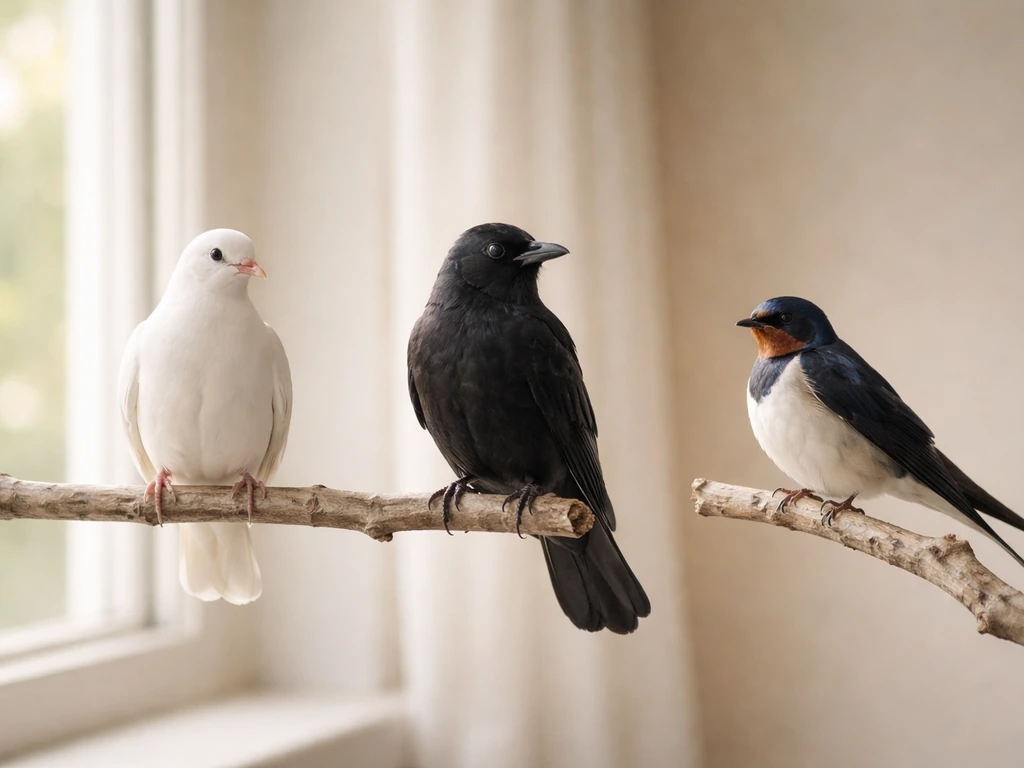
The meaning of a bird omen is almost never fixed across cultures. The same species can be protective in one tradition and foreboding in another. If you want the broader bird-of-good-omen meaning, this cultural perspective helps explain why different traditions read the same species differently bird of good omen meaning. Understanding that range helps you interpret what you see with more nuance rather than defaulting to a single association.
| Tradition | Bird / Symbol | Associated Meaning |
|---|---|---|
| Biblical (Christian) | Dove (Matthew 3:16) | Holy Spirit, peace, divine presence |
| Biblical (general) | Birds (Luke 12:24) | Divine care and provision, trust over anxiety |
| Celtic / Norse | Raven / Crow | Prophecy, foreboding, omens of death, but also wisdom |
| Native American (varied) | Crow | Meanings vary widely by nation; not universally a death omen |
| Babylonian / Ancient Near East | Multiple species | Structured omen systems; specific behaviors catalogued for interpretation |
| Greek / Roman | Various (augury) | Flight patterns and cries read as divine messages; auspex as bird-seer |
| Coleridge / Romantic literary | Albatross | Sacred companion, protective sign, moral responsibility |
The Celtic and Norse traditions show how complex this gets. Ravens in those traditions are often tied to prophecy and to battlefield omens, sometimes read as foreboding, sometimes as wisdom. Western folklore can treat ravens as birds of ill omen, yet other cultural contexts treat them as favorable or even sacred. The label 'good omen' or 'bad omen' is always tradition-relative. This is exactly the kind of variation Coleridge was tapping into when he placed the albatross in the role of a revered, protective sign at sea.
The biblical tradition adds a useful counterweight. Deuteronomy 18 explicitly warns against treating signs and omens as predictive divination tools. Jesus, in Luke 12:24, points to birds as reminders of divine care rather than coded messages to decode. The Christian symbolic use of birds (especially the dove in Matthew 3:16) tends toward meaning and presence rather than prediction. That distinction matters practically: there is a difference between seeing a bird as a spiritual prompt toward reflection and treating it as a guarantee of future events.
Symbolic Traits That Mark a 'Good Omen' Bird
Across traditions, certain qualities in bird behavior tend to elevate a bird into 'good omen' territory. These are not arbitrary. They connect to the same sensory details you would notice in a real encounter.
- Flight: Birds that appear at moments of transition, lifting upward or arriving after a period of stillness, are often read as signs of new direction or positive movement. Coleridge's albatross arrives just as the ship is stuck in ice. The flight that follows its appearance signals freedom and forward momentum.
- Feathers: Finding a feather, particularly an intact or unusually colored one, is widely interpreted as a message or blessing in many traditions. The feather as a detached but still meaningful remnant of flight carries associations with lightness, elevation, and connection to something beyond the immediate.
- Song: Bird calls that seem to arrive at emotionally charged moments, at dawn, during grief, at a threshold, are often described as comforting or affirming. The quality of the song matters: clear, sustained calls are more commonly read as positive than harsh or repetitive alarms.
- Nesting: A bird choosing to nest near a home or return repeatedly to the same spot is traditionally read as a sign of stability, protection, and blessing on that place. Nesting imagery connects to ideas of shelter, family, and long-term well-being.
- Proximity and behavior: When a wild bird approaches closely without fear, or makes sustained eye contact, many people across cultures describe it as an encounter that feels significant rather than coincidental.
In Coleridge's poem, the albatross scores on several of these dimensions. It follows the ship (sustained presence), it arrives during crisis (threshold moment), and the sailors feed it from their hands (proximity). The poem uses all these sensory details deliberately to build the bird's status as something deserving protection. You can apply the same checklist when you are trying to evaluate whether a bird encounter feels symbolically significant.
How to Read a Bird Omen in Everyday Life
If you are noticing birds repeatedly, or had an encounter that felt like more than coincidence, the most useful thing you can do is slow down before you assign meaning. The psychological reality is that confirmation bias shapes what we notice. If you are looking for signs, you will find them. That does not make the experience meaningless, but it is worth holding any interpretation with some looseness.
A more grounded approach is to treat the bird encounter as a prompt rather than a prediction. Instead of asking 'what will happen,' ask 'what is this moment inviting me to notice or consider?' That reframe is consistent with how the biblical tradition uses bird imagery, and it sidesteps the divination problem flagged in Deuteronomy 18 while still allowing the encounter to carry meaning.
Pay attention to what was happening in your life when the bird appeared. What were you thinking about? What decision were you sitting with? What emotion was present? The Ignatian discernment tradition describes this as tracking consolation versus desolation: noticing whether your inner state moves toward peace, clarity, and constructive action, or toward anxiety, confusion, and paralysis. The Office of Ignatian Spirituality describes discernment as tracking consolation versus desolation in daily experience to guide choices, rather than chasing signs for certainty. A bird encounter that prompts calm reflection and a sense of renewed direction is functioning differently than one that sends you spiraling into superstitious worry.
Practical Next Steps After a Bird Encounter
Journal the Encounter While It Is Fresh
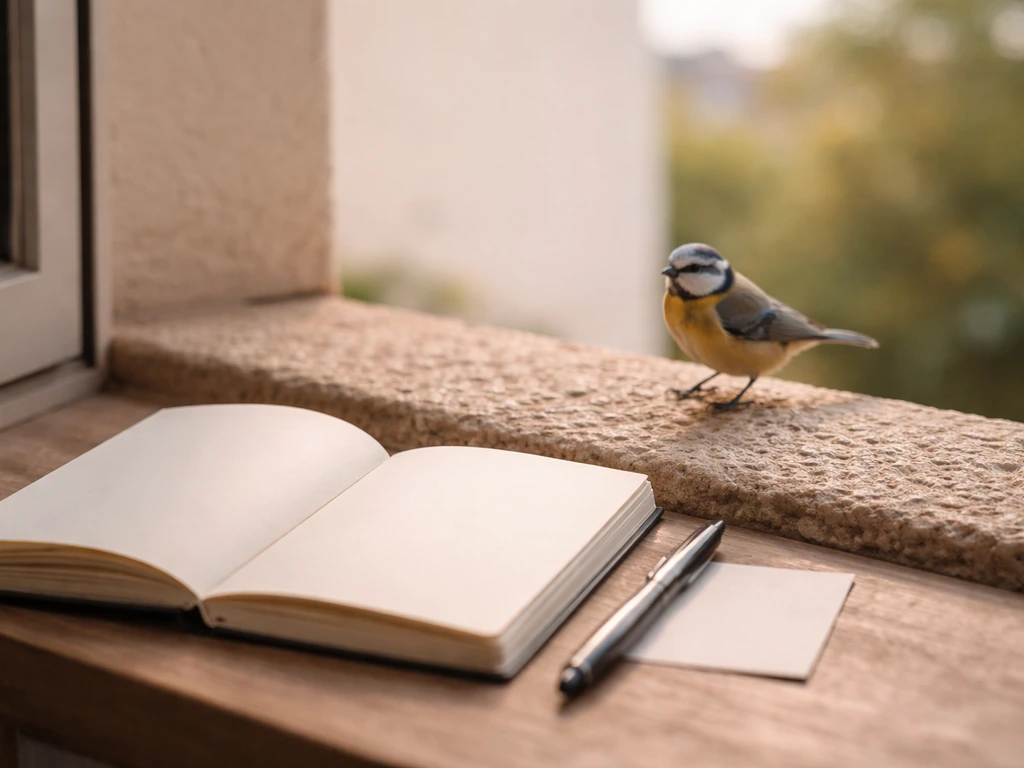
Write down the details as specifically as you can: the species if you know it, what it was doing, where it appeared, what time of day, and what you were thinking or feeling immediately before you noticed it. Then write separately about what the encounter made you feel. Do not try to interpret it yet. Capture the raw experience first. This matters because your interpretation will be more honest if it is not mixed in with the description from the start.
Ask a Few Reflective Questions
After you have recorded the encounter, sit with these prompts. They are drawn from discernment practice and work whether or not you come from a religious background.
- What decision or question am I currently sitting with, and did this encounter seem to relate to it in any way?
- Did the encounter leave me feeling more peaceful and clear, or more anxious and confused? (The direction of that inner movement matters more than the content of any 'message.')
- Is there a tradition or cultural framework (biblical, Celtic, Native American, literary) that resonates with my background and gives this bird a particular meaning? If so, what does that tradition say?
- If this were a 'good omen' in the Coleridge sense, what would it be encouraging me to protect, value, or move toward? What would it be warning me not to destroy or dismiss?
- Am I being invited toward action, rest, gratitude, or simply attention?
Ground It in Prayer or Spiritual Practice

If prayer is part of your life, bring the encounter into it explicitly. Rather than asking 'what does this sign mean,' try expressing gratitude for the moment of attention and asking for clarity about whatever decision or situation is present. This moves the practice away from divination and toward discernment, which is both spiritually safer and practically more useful. You are not demanding a prediction. You are using the moment as a doorway into reflection.
Use It as a Decision Lens
The most concrete thing a 'good omen' bird encounter can do is give you permission to lean toward a choice you were already quietly drawn to. This is not the same as letting a bird decide for you. It is using the moment of heightened attention to check in with what you actually want and whether that impulse feels wise. Coleridge's poem is instructive here: the Mariner's crew initially aligned with the albatross, treating it as beneficial. The crisis came from one person breaking that alignment impulsively. The lesson is less about what birds predict and more about honoring what you recognize as good when you encounter it.
If you want to go deeper into the albatross's specific symbolism and what it means across traditions, the broader question of what these 'good omen' birds represent across cultures is worth exploring. The meaning of a 'good omen' bird more generally, and what distinguishes a 'pious bird of good omen' in Coleridge's specific framing, are both threads worth pulling. And the albatross itself carries rich symbolic weight that extends well beyond this single poem.
FAQ
Is “bird of good omen” in Coleridge always about an albatross, or could it be another bird?
Yes, the exact phrase “bird of good omen” in Coleridge’s context is tied to the albatross in The Rime of the Ancient Mariner, and the “pious bird of good omen” line is the one commonly quoted. If you see the phrase used for another species, it is usually a modern retelling or a generalization, not Coleridge’s wording.
Does “bird of good omen” mean luck is guaranteed, or is it more about morality?
Coleridge’s “good omen” framing is morally loaded. In the poem, the bird is treated like something sacred and then violated, so the lesson is not, “the bird guarantees happiness,” but “honor what appears as protective and do not destroy it.” That matters if you are using the phrase spiritually in everyday life.
What does the “good omen” timing look like in the poem, and should I look for timing in my own encounters?
The poem points to a timing pattern rather than a universal rule: the albatross appears during a crisis at sea and becomes a steady presence as conditions shift. So if you are trying to apply the idea, pay attention to whether the encounter coincides with a threshold decision or emotional turning point, not just whether a bird shows up.
How can I tell if my “bird omen” interpretation is keeping me grounded or pulling me into superstition?
A helpful check is to ask whether your interpretation pushes you toward constructive action or toward spiraling fear. The article suggests treating the encounter as a prompt for reflection, and that aligns with the way the poem uses the bird to surface guilt and responsibility rather than predict an outcome.
What if I keep seeing birds and it starts to feel like signs are everywhere, how do I avoid overreading it?
If you repeatedly notice birds, confirmation bias is a real risk. A practical step is to log the encounters with concrete facts (species, behavior, location, time) before interpreting. Then compare patterns across weeks, you are looking for consistency in what you observe, not just meaning that feels emotionally persuasive.
Why do some people say the same bird is good in one place and bad in another?
The “bird of ill omen” idea is not a fixed property of a species. Traditions can flip the valence, and even within one culture context matters (behavior, setting, life stage, and symbolism). If you want nuance, rely on the situation and tradition you are actually drawing from rather than a single default meaning.
What if the bird shows up very close to me (or in my house), does that intensify the meaning?
If your encounter involved a bird entering a home or repeatedly landing near you, that can feel highly symbolic, but it does not have to function as divination. Consider a non-predictive framing: treat it as an attention cue to check in with your decision and inner state, the “prompt not prediction” approach helps you stay safe spiritually and mentally.
How do I interpret bird symbolism if I am trying to follow the biblical caution against treating signs as divination?
When biblical material is used well, it is often about birds as reminders of care, not encoded forecasts. If you want to keep that spirit, rephrase your question from “what will happen” to “what needs my attention,” and bring gratitude or discernment into the practice rather than demanding a prediction.
What details should I write down after a meaningful bird encounter so my interpretation stays honest?
A “specific enough” way to document it is to write species (if known), behavior (feeding, following, circling, landing), where it was, time of day, and what you were thinking and feeling right before you noticed it. Then write your interpretation separately, so your meaning does not contaminate the factual record.
I saw “The Pious Bird of Good Omen” in a music context, is it still about Coleridge?
Because the phrase also appears as a 1969 Fleetwood Mac compilation title, context matters. If you encountered “The Pious Bird of Good Omen” in a music setting, it is borrowing language rather than quoting Coleridge, so the next step is to treat it as cultural reference, not the original literary source.