Egyptian bird hieroglyphs carry layered meanings that depend entirely on which specific sign you're looking at. If you want a clear answer to the hieroglyphics bird meaning behind your specific sign, narrow down the exact species first and then match it to its role in context. The falcon (Gardiner G5) signals divinity and royal power through its connection to Horus. The sacred ibis (G26) points directly to Thoth, the god of wisdom and writing. The swallow, the vulture, the owl, the goose, each is a different sign with a different symbolic weight, and many of them also carry phonetic values that shaped how ancient Egyptians wrote their language. If you've spotted a bird hieroglyph on a piece of jewelry, a tattoo, a museum artifact, or an online image and you're trying to understand what it means spiritually, the single most important step is identifying exactly which bird sign you have. Everything else flows from there. The Saqqara bird is often linked to specific Old Kingdom funerary beliefs and iconography, so its context matters when asking what it was used for.
Bird Hieroglyph Meaning: Identify and Interpret Egyptian Bird Signs

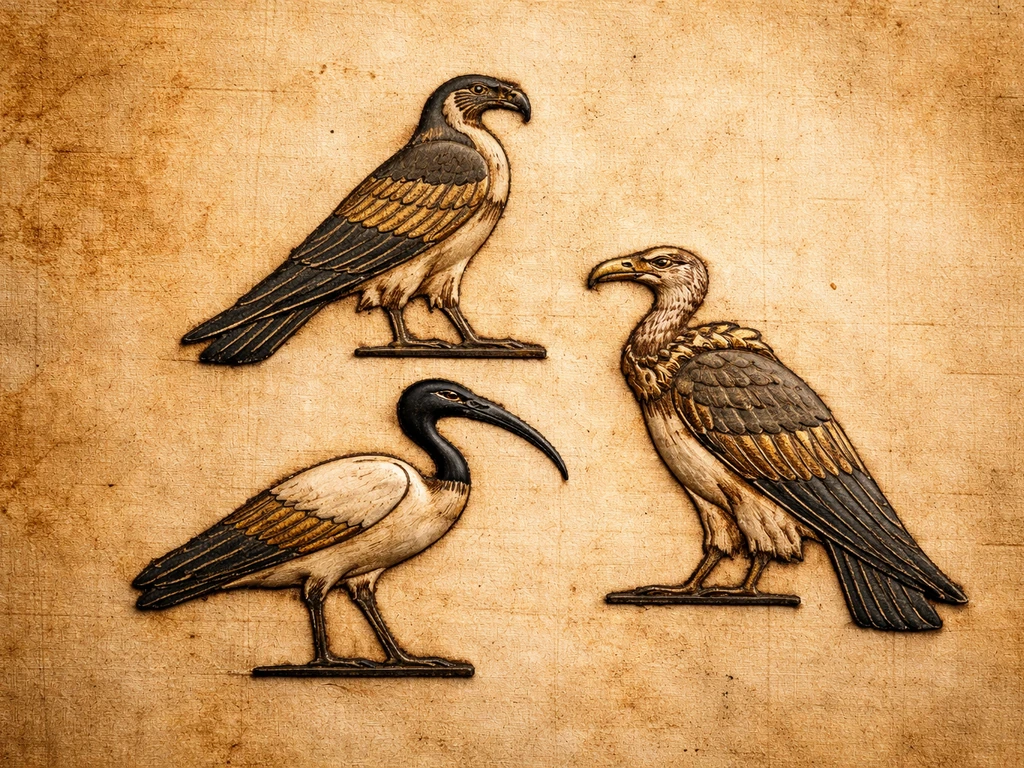
Quick ID: Which Bird Hieroglyph Are You Looking At?
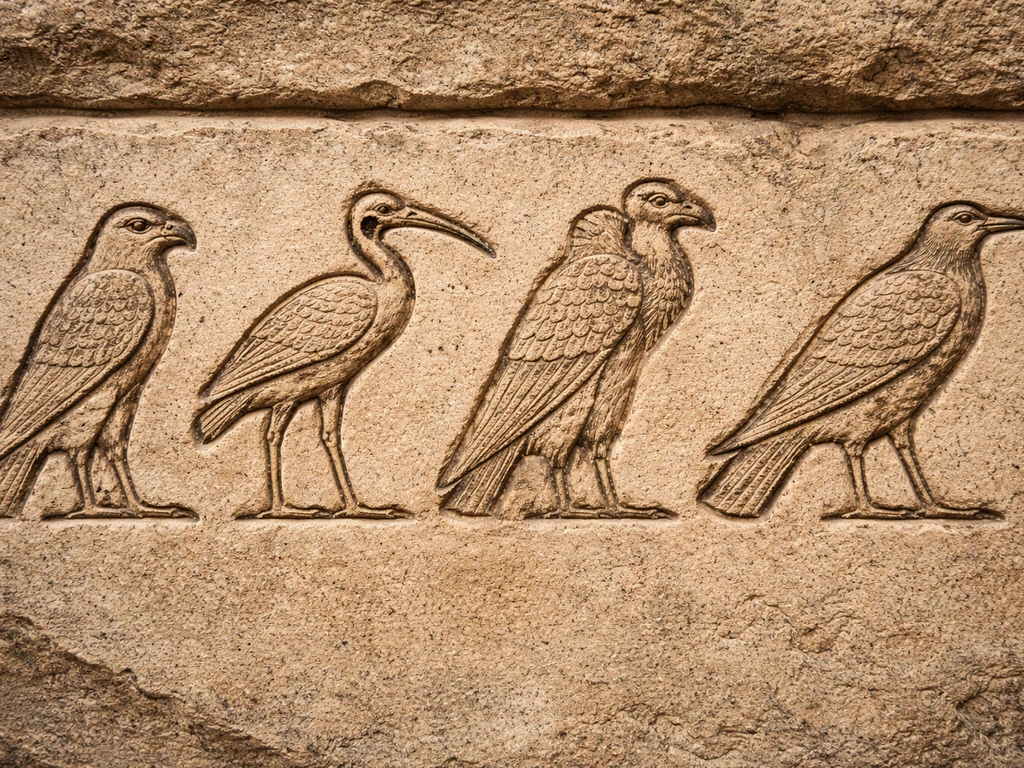
Before you can interpret the symbolism, you need to narrow down the sign. Egyptologists use Gardiner's Sign List as the standard reference, and it organizes bird hieroglyphs under the letter G (with a few exceptions). The visual details matter enormously here. A crested head, a curved beak, a perch or stand beneath the bird, a sun disk above it, these aren't decorative flourishes. They're identification markers. Here's a quick visual guide to the most commonly encountered bird signs:
| Gardiner Number | Bird Type | Key Visual Features | Primary Association |
|---|---|---|---|
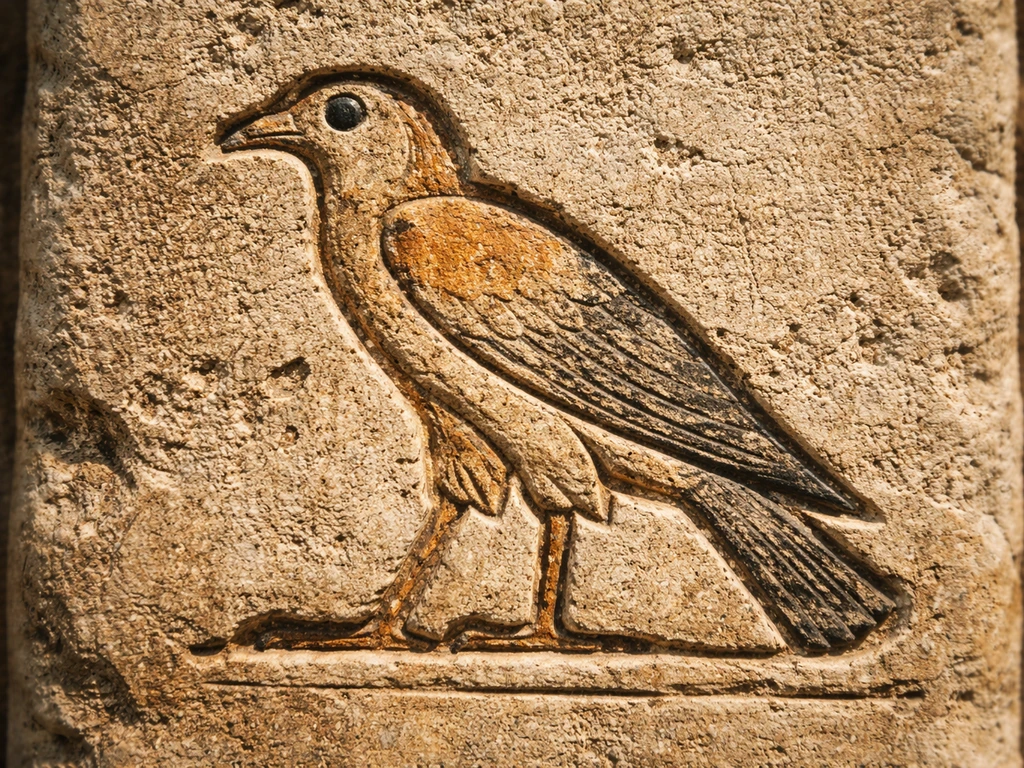
| G5 | Falcon (facing right, perched) | Smooth head, sharp hooked beak, sometimes with sun disk | Horus, kingship, the divine pharaoh |
| G6 | Falcon on a divine/nTr sign | Falcon perched atop the hieroglyph for 'god' | Divine contexts, epithets of gods |
| G14 | Vulture | Heavy body, bald/downy head, broad wings when shown spread | Nekhbet, motherhood, Upper Egypt, protection |
| G17 | Owl | Frontal-facing head, round eyes, compact body | Phonetic value 'm', letters/writing contexts |
| G25 | Crested ibis (Akh-bird) | Prominent forward crest, long beak, upright stance | The akh spirit, transfigured deceased |
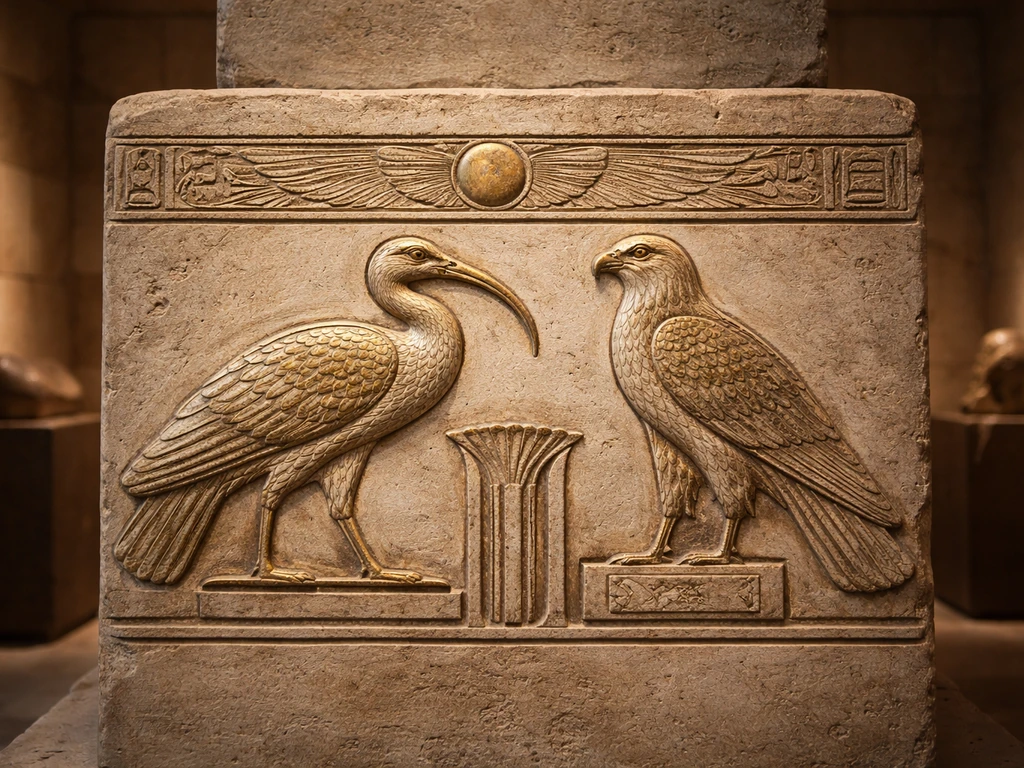
| G26 | Sacred ibis on a standard/stand | Long downcurved beak, black head, elevated on a perch | Thoth, wisdom, writing, the moon |
| G38 | White goose (domestic goose) | Plump body, short neck, horizontal posture | The Great Cackler, Geb, the soul of Ra |
| G39 | Pintail duck | Slim body, pointed tail, often shown in flight | Phonetic value 'zA', son/daughter titles |
If your bird has a strikingly curved, downward-sweeping beak, you're almost certainly looking at an ibis variant. If it's sleek, upright, and regal with a hooked beak, it's most likely a falcon. A frontal-facing small bird with large round eyes is the owl (G17), which appears constantly in Egyptian texts because it carries the phonetic value 'm.' Context is everything: a bird sitting on top of another sign, or placed inside a cartouche, changes the reading entirely.
Core Meanings of the Bird Sign: Symbol, Sound, and Spirit
Egyptian hieroglyphs work on multiple levels simultaneously, which is part of what makes them so rich for spiritual interpretation. A single bird sign can function as a logogram (standing for the word it depicts), a determinative (a silent classifier that tells you what category a word belongs to), or a phonogram (representing a sound or sound cluster). Understanding which role the bird plays in a given context shapes what it means.
The falcon (G5), for example, functions as a logogram for Horus himself, the word 'ḥr.w', and as an ideogram in royal and divine titles. It's not just a pretty bird; it's a compressed statement about divine kingship. The owl (G17) is almost always phonetic, representing the consonant 'm,' so when you see it in a spiritual inscription, it's doing linguistic work rather than symbolic work. The sacred ibis (G26) is primarily an ideogram for Thoth, meaning it stands for the god directly. And the crested ibis or 'akh-bird' (G25) is a logogram for the Egyptian concept of the akh, the transfigured spirit of the deceased that had successfully passed into the afterlife. That last one is particularly powerful if you've encountered it in a funerary context.
For spiritual readers, the most meaningful bird signs tend to be the ideogrammatic and logogrammatic ones, the signs that stand for a concept or a deity rather than just a sound. These are the birds the Egyptians were really 'saying something' with in the symbolic sense.
The Most Common Bird Species: What Each One Carries
The Falcon: Power, Sight, and Divine Kingship
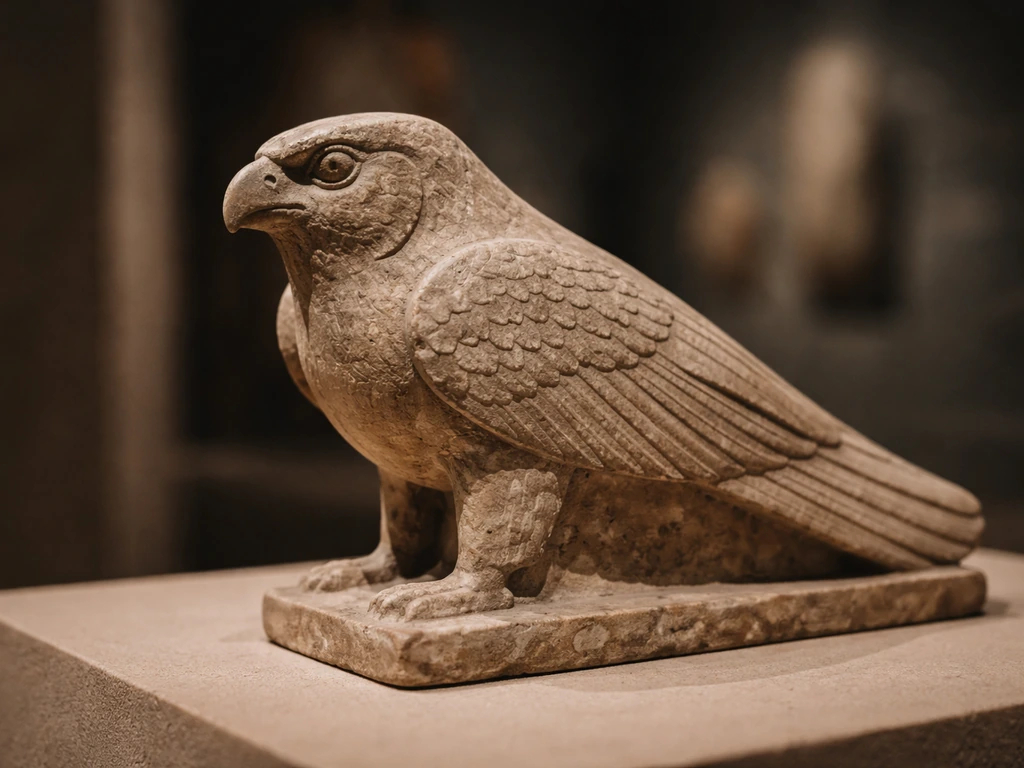
The falcon is probably the most recognizable Egyptian bird hieroglyph, and for good reason. It represents Horus, the sky god whose eyes were the sun and the moon. If you are specifically asking, “what bird is horus,” this falcon sign is the common answer to that question as well. The word 'Horus' itself is embedded in the falcon sign, and when you see a falcon wearing a double crown or a sun disk with a uraeus cobra, you're looking at one of the most potent royal symbols in Egyptian art. Spiritually, the falcon carries themes of sharp vision (seeing the truth of a situation), protection from above, and the bridge between the divine and the earthly. The pharaoh was literally called 'the living Horus', the falcon in human form on earth.
The Sacred Ibis: Wisdom, Writing, and the Moon
The sacred ibis (G26) is Thoth's bird, full stop. Thoth was the god of writing, mathematics, wisdom, magic, and the moon, an enormously important figure in Egyptian religion and in the afterlife judgment process, where he recorded the weighing of the heart. If you've encountered an ibis sign, especially one mounted on a standard or stand, you're in Thoth's territory. The symbolic meaning is rich: wisdom earned through careful observation, the recording of truth, the magical power of language. The ibis was also a liminal creature, it waded in the boundary between water and land, which made it a natural symbol for beings who moved between worlds.
The Vulture: Maternal Protection and Deep Power
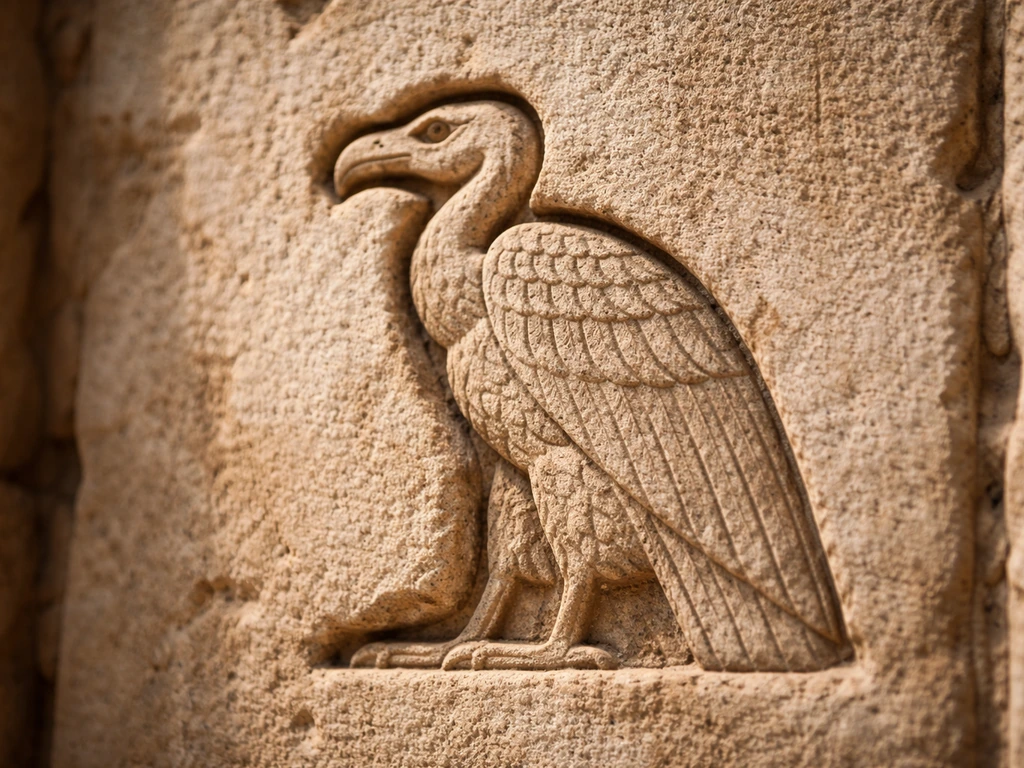
The vulture hieroglyph (G14) is associated with Nekhbet, the protective goddess of Upper Egypt and one of the two goddesses who guarded the pharaoh. Despite modern Western associations of vultures with death and decay, the Egyptians read the vulture very differently: as a fiercely protective mother. Ancient naturalists (incorrectly) believed vultures were all female, which made them a symbol of pure maternal power. When you see a vulture with wings spread over a figure, it's an image of divine shelter. Phonetically, the vulture also carries the value 'A' (the glottal stop), making it one of the most common signs in written Egyptian.
The Goose and the Swallow: Soul and Sorrow
The goose appears in several forms. The pintail duck (G39) carries the phonetic value 'zA,' meaning 'son' or 'daughter,' so it frequently appears in genealogical inscriptions. The white goose (G38) is linked to Geb, the earth god, and to the mythological 'Great Cackler' whose honk broke the primeval silence and began creation. The swallow (G135), though less frequently discussed, was associated with the souls of the dead and with the stars, swallows were thought to be the souls of the deceased flying freely in the celestial realm.
The Akh-Bird (Crested Ibis): The Transfigured Soul
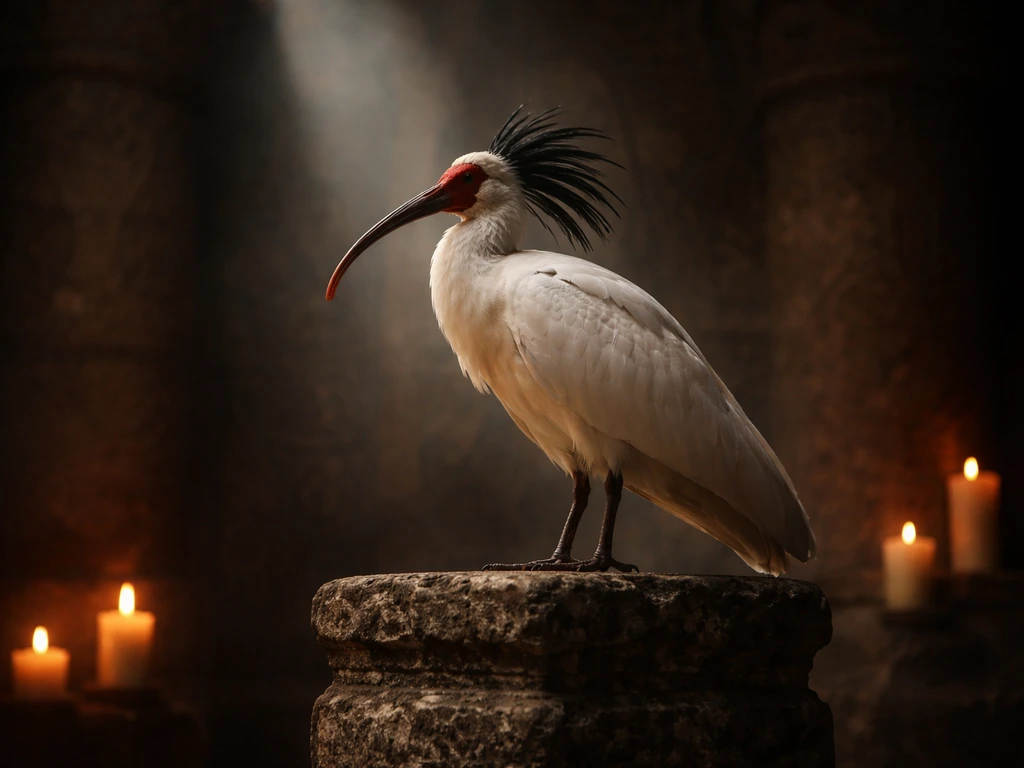
The crested ibis (G25) is one of the more spiritually charged bird signs for anyone working with funerary or afterlife themes. It represents the akh, the luminous transfigured spirit of a person who had successfully completed the journey through the Duat (the Egyptian underworld) and joined the imperishable stars. If this is the bird on your artifact or tattoo, its message is about transformation, spiritual completion, and luminosity. It's not a bird of this world, it's a bird of the achieved afterlife.
Bird Symbolism in Egyptian Culture: Gods, Royalty, the Afterlife, and Omens
Birds occupied a uniquely elevated place in Egyptian cosmology because of their ability to fly between earth and sky. The sky was divine territory, the realm of Ra, the sun god, who traveled it daily in his solar barque. Birds that could soar high, like the falcon, were natural embodiments of divine presence. This is why so many Egyptian gods have bird heads or bird forms: Horus (falcon), Thoth (ibis), Ra (falcon with sun disk), Nekhbet (vulture), Horus of Behdet (winged sun disk with falcon wings), and Mut (vulture). The bird wasn't just a symbol for these gods, in many cases the bird was considered a manifestation of the god's ba, the mobile, individuated soul-aspect that could travel freely.
Royalty was directly tied to bird imagery. The pharaoh bore a Horus name, literally a falcon name, as one of his five royal titles, and the falcon was carved or painted above royal cartouches on temple walls across Egypt. The double-headed falcon sometimes represented a cosmic unity of upper and lower Egypt. The vulture and cobra (Nekhbet and Wadjet) appeared together on the royal crown as the 'Two Ladies,' protecting the pharaoh from both north and south.
In the afterlife context, birds were especially significant as vessels for the ba soul. The ba was depicted as a human-headed bird, a being that could fly between the world of the living and the realm of the dead. Funerary papyri, particularly those from the Book of the Dead, are dense with bird imagery. In some passages, specific birds were also used as messengers to carry communications between people and the divine. Spells enabled the deceased to transform into specific birds, the falcon, the swallow, the heron (the Bennu bird, associated with rebirth and the sun), as a way of moving freely through different spiritual zones. The Bennu, often described as the Egyptian prototype of the phoenix, stood on the primordial mound at the moment of creation and was linked to both the sun and resurrection.
Feathers, Flight, and Nesting: The Universal Bird Language Behind the Sign
Beyond the specific Egyptian meanings, the bird hieroglyphs tap into a deep, cross-cultural symbolic vocabulary that the site's broader framework of bird symbolism explores thoroughly. Flight is universally associated with freedom, transcendence, and the movement of the soul between states of being. When an Egyptian scribe carved a falcon to represent Horus, they were also invoking the raw, instinctive meaning of a bird that soars above everything below it. That symbolic resonance doesn't require you to read Middle Egyptian to feel it.
Feathers carried their own separate weight in Egyptian thought. The feather of Ma'at, the ostrich feather of truth and cosmic order, was the counterweight in the judgment of the heart. Every soul was weighed against it. This means that even a single feather in Egyptian iconography is a statement about truth, justice, and spiritual integrity. If your bird hieroglyph includes feather detail or appears near a feather sign, that layering is intentional and deeply meaningful.
Nesting is a less-discussed but present symbolic thread. The goose that 'nested' to produce the cosmic egg, the falcon that nested high in cliffs and temples, the ibis that returned seasonally with the Nile's flooding, all of these behaviors were observed and folded into Egyptian symbolism. Birds that returned predictably were signs of cosmic order (Ma'at) being maintained. A swallow's return was a sign that the correct seasons were unfolding. This kind of attentiveness to bird behavior as a signal of cosmic health is something Egypt shares with many other traditions, from Celtic augury to Native American bird reading.
How to Research Your Exact Symbol and Read It in Context
If you've seen a bird hieroglyph and you want to be confident about what it means, the single most valuable thing you can do is study what surrounds it. Egyptian hieroglyphs almost never appear in isolation, they're embedded in texts, scenes, and programs that give enormous amounts of contextual information. Here's a practical approach:
- Identify the bird's physical details: beak shape (straight, hooked, or dramatically curved), head features (crest, bare skin, or smooth), body posture (upright, horizontal, in flight), and any objects above or below it (staffs, standards, sun disks, crowns).
- Cross-reference with Gardiner's Sign List. The G-series covers most bird signs. Gardiner numbers are widely cited in museum labels, academic texts, and reputable online Egyptian resources. If a website or tattoo artist gives you a Gardiner number, you can verify it independently.
- Check the Thot Sign List (TSL), an online database that provides per-sign pages with bibliographic references. It's particularly useful when you're dealing with a variant or less common bird sign that Gardiner's printed list doesn't illustrate as clearly.
- Look at the register and scene. Is the bird appearing in a funerary papyrus, a temple wall, a royal cartouche, or a personal amulet? Funerary contexts lean toward afterlife symbolism. Royal contexts point to divine kingship. Temple contexts often identify a specific god.
- Note what other signs immediately flank the bird. If you see the bird sandwiched between signs you can identify (like the ankh, the eye of Horus, or a cartouche ring), those companions constrain and clarify the bird's role.
- Compare with published examples. The Metropolitan Museum of Art's Ancient Egyptian Calligraphy publication (available as a PDF) includes named bird signs in its sign-by-category plates and is a trustworthy, accessible reference.
One practical note: many bird images circulating on social media and in tattoo catalogs are simplified or artistically stylized to the point where the identifying details are lost or blurred. If your bird hieroglyph is from a tattoo flash sheet or a commercial jewelry piece, treat the identification as tentative until you can find a primary or scholarly source that matches the visual closely. The difference between a sacred ibis (Thoth, wisdom) and a crested ibis (akh, transfigured soul) comes down to a crest, a detail easily omitted in a quick sketch. If you're trying to figure out what egyptian god is a bird in your specific sign, remember the sacred ibis points to Thoth and the falcon points to Horus. If you want the egyptian bird symbol meaning behind a specific bird, compare your sign to the species and the context it appears in.
Your Spiritual Takeaway and What to Do with It
Once you've identified your bird sign and grounded it in its Egyptian meaning, the spiritual work begins. The Egyptians understood bird symbolism as a living language, one that connected the human world to the divine, the living to the dead, the earthly to the cosmic. You don't need to be an Egyptologist to work with that language meaningfully. You just need to be intentional about it.
If your bird is the falcon, sit with themes of clear vision, sovereign purpose, and divine protection. The falcon doesn't scan the ground nervously, it holds altitude and sees everything. A journaling prompt: where in your life are you being called to rise above the immediate and see the larger pattern? If your bird is the ibis, you're in Thoth's domain: what knowledge are you being asked to record, preserve, or honor? What truth are you avoiding writing down? The ibis is a bird of careful attention and long memory.
If you encountered the akh-bird (G25) or any funerary bird imagery, the invitation is toward transformation, specifically the kind that requires passing through difficulty to reach luminosity. The Egyptian akh wasn't born; it was earned through the journey. If the vulture found you, consider the theme of fierce, unconditional protection: who or what are you sheltering, and who is sheltering you?
For practical next steps: start a small visual record of the bird sign you've encountered. Sketch it, note where you saw it, and write down what was happening in your life at the time. Then research the specific sign using the Gardiner list or the Thot Sign List and write a short paragraph connecting the Egyptian meaning to your current situation. This isn't about literal fortune-telling, it's about using an ancient symbolic framework as a mirror for reflection, exactly the way the Egyptians used their own religious imagery. Their art wasn't decoration; it was theology in visual form. Treating it with that same seriousness, even from a personal and modern spiritual perspective, is the most honest way to honor what these bird signs actually were.
The bird hieroglyph you've found is a doorway. What's on the other side depends on which bird it is, what it's doing, and what you bring to the encounter. Identify it carefully, read its context, and then let the symbolism breathe. That's exactly how the Egyptians would have wanted it used.
FAQ
My bird hieroglyph on a tattoo is simplified. How can I tell whether it is a sacred ibis (Thoth) or a crested ibis (akh-bird)?
Focus on the crest, not the body shape. The sacred ibis is typically shown without the distinctive head/crest feature that signals the crested ibis (akh-bird). Also check whether the bird is placed in a funerary scene or near other afterlife indicators (for example, symbols of transformation or the spirit). If your design includes feathered crest detail, it leans toward the akh-bird rather than the Thoth ibis.
What should I do if the bird sign in my image is too blurry to identify the exact Gardiner number?
Use a “feature checklist” before you guess: beak direction (downward sweep vs hooked), whether the bird is perched or standing on a stand, presence of a sun disk above, and any head ornamentation. Then compare your best matches against the Gardiner bird subgroup for the closest morphology. If none fit, treat the meaning as provisional, because small visual markers change both the deity association and whether it behaves as logogram or ideogram in context.
Can the same bird hieroglyph have a different meaning depending on where it appears on the artifact?
Yes, location is often decisive. A bird placed inside a cartouche, on top of another symbol, or mounted on a standard can shift the reading from a more direct theological statement to a linguistic or contextual one. Before interpreting spiritually, note the immediate neighbors (deity names, royal titles, or funerary motifs) and whether the bird seems to label something versus classify a surrounding word.
How can I tell whether my bird hieroglyph is being used more like a sound (phonogram) or a concept (logogram/ideogram)?
Look for patterns in surrounding signs. If the bird sits where a word’s consonants would be expected, it likely functions phonetic. If it stands next to deity names, royal titles, or clear thematic markers, it more often works as an ideogram or logogram carrying meaning directly. Also, if your bird repeats in a way that seems too “consistent” for a standalone idea, it may be phonetic support rather than the main symbolic message.
If I see a feather symbol near my bird sign, does that change the interpretation?
It usually adds a moral and cosmological layer. The feather of Ma’at (truth and order) is tied to judgment and spiritual integrity. When a bird and a feather appear close together, the symbolism often moves from “who the bird represents” to “what spiritual quality is being affirmed or evaluated,” even if the bird still points to a specific god or state.
Are birds always symbolic, or can they also be purely phonetic in a text?
They can be both. Some bird signs are frequently phonetic, such as the owl’s common use for the consonant value associated with 'm'. If your bird appears frequently without a thematic cluster (no deity name, no funerary imagery, no royal title context), it may be serving as linguistic material rather than expressing a spiritual message on its own.
How should I interpret bird imagery in a Book of the Dead type context versus in a temple or royal setting?
In funerary programs, bird images often connect to transformation, the ba, and safe passage between worlds, so meanings trend toward afterlife states and spiritual transition. In royal or temple contexts, birds more often support divine kingship themes, protective authority, and cosmic legitimacy. The same bird species can carry different emphasis based on whether the surrounding program is about judgment and transformation or about sovereignty and protection.
What is a good way to start journaling using bird hieroglyph meaning without turning it into fortune-telling?
Treat it as reflection on function and role rather than prediction. Write a prompt that mirrors the sign’s “job” in Egyptian thought. For example: if the bird is falcon imagery, ask where you need clearer perception or protection by stepping back and rising above. If the bird is ibis imagery, ask what truth you are recording or avoiding. Then end with a practical action you can take this week.