Egyptian bird symbolism centers on a handful of sacred birds, each tied to a specific god, concept, or afterlife function. The most common ones you'll encounter are the falcon (Horus, kingship, the sun), the ibis (Thoth, wisdom, writing), the vulture (Nekhbet or Mut, protection, royalty), and the ba-bird (the human-headed bird that represents the soul). If you can identify which bird you're looking at, you can pin down the meaning with surprising precision.
Egyptian Bird Symbol Meaning: Tattoos, Gods, and Interpretation

Eleanor Hartwell
23 Apr 2026
Egyptian bird symbolism at a glance
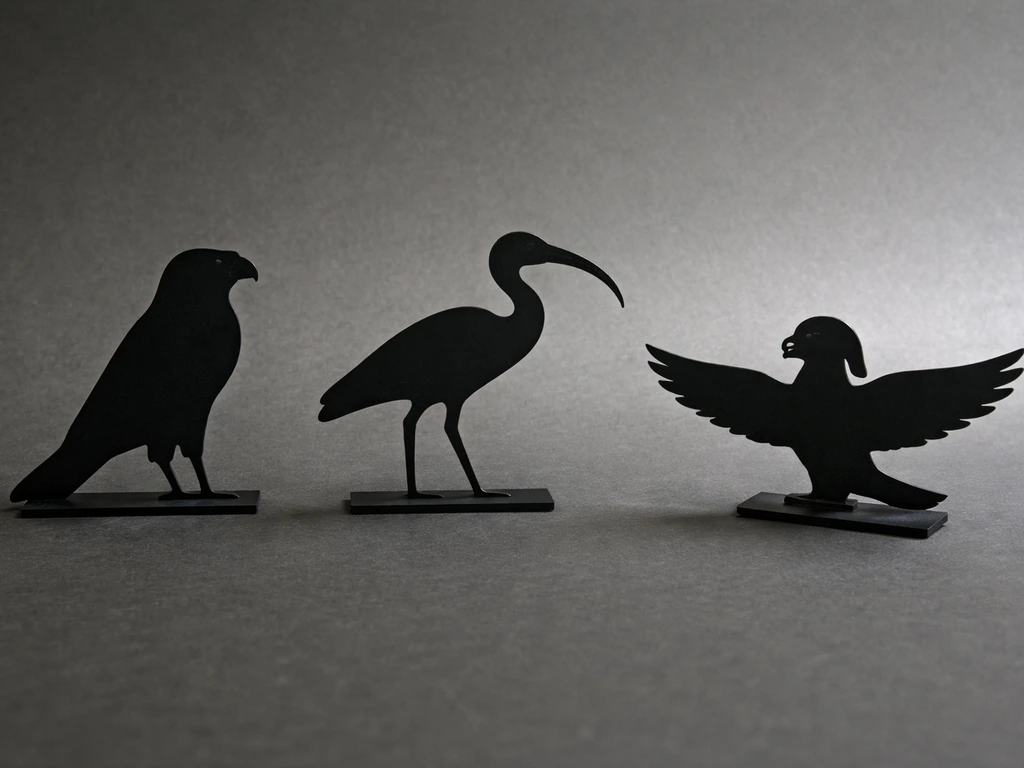
Birds held a uniquely elevated place in ancient Egyptian thought because they could do something humans couldn't: move freely between earth and sky. That ability to ascend, to cross realms, made them natural symbols for the soul, divine power, and protection. Almost every major Egyptian deity had a bird form or a sacred bird companion, and Egyptian art returned again and again to wings as a symbol of shelter, flight as freedom from death, and bird silhouettes as shorthand for the divine. When you see a bird in Egyptian imagery, it almost always carries one of these core themes: the soul in transit, a deity's presence, royal protection, or the promise of resurrection.
| Bird | Associated Deity | Core Symbolic Meaning |
|---|---|---|
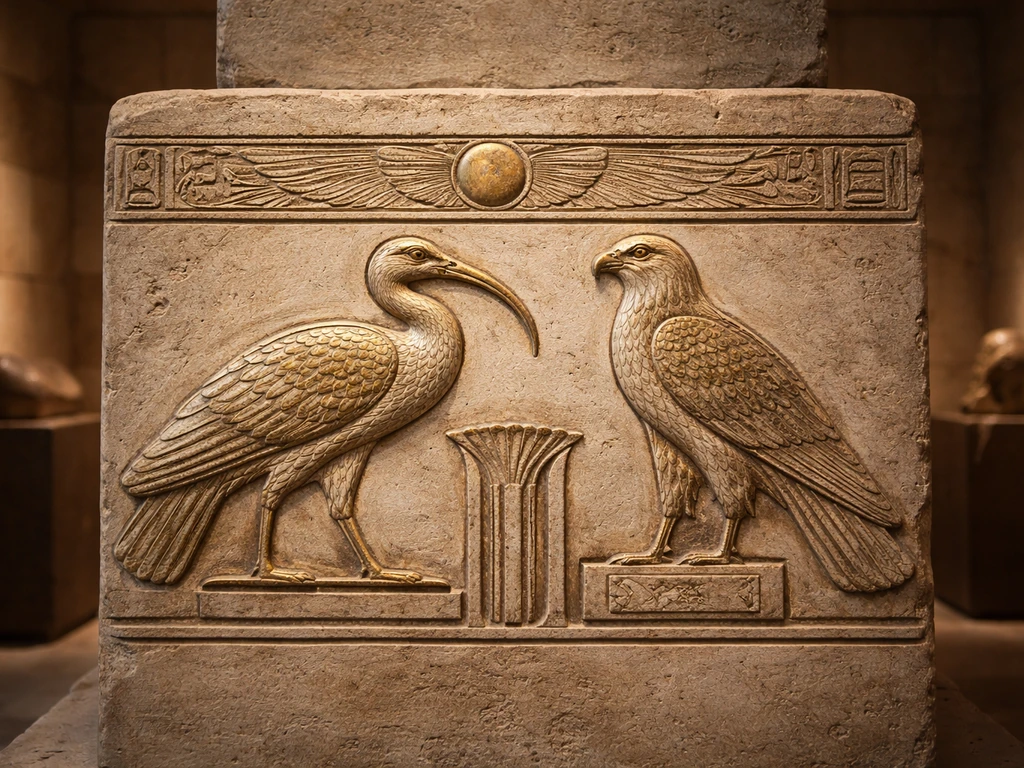
| Falcon | Horus | Kingship, sky, sun, divine protection |
| Ibis | Thoth | Wisdom, writing, knowledge, scribal arts |
| Vulture | Nekhbet / Mut | Maternal protection, royalty, Upper Egypt |
| Ba-bird (human-headed bird) | Not a deity — represents the individual soul | The soul's freedom to travel after death |
| Heron (Bennu) | Ra / Osiris | Creation, rebirth, the primordial sun |
These aren't rigid categories, Egyptian religious thought layered meanings constantly. A falcon could be Horus in one context and Ra-Horakhty (a solar fusion deity) in another. But this table gives you a reliable starting point before you go deeper.
How to identify the bird in your image or tattoo
The single most useful thing you can do is look closely at the bird's head. In bird anatomy, the syrinx is the vocal organ that helps some birds produce sound syrinx definition bird. That one detail tells you almost everything. A bird with a human head is the ba-bird, the Egyptian soul made visible. A bird with a hooked beak and a sleek profile, often wearing a double crown or uraeus (the royal cobra), is almost certainly a falcon and points to Horus. A bird with a long, downward-curved beak is an ibis and connects directly to Thoth. A large bird with a broad wingspan and no crown, especially shown hovering or spreading wings over a figure below, is likely a vulture and signals Nekhbet or Mut.
Context matters almost as much as the bird itself. Ask yourself these questions as you look at your image:
- Does the bird have a human head? If yes, you're looking at a ba-bird, the soul symbol, not a deity's form.
- Is the bird wearing a crown, uraeus, or headdress? Crowns indicate a deity's form. A double crown or sun disk points to Horus or a solar god.
- What is the bird doing? Wings spread over a figure below = protective deity (often Isis, Mut, or Nekhbet). Bird perched upright with a staff = Thoth in scribe mode. Bird in profile walking = hieroglyphic or narrative context.
- Where does this image appear? A funerary amulet or coffin decoration = almost certainly afterlife symbolism (ba-bird, Horus, Osiris connections). A temple wall = deity context. A royal object = kingship and Horus are likely.
- Is the bird accompanied by specific symbols? A feather of Maat alongside an ibis confirms Thoth. A djed pillar or ankh near a human-headed bird confirms the ba in a resurrection context.
If you're working from a hieroglyph rather than a figurative image, the bird signs in Egyptian hieroglyphics are among the most common in the entire script. The owl, the quail chick, the falcon, and the ibis all appear as phonetic or determinative signs, and their meaning in that context is linguistic rather than purely symbolic. The related topic of bird hieroglyph meanings goes into this in more depth, but the short version is: a bird in a hieroglyphic inscription isn't always meant symbolically. hieroglyphics bird meaning hieroglyphic inscription isn't always meant symbolically. If you're trying to nail down the bird hieroglyph meaning, this context check will help you avoid reading it purely as symbolism bird hieroglyph meanings. It may just be spelling a word.
Meanings linked to Egyptian religion and the afterlife
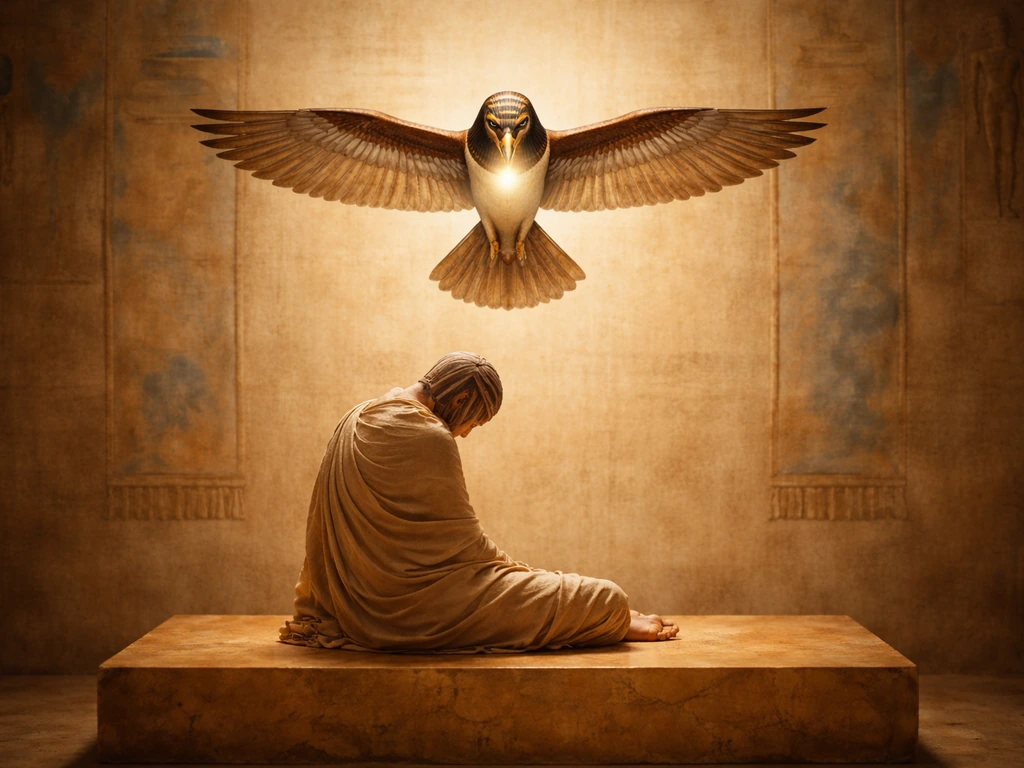
The ba-bird is probably the Egyptian bird image most people encounter without recognizing it. It looks like a regular bird at first glance, but if you look at the head, it has a human face, sometimes also human arms. That's the ba, one of the key spiritual components of a person in Egyptian belief, roughly equivalent to what we'd call the soul or vital essence. The ba was thought to leave the body after death, fly freely in the world during the day, and return to the mummy at night. Museum collections at the Met, the Brooklyn Museum, and the British Museum all describe ba-bird amulets placed on the chest of mummies during the Late and Ptolemaic Periods, designed to protect and support this soul-flight.
The Book of the Dead, formally called the Book of Going Forth by Day, includes vignettes showing the ba as a human-headed bird hovering over the mummy or flying out of the tomb. This imagery captures the Egyptian understanding of death not as an ending but as a transition requiring the right spiritual tools and representations. If you see an Egyptian bird with a human head in any context, whether it's a pendant, a tattoo, a wall painting, or a print, it's invoking this idea of the soul's journey and freedom after death.
The Bennu bird, often depicted as a heron, adds another layer. Associated with Ra and Osiris, the Bennu was the Egyptian prototype for the later Greek phoenix myth. It represented the primordial moment of creation and the cyclical renewal of the sun. If you see a tall, elegant heron-like bird in Egyptian religious art, particularly in solar or creation contexts, you're looking at the Bennu and the symbolism of rebirth and cosmic renewal.
Egyptian birds and their connection to specific gods
The falcon is the most prominent divine bird in the entire Egyptian pantheon. Horus, one of the oldest and most important Egyptian gods, appears as a falcon or as a man with a falcon head. As a sky god, Horus was believed to embody the heavens themselves, with his right eye representing the sun and his left eye the moon. Because the pharaoh was considered the earthly incarnation of Horus, the falcon became inseparable from the idea of divine kingship. You'll find falcon imagery on royal objects, temple walls, and crowns precisely because it signals legitimate rule sanctioned by the gods. The Smithsonian and the Harvard Art Museums both emphasize this link: the falcon is the symbol of Horus, whose earthly embodiment was the pharaoh.
Thoth is the second major bird deity and takes the ibis form. Thoth was the god of wisdom, writing, mathematics, and magic, which made him the patron of scribes and the divine record-keeper. The Walters Art Museum describes the ibis as Thoth's sacred bird outright, and the Met's collections include an inlay showing Thoth in ibis form paired with a Maat feather, reinforcing the connection between knowledge, truth, and divine order. If your Egyptian bird image has that distinctively long, curved beak, you're in Thoth's territory: intellect, communication, and sacred knowledge.
The vulture rounds out the major divine birds. The Global Egyptian Museum notes that the vulture was regarded as the manifestation of Nekhbet, the protective goddess of Upper Egypt, and also Mut, the mother goddess. Vulture imagery appears regularly in royal crowns and headdresses, where the vulture cap worn by queens and goddesses signals divine maternal protection and sovereignty. If you see a broad-winged bird hovering over a royal or divine figure from above, that protective, sheltering pose is the visual language of the vulture goddesses.
Isis, though not a bird herself, appears constantly in bird-adjacent imagery because her wings wrap around Osiris and other figures in a protective embrace. The British Museum's collection includes statues and shrine pieces where Isis's outspread wings are the central protective gesture. This winged protection motif is one of the most common Egyptian visual conventions, and it connects to the same symbolic logic as the vulture: wings equal shelter, safety, and divine love.
Egyptian bird tattoo meaning by placement, pose, and context
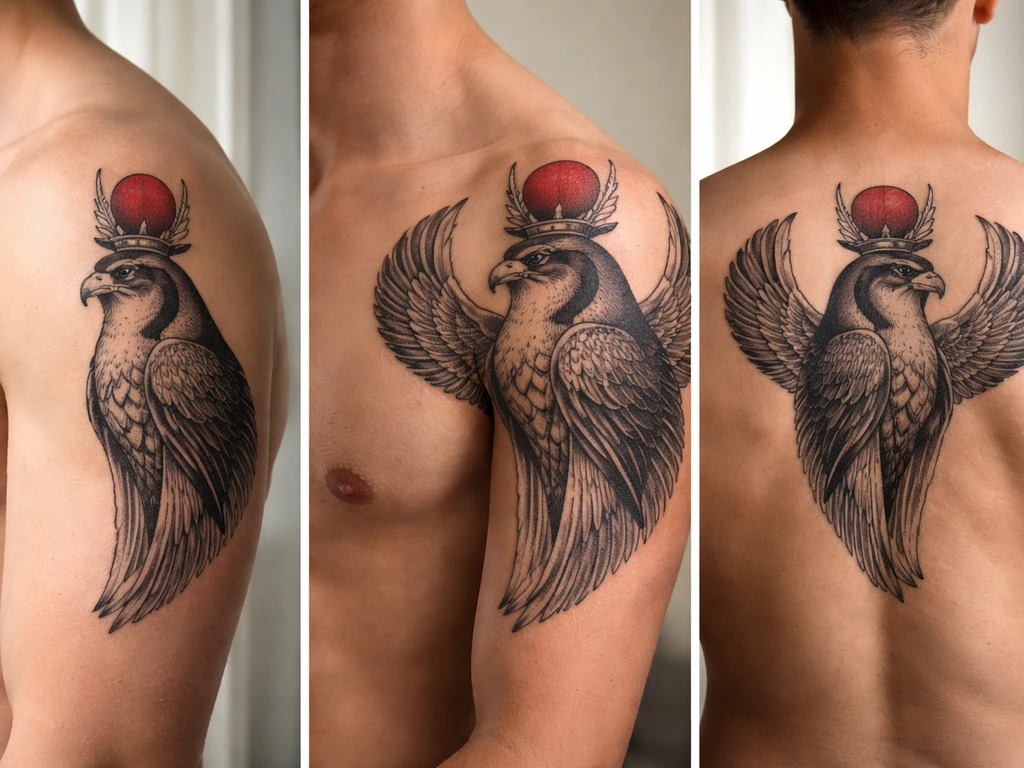
Egyptian bird tattoos are rarely chosen at random. Most people drawn to this imagery are working with themes of the soul, transformation, protection, or spiritual power, and the specific bird they choose shapes which of those themes comes forward. Here's how to read the common choices.
Falcon tattoos
A falcon tattoo in an Egyptian style almost always calls on Horus's symbolism: strength, vision, divine authority, and protection. If the falcon wears a double crown or a sun disk, it's leaning into the solar and royal aspects. If it's shown in a diving or hunting pose, the emphasis shifts to precision, power, and action. Placed on the chest or upper arm, a falcon tattoo often signals personal strength and protection. On the back, especially spread across the shoulder blades, it evokes the sky-god aspect of Horus, the sense of divine oversight and elevation.
Ba-bird tattoos
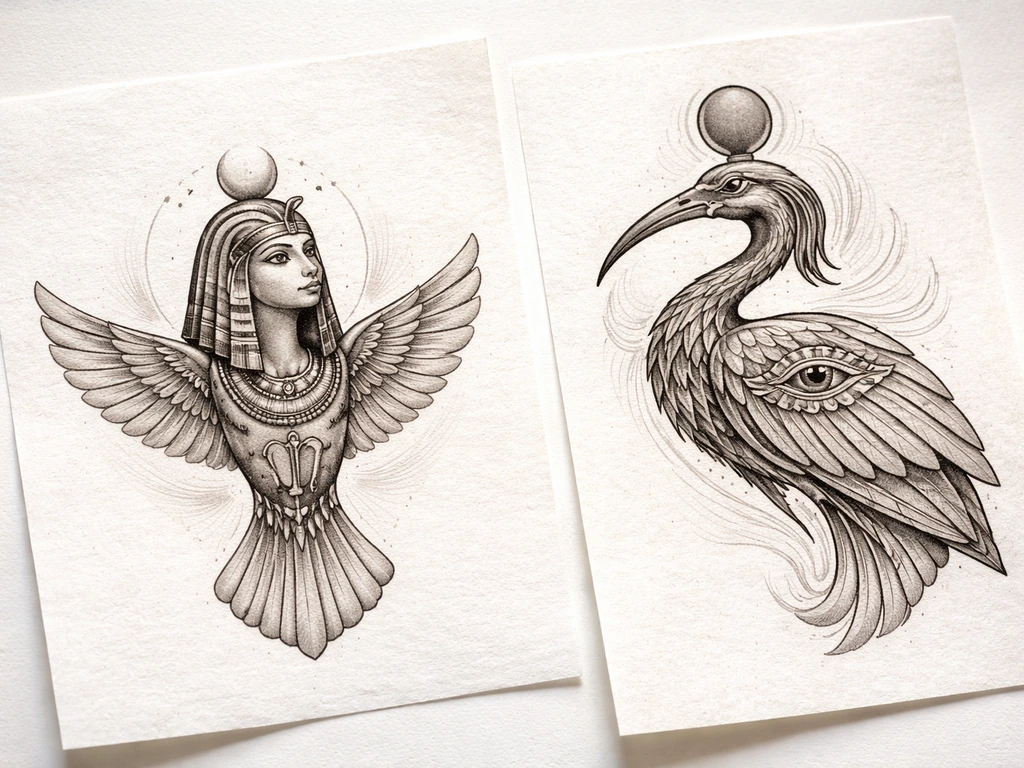
A human-headed bird is one of the most spiritually loaded Egyptian tattoo choices you can make, because it's explicitly a soul symbol. People who get ba-bird tattoos often do so in memory of someone who has died, or as a personal statement about the soul's continuity beyond physical death. The ba-bird with outstretched wings, mirroring the protective pendant that was placed on mummies' chests, carries particular weight as a memorial image. Placed near the heart or sternum, it echoes the exact placement of ba-bird amulets in ancient funerary practice.
Ibis tattoos
An ibis tattoo in Egyptian style points directly to Thoth: wisdom, intellectual power, the sacred arts of writing and magic. People who work in creative or scholarly fields sometimes choose this image deliberately. The ibis in profile, particularly carrying a scribal palette or a Maat feather, emphasizes the knowledge and truth aspects of Thoth's domain.
Wings and vulture imagery
Egyptian wings spread across the back, shoulders, or collarbones evoke the protective wing motif shared by Isis, Nekhbet, and the broader category of divine protection. This placement makes visual sense: the wings appear to originate from the wearer's body, as if they themselves carry this protective power. A vulture shown overhead or hovering, especially with its wings down and spread wide, signals maternal guardianship and royal spiritual authority.
How to interpret your "personal message" and next steps
The most reliable way to arrive at a personal meaning is to work from the specific to the general. Don't start with "what does an Egyptian bird mean" and try to apply that broadly. Start with the bird itself, identify it as precisely as you can using the head shape, beak shape, and accompanying symbols, then layer in the deity or spiritual concept it connects to, and finally ask what that concept means in your own life and context.
If you're trying to interpret an image you've encountered, whether on an amulet, in a museum print, in art, or as a tattoo you're considering, here's a practical sequence:
- Identify the bird species or type first: falcon (hooked beak, sleek body), ibis (long curved beak), vulture (broad wings, bald head), or ba-bird (human head on a bird body).
- Check the head and crown: divine bird forms almost always wear a crown, uraeus, or sun disk. A bare head means you're likely looking at a soul symbol (ba) rather than a deity's form.
- Note the pose and context: hovering with wings spread = protection; perched upright = divine authority or wisdom; in flight = soul in transit or freedom.
- Identify the object or medium: funerary amulet or coffin = afterlife and soul symbolism; temple wall = deity and royal power; personal tattoo = a chosen symbolic identity.
- Match the bird to its deity or concept using the framework above, then ask what that deity's core qualities (wisdom, protection, kingship, soul-freedom) mean to you personally.
- If your bird appears in a hieroglyphic inscription rather than figurative art, treat it as a linguistic sign first. The hieroglyphics bird meaning topic explores this distinction in more detail.
One thing worth sitting with: Egyptian symbolism was never meant to be a simple one-to-one code. The same bird could carry multiple meanings depending on the ritual context, the period, and the person. The ba-bird placed on a mummy's chest was a very specific, protective object. The falcon in a royal cartouche was a political and theological statement. The ibis in a scribe's workshop was a daily reminder of the divine patron of their craft. When you interpret Egyptian bird symbolism for your own life, you're participating in a tradition of layered meaning-making that the Egyptians themselves practiced for over three thousand years. That's not a reason to be vague. It's a reason to be thoughtful about which layer of meaning resonates most with what you're actually looking for.
If you want to go further, the related questions of what Egyptian god is a bird, what the Saqqara bird was used for, and how Horus specifically relates to the falcon all open up different corners of this same symbolic world. You may also be curious about which bird was used to carry messages, since some traditions link specific birds to communication and messengers. If you are wondering "what bird is Horus," the answer is the falcon, since Horus is commonly depicted as a falcon or a man with a falcon head what Egyptian god is a bird. Each one adds specificity and depth to what might start as a simple image you noticed and wanted to understand.
FAQ
If I see an Egyptian bird in a hieroglyph, is it definitely a spiritual symbol?
Not always. In hieroglyphic writing, bird signs can function as determinatives or phonetic elements that help spell a word, so the “meaning” may be linguistic rather than symbolic. A quick check is whether the bird appears inside a running text block (more likely spelling) versus shown as an isolated icon with crowns, feathers, or a deity context (more likely symbolism).
How can I tell the ba-bird from an ordinary bird if the human head details are subtle?
Look for “human-faced” head features and the overall proportions. The ba-bird is typically human-headed, sometimes with human arms, and it is often shown hovering above a body (mummy) or tied to funerary scenes. If the bird’s head is only bird-like (hooked beak, no human facial features), you are probably not looking at the ba.
What should I do if the bird could mean more than one thing (for example falcon vs solar king imagery)?
Plenty of images overlap visually. The falcon and several divine associations can appear in the same style, and context decides which layer is intended, such as royal regalia (cartouches, crown cues, royal stance) versus funerary or solar settings. Treat companion symbols (solar disk, uraeus, Maat feather, hovering over a mummy) as deciding factors, not just the bird alone.
How do I avoid misreading a stylized tattoo version of an Egyptian bird?
Yes, you can get it wrong if you focus only on the beak. For tattoos and modern art, many artists stylize anatomy, so the safest method is to cross-check at least two cues (head type plus accompanying emblems like crown, uraeus, scribal palette, or Maat feather). If only one cue is present, keep the interpretation provisional.
Does where I place the tattoo (chest, forearm, back) change the meaning of an Egyptian bird symbol?
Placement can shift the emphasis even when the same bird is used. For example, an ibis on the chest may read more like personal “knowledge” or patronage of learning, while pairing it with a scribal palette or Maat-like feather pushes the meaning toward truth, writing, and divine order. Chest or sternum placement is especially consistent with heart-area memorial symbolism for ba-bird designs.
If I see wings around a figure, does that always mean a vulture?
Yes. If a bird is paired with a protective wing motif, the theme can be shelter and divine guardianship even when no vulture is clearly shown. Wing-embrace layouts are often read as Isis-style protection, so it may represent protection broadly, not one specific bird deity.
How can I recognize the Bennu (Egyptian phoenix) when artists draw it in a heron-like style?
Check for “phoenix-like” visual language: tall, heron-like body, elegant posture, and placement in solar or creation scenes. The Bennu is often depicted as heron or heron-like, tied to renewal and primordial moments, so a context cue like the sun or cosmic regeneration makes it more likely than a generic bird symbol.
Does the meaning change if the same bird appears in an amulet-style image versus a casual artwork or decoration?
Be cautious with amulets versus general art. A ba-bird shown as an amulet-style chest piece in funerary contexts carries a stronger “soul flight” reading than the same human-headed bird used as decoration or in a modern composition without a mummy or afterlife setting. Ask whether the image implies a journey (hovering over death-related imagery) or just general spirituality.
How do I interpret an Egyptian bird I found in a museum print when the scene is political or occupational?
Yes. If the bird appears inside a cartouche-like frame, next to royal titles, or in a throne or kingly context, the reading may tilt toward kingship and legitimate rule for Horus-associated falcon imagery. If it appears in a scribe workshop motif, it more strongly suggests Thoth and daily practice of writing or record-keeping.
Next Articles
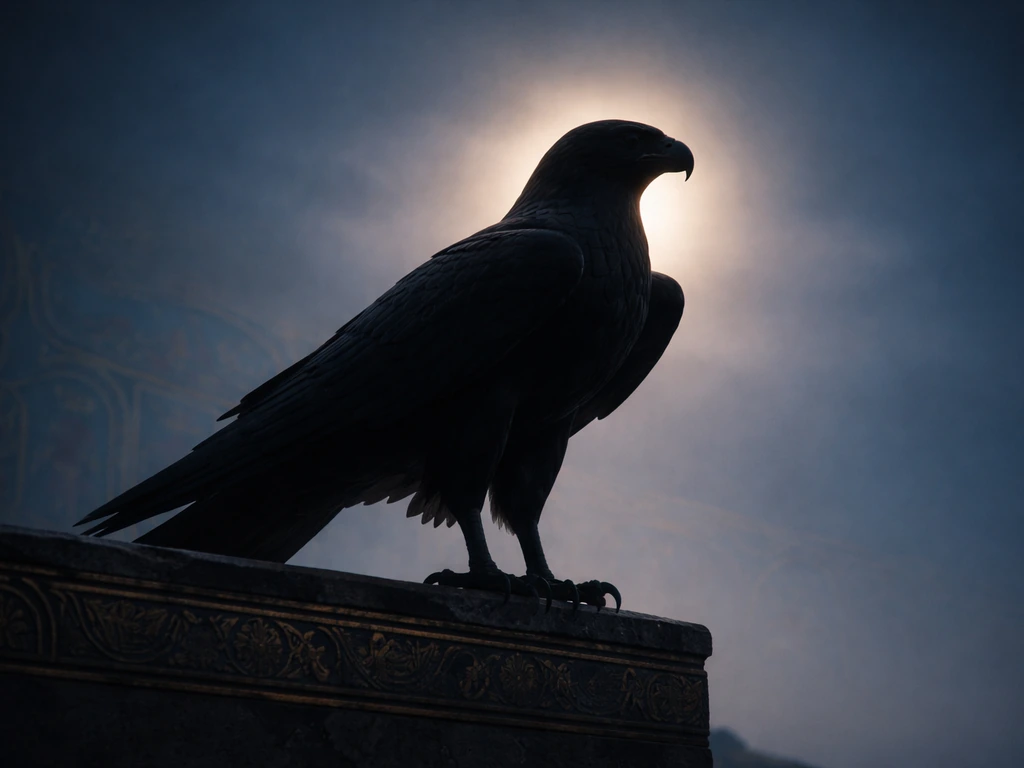
What Bird Is Horus? Falcon, Meaning, and Symbolism
Find what bird represents Horus, why it is usually a sacred falcon, plus symbolism meanings like protection and kingship
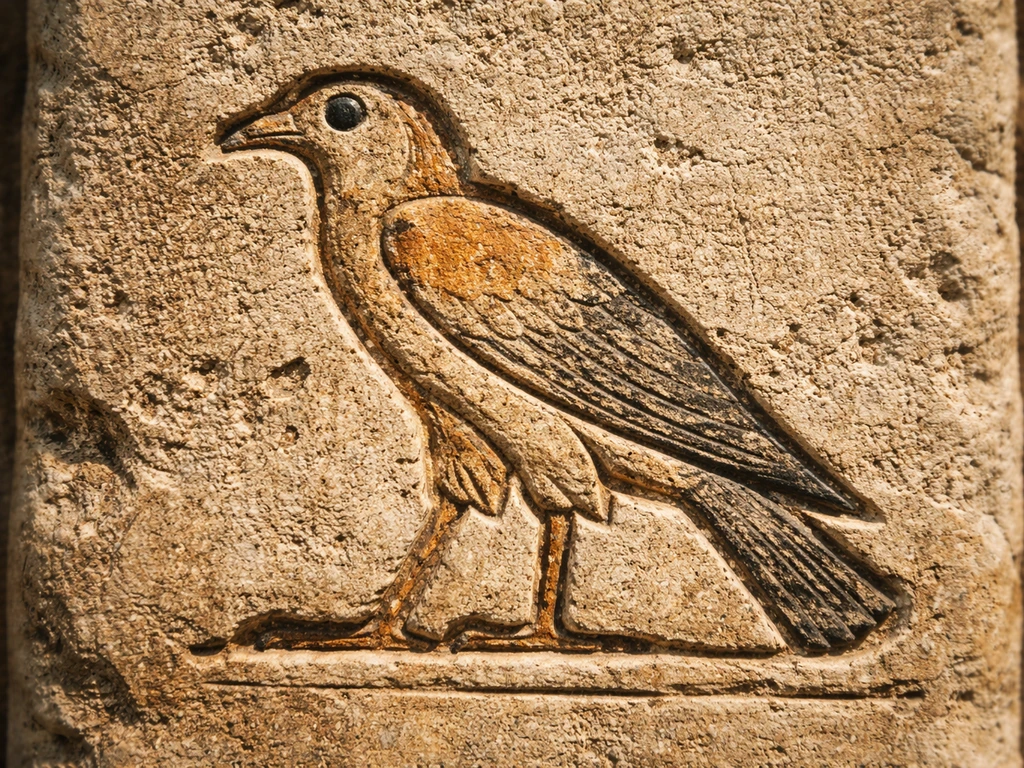
Hieroglyphics Bird Meaning: How to Identify Egyptian Bird Signs
Identify Egyptian bird hieroglyphs by shape and context, then decode their sound, determinatives, and symbolism.

Is the Holy Spirit a Bird? Dove Meaning in Scripture
Biblical answer to is the Holy Spirit a bird, explaining the dove appearance at Jesus baptism and dove symbolism for pra