
The Egyptian god most people are thinking of when they picture a bird head is either Horus (falcon-headed, linked to kingship and the sky) or Thoth (ibis-headed, linked to writing, wisdom, and the moon). Those two cover the vast majority of bird-headed deity images you will encounter in books, museums, and temple art. A third worth knowing is Ra-Horakhty, a combined solar form of Ra depicted with a falcon head and a sun disk, and a fourth is Sokar, a hawk-headed funerary god of the Memphite necropolis. If you are looking at a bird-headed figure right now and want to pin down exactly which god it is, the specific bird type and the headdress or crown will tell you almost everything you need.
What Egyptian God Is a Bird Head? Identify and Meaning

Eleanor Hartwell
30 Apr 2026
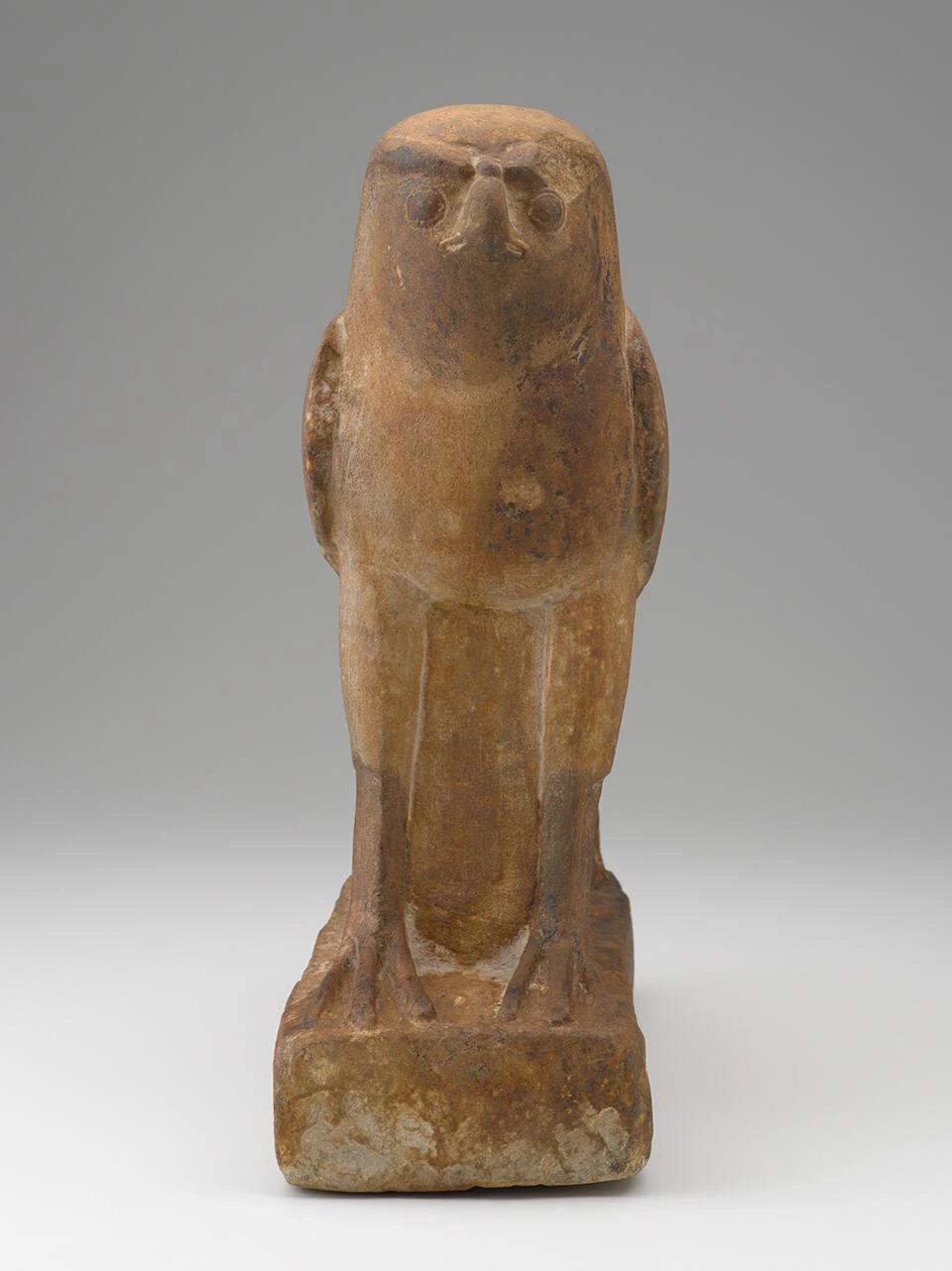
The main bird-headed Egyptian gods
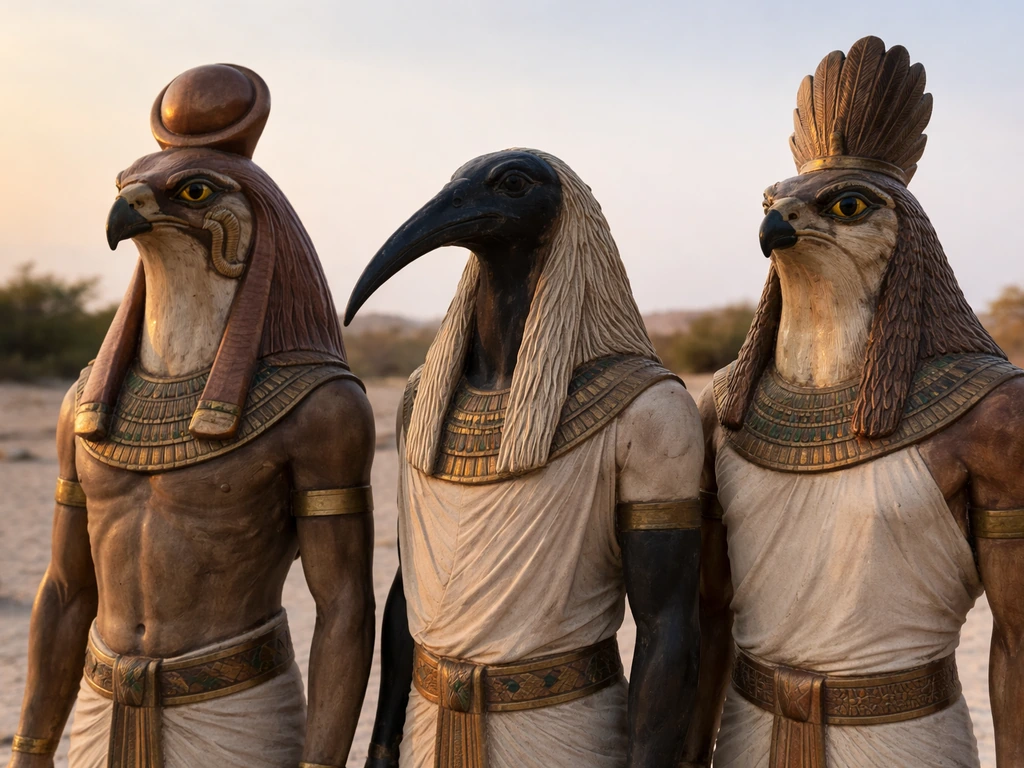
Egyptian religion is rich with hybrid deity forms, but a handful of gods account for nearly every bird-headed image in the historical record. Here is who they are and what bird they carry.
| God | Bird Type | Core Role | Key Symbol |
|---|---|---|---|
| Horus | Falcon | Sky, kingship, divine royal power | Double crown (pschent), solar disk with uraeus |
| Ra-Horakhty | Falcon | Sun god, sky at midday | Solar disk with uraeus on head |
| Thoth | Ibis | Moon, writing, wisdom, reckoning | Moon disk, Atef crown, sometimes wedjat eye |
| Sokar | Hawk/Falcon (often mummified) | Funerary, Memphite necropolis, rebirth | Mummiform wrapping, flail, crook, sun disk |
Horus
Horus is probably the single most recognizable bird-headed deity in Egyptian art. He appears as a falcon-headed man, often wearing the double crown of Upper and Lower Egypt (the pschent), which signals his connection to unified kingship.
The Egyptian king was understood to be the "Living Horus" on earth, which is why this imagery saturates royal monuments, coffins, and temple walls from the earliest dynasties onward. Horus takes several localized forms: Heru-Behdeti (Horus of Behedet) appears as a winged sun disk, most famously carved above the entrance at the Temple of Edfu, while Ra-Horakhty fuses the Horus sky aspect with the Ra solar identity.
When you see a falcon-headed figure in a scene of royal coronation or divine protection, Horus or one of his aspects is almost always the explanation.
Thoth
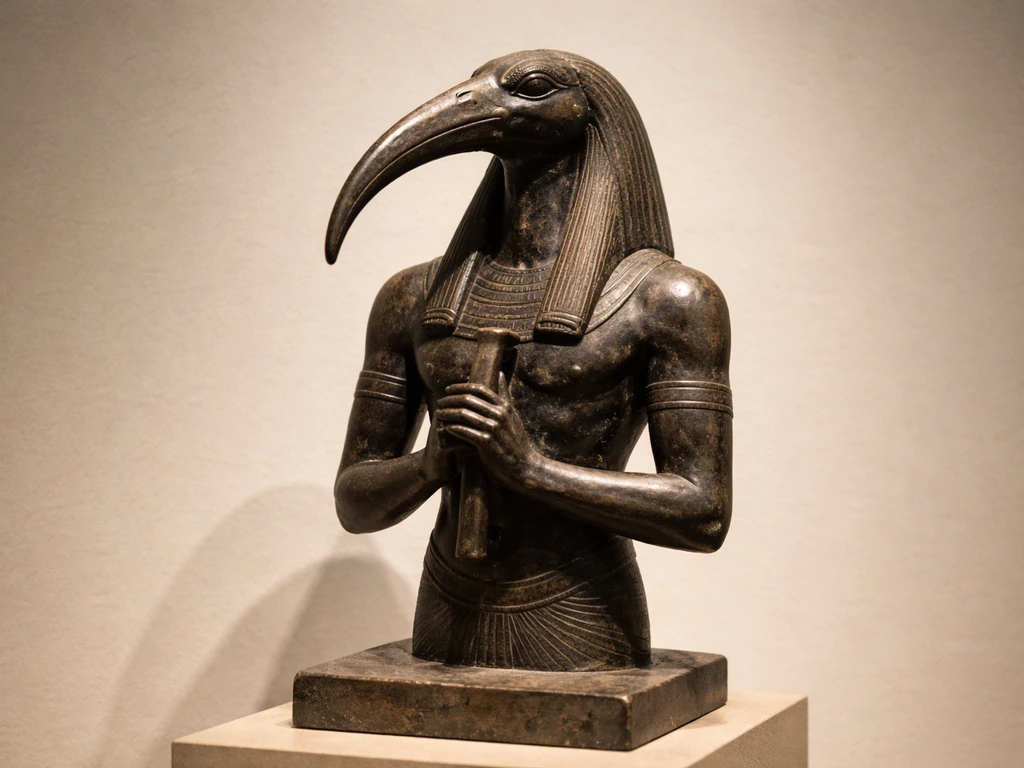
Thoth is the ibis-headed god, and the ibis head is quite distinct from a falcon's once you know what you are looking for. The ibis has a long, dramatically curved downward beak, nothing like the sharp hooked profile of a falcon. Thoth governed writing, language, the calendar, the moon, and cosmic reckoning. He appears in judgment scenes in the Book of the Dead, recording the outcome of the weighing of the heart ceremony.
The Walters Art Museum notes that Thoth's ibis-headed form goes back as far as the Pyramid Texts, making this one of the oldest deity images in Egyptian religion. Smithsonian museum collections describe his amulet form simply as "ibis-headed god Thoth," which tells you how clearly that bird type functions as his identifier.
Ra-Horakhty
Ra-Horakhty is essentially a merged form of Ra and Horus representing the sun at its peak power in the sky. The British Museum describes him with the head of a hawk or falcon and the body of a human, wearing a solar disk. Wikipedia and World History Encyclopedia both note the consistent formula: falcon head plus sun disk inside the uraeus. He is almost always male and standing or striding, and when the solar disk dominates the headdress above a falcon face, Ra-Horakhty is the most likely identification. This is the form most commonly labeled simply as "Ra" in introductory texts, though Egyptologists distinguish the two.
Sokar
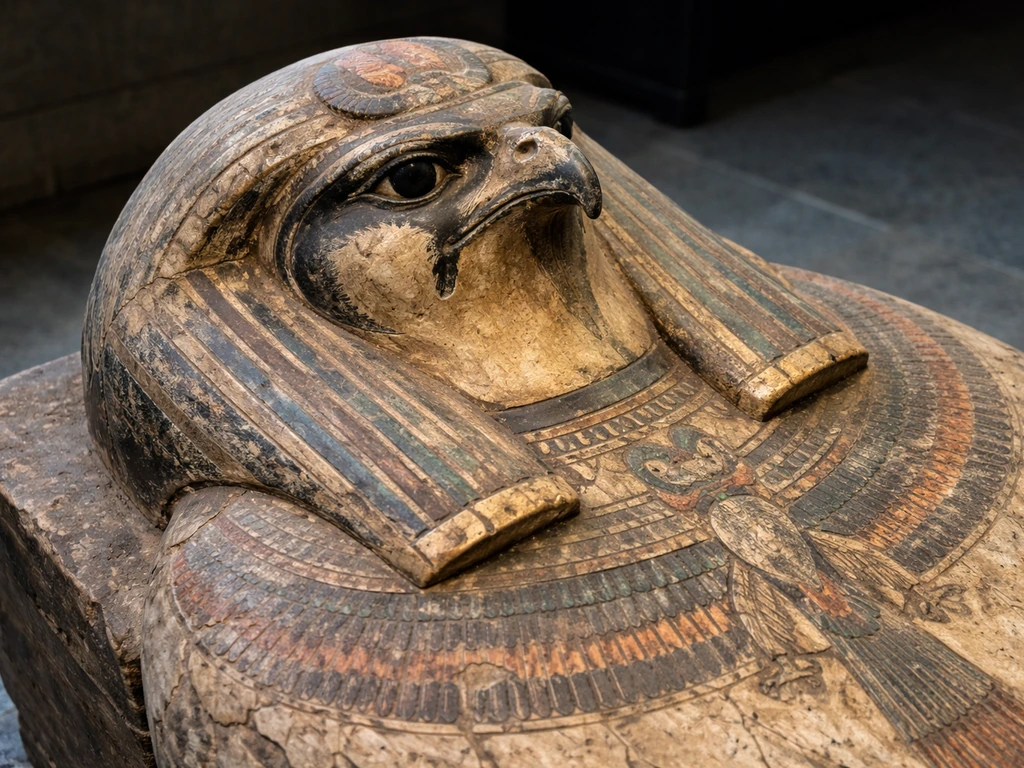
Sokar is less widely known but appears frequently in funerary objects. The British Museum identifies him as the hawk-god of the Memphite necropolis, and he is often depicted in a mummiform or wrapped state rather than as a fully anthropomorphic figure. The Metropolitan Museum of Art notes that during the Sokar festival, the mummified god was imagined to be reborn as the solar falcon, which means his iconography blends death and renewal in a specifically burial-related context. When you see a falcon or hawk-headed figure that is wrapped like a mummy, or appears on a coffin, box, or funerary statuette alongside Osiris imagery, Sokar (or the merged deity Ptah-Sokar-Osiris) is worth considering.
How to confirm which god you're looking at
Museum curators use a consistent set of visual clues to identify bird-headed deities, and you can apply the same approach. Start with the bird type, then check the headdress, then look at what the figure is holding and where the image appears. If you are trying to get the bird term right, it can help to also check the syrinx definition for birds before matching iconography syrinx definition bird.
- Identify the bird: The beak shape is the fastest tell. A long, sharply downward-curving beak is an ibis, which means Thoth. A short, hooked raptor beak on a compact head is a falcon or hawk, pointing toward Horus, Ra-Horakhty, or Sokar.
- Check the headdress: A solar disk with a uraeus coiled around its base on a falcon head usually indicates Ra-Horakhty. The double crown (a tall white crown set inside a red crown) on a falcon head points to Horus in his kingship role. A moon disk or Atef crown (a white crown with feathers and sometimes ram horns) on an ibis head points to Thoth.
- Look at the body posture and wrapping: A mummiform or wrapped body combined with a hawk head in a funerary object strongly suggests Sokar or the merged Ptah-Sokar-Osiris. An unwrapped, striding human body with a falcon head is more typical of Horus or Ra-Horakhty.
- Note the companion objects: Thoth in judgment scenes often holds a palette and stylus or the wedjat eye. Horus figures in royal contexts are frequently shown with the crook and flail or hovering protectively above a pharaoh. Sokar in combined funerary figures may hold the flail and crook alongside mummy wrappings.
- Read the inscription if one is present: Egyptian hieroglyphic captions on temple walls, stelae, or coffins often name the deity directly. Even a basic hieroglyphic dictionary can confirm the name appearing next to a bird-headed figure, and the bird hieroglyphs themselves carry meaning within those inscriptions.
A Museo Egizio statuette of Horus, for example, is described as falcon-headed with a solar disk adorned with a uraeus on his head, which is an exact match for Ra-Horakhty's formula as well, showing why both the head type and the specific crown details together matter for a confident identification. A British Museum image caption for a Horus figure similarly specifies "falcon wearing the double crown" as its identifying description, giving you a concise two-feature test.
What the bird imagery actually means spiritually
Egyptian bird-headed gods are not just visually dramatic. Each bird choice was deliberate, and the symbolism runs deep and specific to each deity rather than representing a generic idea of "birds" as messengers or omens. In later Egyptian symbolism, birds also appear as carriers of messages, linking them to communication and divine conveyance birds as messengers or omens. In Egypt, the bird’s type and the headdress details also determine the Egyptian bird symbol meaning tied to each deity.
The falcon: sky, power, and the living king
The falcon soars higher than almost any other bird in the Nile environment, and to the Egyptians that height was not incidental. It placed the falcon literally in the realm of the sun and the heavens, making it the natural embodiment of sky-divinity. Horus as falcon represented the king's divine authority: the reigning pharaoh was the "Living Horus," and the deceased pharaoh merged with Osiris. The Detroit Institute of Arts describes the Horus falcon image as a symbol of divine kingship, associating the king with the sky god. When you see a falcon head on a deity, the dominant themes are protection, sovereignty, celestial power, and the ordered rule of the cosmos.
The ibis: knowledge, the moon, and cosmic order
The ibis was observed wading in the Nile's shallows, probing the mud with that curved beak in a motion that visually evoked writing. The Egyptians made that connection explicit: Thoth, the ibis-headed god, was the divine scribe, the keeper of records, and the master of hieroglyphs. The bird hieroglyph meaning is often tied to Thoth, since the ibis symbolizes writing, records, and the master of hieroglyphs. But his domain extended further.
Britannica describes Thoth as god of the moon, reckoning, and learning, and Wikipedia maps his attributes across wisdom, knowledge, writing, hieroglyphs, and judgment. The ibis-head therefore carries connotations of precise intellect, the measurement of time (tied to the lunar calendar), and the cosmic balance maintained through accurate record-keeping. On this site's broader framework of bird symbolism, the ibis brings an unusually specific portfolio: not general wisdom, but the disciplined, recorded kind.
The hawk in funerary contexts: death, rebirth, and the solar journey
Sokar's hawk-headed funerary form carried a different symbolic weight than Horus's sky-kingship falcon. Here the bird imagery is tied to the regenerative cycle of the sun moving through the underworld and emerging reborn at dawn. The Met describes the Sokar festival as imagining the mummified god reborn as the solar falcon, which is essentially a metaphor for the soul's transformation after death. When falcon or hawk imagery appears on coffins, canopic equipment, or funerary boxes, it often points toward this theme of protection through the underworld passage and renewal on the other side.
Where you'll actually see these images
Bird-headed Egyptian deities appear across a wide range of contexts, and knowing where to look helps you interpret what you are seeing.
- Temple walls and ceilings: Major temples at Edfu, Karnak, Luxor, and Dendera feature Horus, Thoth, and Ra-Horakhty prominently in painted and carved reliefs. The Temple of Edfu is arguably the best single location to see Horus imagery, including the famous winged sun disk of Heru-Behdeti above doorways. Dendera temple ceiling programs feature ibis-headed Thoth in astronomical and cosmological contexts.
- Funerary papyri and the Book of the Dead: Thoth appears in nearly every illustrated Book of the Dead judgment scene, recording the heart-weighing verdict. Horus figures often escort the deceased or stand as one of the four sons of Horus protecting the canopic jars.
- Statues and amulets in museum collections: The British Museum, the Metropolitan Museum of Art, the Brooklyn Museum, and the Art Institute of Chicago all hold identified falcon-headed Horus figures and ibis-headed Thoth figures that are searchable in their online collections. The Smithsonian holds an ibis-headed Thoth faience amulet.
- Coffins and funerary objects: Sokar falcon figurines and Ptah-Sokar-Osiris statuettes appear on and inside coffins, often in falcon or hawk-headed mummiform. The Met's collection includes falcon figurines specifically from coffin or box contexts.
- Hieroglyphic inscriptions and texts: The ibis and falcon appear as hieroglyphic signs within texts, sometimes representing phonetic values and sometimes used as determinatives marking divine names. Reading these alongside bird-headed deity images connects the visual and written Egyptian symbolic systems.
Avoiding the common mix-ups
Several confusions come up repeatedly when people research Egyptian bird-headed gods, and it is worth addressing them directly.
Mixing up Horus and Ra (or Ra-Horakhty)
Both Horus and Ra-Horakhty have falcon heads, and in many popular books they are conflated into a single "falcon sun god" image. They are distinct, though they overlap historically. Ra-Horakhty is a specific solar fusion deity whose identifying feature is the sun disk with uraeus as the dominant headdress. Horus in his royal form emphasizes the double crown of the Two Lands. The confusion is understandable because Egyptian theological thinking intentionally layered these identities, but for identification purposes the headdress is your clearest differentiator.
Confusing Sokar with Horus in falcon form
Because both Sokar and Horus appear as hawks or falcons, objects showing a wrapped or mummiform bird-headed figure are sometimes labeled as Horus when they are more precisely Sokar. Chiddingstone Castle's collection notes explicitly distinguish the mummified hawk form of Sokar from the striding anthropomorphic falcon of Horus. Context matters: a falcon figure found inside a coffin or on a funerary box is statistically much more likely to relate to Sokar or the Ptah-Sokar-Osiris composite than to a royal Horus depiction.
Assuming Egyptian bird symbolism transfers directly to other traditions
One of the most common reader errors is assuming that a "bird god" in one culture maps neatly onto a bird symbol from another. The falcon's association with sky-power and kingship in Egypt is culturally specific. It does not map cleanly onto, say, the Norse raven's role as Odin's messenger, or the phoenix as a symbol of rebirth found in Greco-Roman and later Christian contexts.
Even within Egyptian tradition, the Saqqara bird (a famous wooden carved object) carries entirely different interpretive questions unrelated to deity iconography. The Saqqara bird is a separate ancient Egyptian object, often interpreted as a model or ritual item rather than a deity image. Keeping Egyptian bird-headed deity symbolism grounded in its own cultural framework gives you a far more accurate and meaningful interpretation.
Greek and Roman period name overlaps
During the Ptolemaic period, Egyptian deities were sometimes presented in syncretic Greek forms. Thoth was identified with Hermes, producing the figure of Hermes Trismegistus in later traditions. Horus in his childhood form (Harpocrates) became a popular amulet figure in the Greco-Roman world. These later interpretations are fascinating but distinct from classic pharaonic iconography, so if you are reading a text that uses names like Harpocrates, be aware that you have moved into a later, syncretic layer of the tradition.
Where to go next for reliable research
If you want to go deeper on any of these deities or verify a specific image you have found, the following paths are consistently reliable and publicly accessible.
- Search museum collection databases directly: The British Museum, the Metropolitan Museum of Art, the Brooklyn Museum, the Art Institute of Chicago, and the Smithsonian all have free online collection search tools. Search the deity name plus a term like "falcon-headed" or "ibis-headed" and you will find museum-verified, labeled objects with curatorial notes explaining the identification.
- Use Britannica and World History Encyclopedia for deity overviews: Both are editorially reviewed and give accurate summaries of each god's role, iconographic features, and mythological context. World History Encyclopedia's articles on Ra, Thoth, Horus, and Sokar are solid starting points.
- Check Egyptological resources for temple-specific imagery: The Oriental Institute at the University of Chicago (now the Institute for the Study of Ancient Cultures) publishes academic work on Egyptian religion and temple programs. Their resources on Horus the Behdetite, for example, explain the nuanced distinctions between forms of Horus across different temple sites.
- Visit the temples virtually or in person: The Temple of Edfu and the Temple of Karnak both have significant photographic documentation online, including through the Digital Karnak project at UCLA. Seeing the imagery in situ (even digitally) gives you a sense of scale, context, and compositional placement that no isolated photograph conveys.
- Cross-reference hieroglyphic captions with a basic sign list: Sir Alan Gardiner's sign list, available in many Egyptology introductions, includes the ibis and falcon as specific hieroglyphic signs. Understanding how these birds function as both pictorial symbols and phonetic elements in inscriptions deepens your reading of any Egyptian bird-headed image significantly.
Egyptian bird-headed deities reward the extra research effort. What looks at first like a generic "bird god" image turns out, on close inspection, to carry a very precise symbolic vocabulary: the angle of a beak, the shape of a crown, the presence of a uraeus or a wedjat eye, the setting of a funerary box versus a temple column. That precision is part of what makes Egyptian iconography so compelling to study, and it connects directly to the broader question this site explores: why birds, across so many cultures and centuries, consistently become the visual language for the things humans find hardest to express.
FAQ
How can I tell which bird-headed god I’m looking at if the image is small or blurry?
A bird head most often points to Horus (falcon), Thoth (ibis), Ra-Horakhty (falcon with a dominant sun disk and uraeus), or Sokar (hawk/falcon in funerary, often mummiform or wrapped form). If you can describe the bird shape and the headdress (double crown, sun disk, uraeus, or wrap), you can usually narrow it to one within a few checks.
What’s the quickest way to differentiate Horus (falcon) from Thoth (ibis) in artwork?
Start with the beak profile. A sharply hooked, short beak usually indicates a falcon type (more Horus or Ra-Horakhty), while a long, curved downward beak is the ibis type (Thoth). Then confirm with the headdress: Thoth tends to lack the classic falcon-sun fusion look, while Ra-Horakhty has the sun disk and uraeus prominently above the falcon face.
When does a falcon-headed figure become Ra-Horakhty instead of Horus?
If the headdress is dominated by a solar disk and uraeus over a falcon face, the figure is much more likely Ra-Horakhty than Horus-as-sky. Horus-as-royal typically emphasizes royal regalia cues like the double crown theme, and the scene often relates to kingship or divine protection rather than a fused “peak-sun” formula.
If I see a hawk or falcon on a coffin, should I assume Horus?
Sokar is commonly recognized by funerary setting plus “wrapped” or mummiform presentation. If you see the bird-headed figure inside coffin-related objects, canopic or funerary boxes, or alongside Osiris context, label it as Sokar (or the Ptah-Sokar-Osiris composite) first, and treat Horus as a lower-probability option for that context.
Why is it risky to match an Egyptian bird god to bird symbolism from another culture?
Don’t rely on the word “bird” alone, because later cultures’ bird symbols often represent different meanings (for example, ravens and messengers in other traditions). In Egyptian iconography, the specific bird type and headdress function as the identifier, so a “bird god” label without visual details is usually too vague to be accurate.
Can older Egyptian bird-headed gods show up under different names in later sources?
Yes. In the Greco-Roman and syncretic layers, you may encounter equivalents like Hermes Trismegistus (linked to Thoth) or Harpocrates amulet figures (linked to Horus). If a text emphasizes those Greek names, it may describe a later interpretation rather than the older pharaonic iconography your image-reading method expects.
What’s a practical rule of thumb to avoid mixing up Horus and Ra-Horakhty?
People often conflate Horus and Ra-Horakhty because both use a falcon head. A practical rule: check which feature dominates the headdress. A prominent sun disk with uraeus supports Ra-Horakhty, while double-crown royal symbolism supports Horus. If both features are present, you may be looking at a syncretic or overlapping representation, but the headdress priority still helps.
How do composites like Ptah-Sokar-Osiris affect identification of a hawk-headed figure?
Yes, be alert to “composite” identities. Sokar can appear merged as Ptah-Sokar-Osiris, especially in funerary contexts. If the surrounding imagery includes Ptah or Osiris themes, don’t force the figure into a single-name label, use the composite as the best fit for the object’s program.
Does the setting (temple vs. funerary object) change which bird-headed god is most likely?
If an object is the key clue, use it. Temple columns, royal monuments, and coronation or protection scenes lean toward Horus or one of his royal sky-linked aspects. Funerary boxes and coffin contexts lean toward Sokar or composite funerary forms. The same bird head can shift meaning based on where it appears.
If a bird appears as a symbol in hieroglyphs, does it always mean the god Thoth?
One common mistake is treating the bird hieroglyph as if it guarantees Thoth. The ibis bird is closely associated with Thoth’s writing role, but the only reliable identification comes from the complete iconography: bird type, headdress, and the object or scene. A bird sign alone could mean “writing” or “time” rather than a fully depicted deity.