The Saqqara bird was almost certainly used as a ceremonial or religious object, most likely a votive offering or a symbolic artifact placed in a tomb context, though a small but persistent group of researchers has argued it could represent an early model of an aerodynamic glider. The mainstream archaeological view, backed by the object's tomb provenance and its resemblance to other Egyptian bird-shaped items, is that it functioned as a ritual or decorative piece tied to Egyptian beliefs about the soul, the divine, and the afterlife rather than as any kind of flying device.
What Was the Saqqara Bird Used For in Ancient Egypt

Eleanor Hartwell
14 May 2026
What people actually mean by the "Saqqara bird"
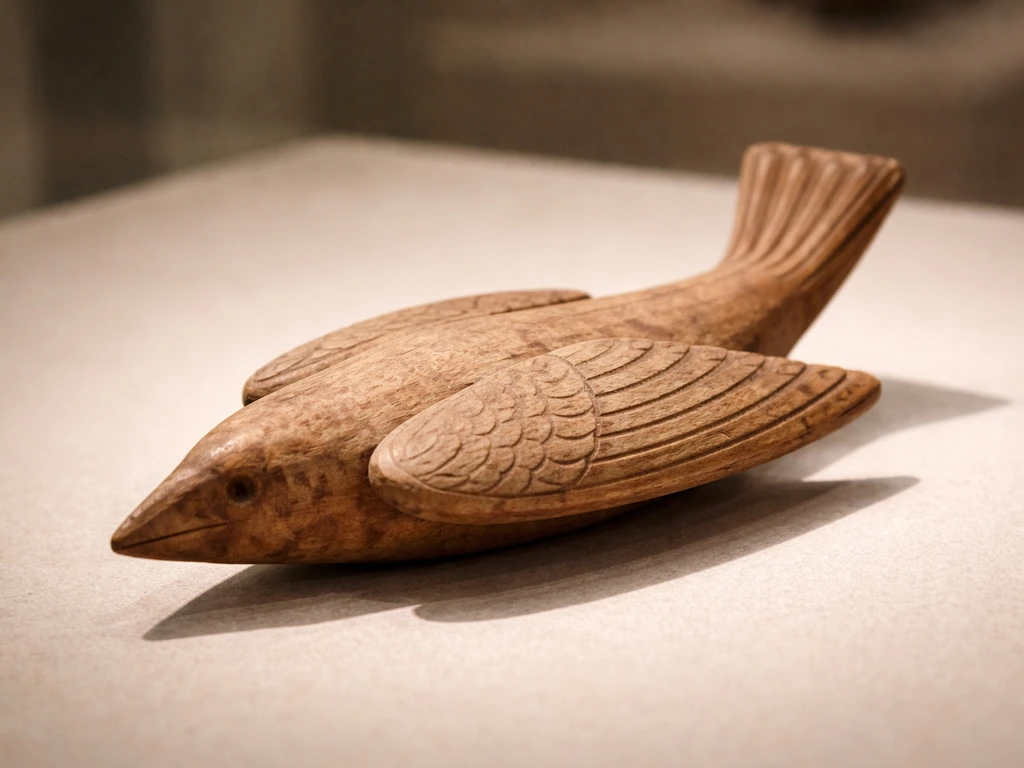
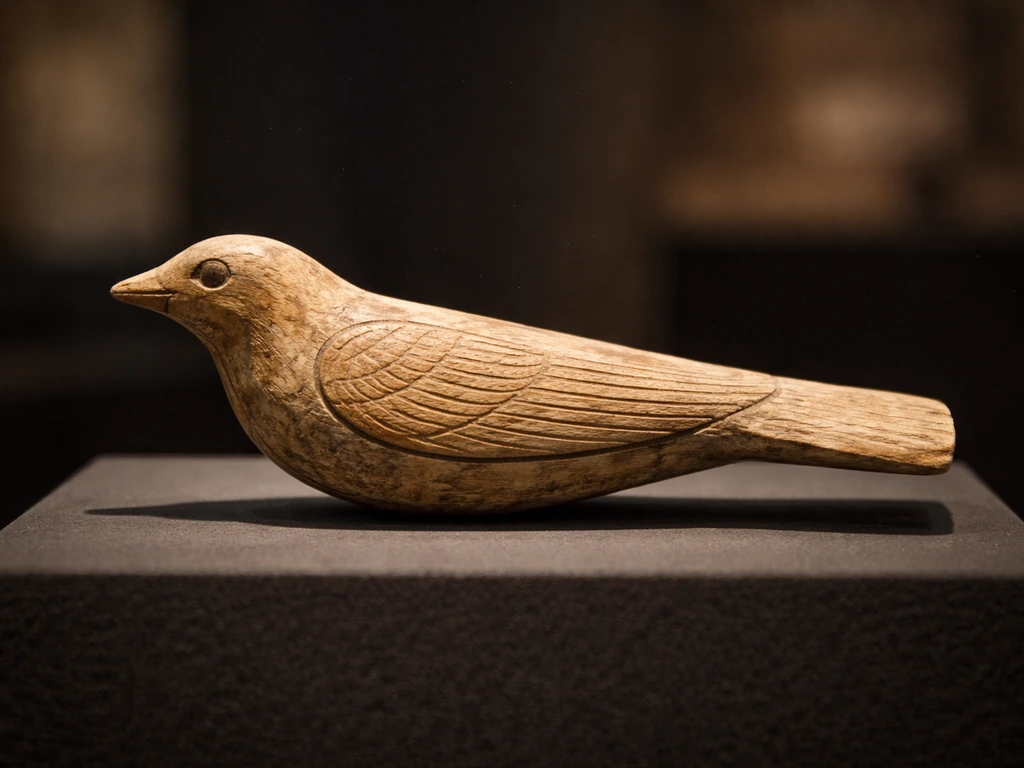
When people search for the Saqqara bird, they are almost always referring to a single specific object: a small carved wooden bird-shaped artifact excavated from the Saqqara necropolis in Egypt. It was found during an 1898 excavation of the tomb of Pa-di-Imen (sometimes transliterated as Pa-di-Amun), a burial site located in the Saqqara cemetery complex near Memphis. The object is carved from sycamore wood and measures roughly 14 centimeters (about 5.5 inches) long. Its wings are straight rather than curved downward like a natural bird at rest, and it has a vertical tail fin rather than a horizontal one, which is what sparked decades of speculation about its possible aerodynamic function.
It is worth being precise here because the word "bird" turns up constantly in Egyptian museum catalogs. The British Museum and the Egyptian Museum in Cairo both hold dozens of bird-shaped amulets, ba-bird figures, and other avian objects from various sites, including Saqqara. The specific artifact known as "the Saqqara bird" is cataloged at the Egyptian Museum in Cairo under Special Register 6347 (also referenced in secondary sources as 6347/69).
This object is commonly identified as the small carved wooden “Saqqara bird” excavated around the 1898 excavation of the tomb of Pa-di-Imen at Saqqara, and it entered the collection of the Egyptian Museum in Cairo cataloged at the Egyptian Museum in Cairo under Special Register 6347. If you are trying to verify the object you have read about, that catalog number is the clearest anchor.
How to identify and locate it today
The Saqqara bird is held in the Egyptian Museum in Cairo (Tahrir Square), which remains its primary custodial institution. The catalog designation Special Register 6347 is the standard reference used in academic discussions. The object is small enough to sit in the palm of your hand, carved from a single piece of sycamore wood, and painted to suggest a stylized bird with outstretched wings. The tail fin projects vertically rather than fanning out horizontally, which is the morphological detail that distinguishes it visually from a naturalistic bird carving.
If you want to verify the artifact's details independently, the Egyptian Museum's own publications and the catalog records maintained by institutions like the Petrie Museum at University College London or university Egyptology departments are your most reliable starting points. Be cautious with secondary web sources: many websites repeat the same handful of claims (sometimes inaccurately) without tracing back to the original excavation report or museum record. Dating estimates place the object in the Late Period of ancient Egypt, roughly 200 BCE, though you will find some sources that list broader or slightly different ranges.
What it was most likely used for
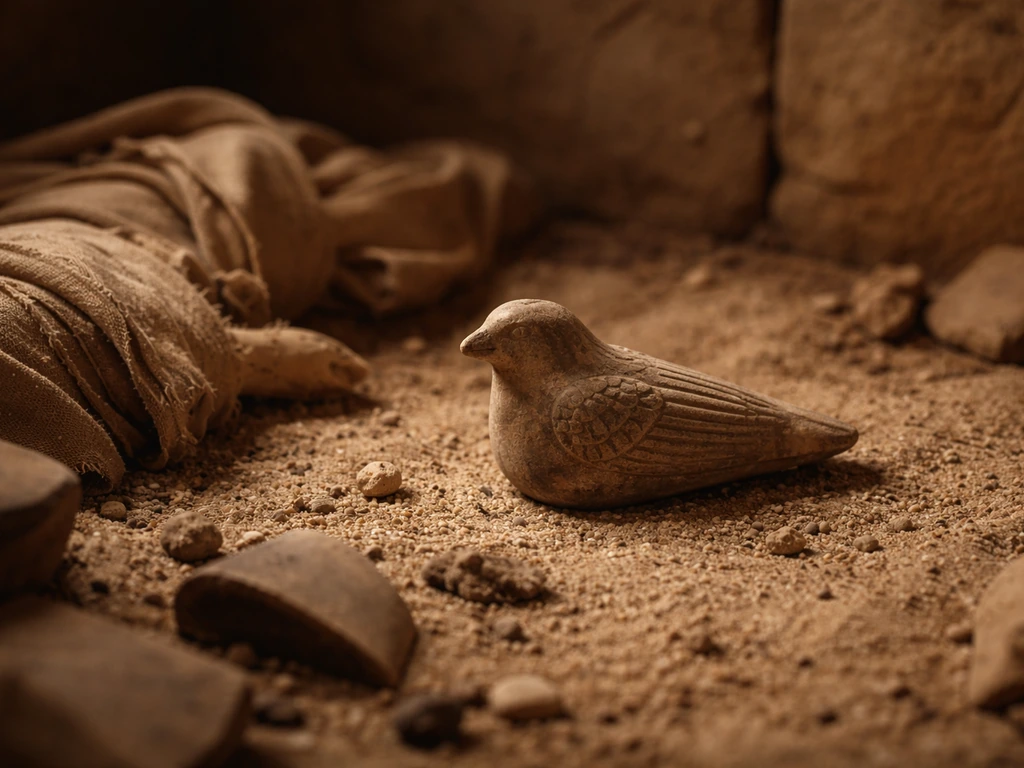
The evidence-based answer is straightforward: bird-shaped objects placed in Egyptian tombs were overwhelmingly ritualistic or votive in nature. The tomb of Pa-di-Imen was a burial context, and small carved objects found there fit a well-documented pattern of grave goods, protective amulets, and symbolic offerings. Bird-shaped amulets are one of the most common categories of small artifacts recovered from Egyptian burials across thousands of years.
blank" rel="noopener noreferrer">The British Museum's own collection, for example, includes numerous amulets explicitly described as "Amulet: Bird" that were excavated from tombs in the Saqqara-Memphis region, with suspension perforations indicating they were worn or hung as protective charms. A Princeton University Art Museum object record for an “Amulet: Bird” describes the type as an amuletic bird form with the kinds of cataloged features typically used to distinguish these items “Amulet: Bird” amulets with suspension perforations.
Given that context, the most defensible interpretation is that the Saqqara bird was either a votive offering placed in the tomb as part of burial ritual, a decorative object with religious significance, or possibly a miniature representation of a divine or soul-related concept (discussed more below). There is no contemporaneous text or inscription associated with the object that specifies its purpose, so the function is inferred from archaeological context and comparison with similar objects. That absence of inscription is important to keep in mind when evaluating any claim about its use.
The alternative theories, and why they keep coming up
In 1972, Egyptian archaeologist Khalil Messiha published a paper arguing that the Saqqara bird's vertical tail fin and swept-back wings gave it aerodynamic properties consistent with a glider, and that it might represent evidence of ancient Egyptian knowledge of flight principles. This argument attracted significant popular attention and has been repeated in countless books and documentaries about ancient mysteries. Messiha also noted that no eyes were carved onto the object, which he suggested meant it was not modeled after a real bird species.
Subsequent researchers, including aerospace engineer Martin Gregorie, tested scale models of the object and found that while the general shape has some aerodynamic qualities, it does not function as a stable glider without modifications (particularly to the nose weight and wing geometry). The vertical tail fin, rather than being evidence of aeronautical engineering, may simply reflect an artistic convention or the natural way a carver interpreted a particular bird species. Falcons and similar birds, which feature heavily in Egyptian art, can appear to have a narrower, more upright tail profile when carved in certain poses.
The theory persists for a few reasons. First, the shape genuinely is unusual compared to most Egyptian bird carvings. Second, there is a natural human interest in finding technological sophistication in ancient cultures. Third, the absence of clear textual evidence about the object's use leaves interpretive space open. But "unusual shape" and "no inscription" do not constitute evidence of advanced aviation knowledge. The mainstream Egyptological consensus treats the glider theory as speculative and unsupported by the broader archaeological record.
What a bird meant in ancient Egyptian belief
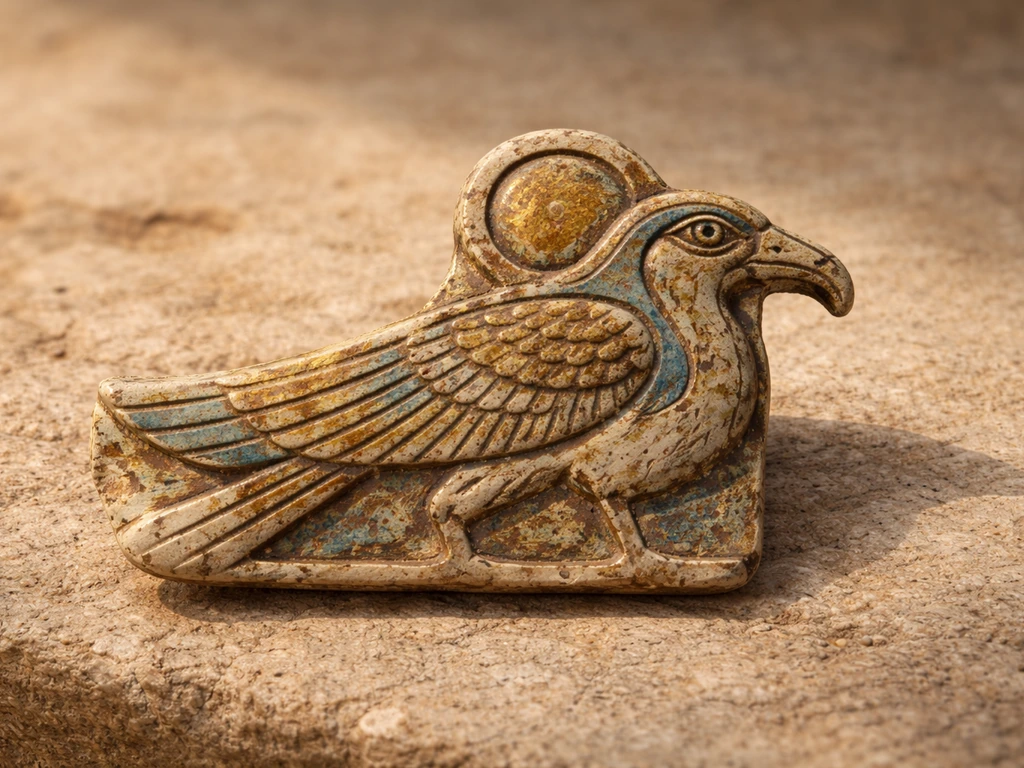
To understand why a bird-shaped object belongs in a tomb, you need to know how Egyptians thought about birds. In Egyptian cosmology, birds were not simply animals. They were carriers of the divine, symbols of the soul, and vehicles of transformation. If you want the wider Egyptian bird symbol meaning behind images like the ba-bird, it helps to start with how birds functioned as divine messengers and soul carriers. The concept of the ba, one of the soul's aspects, was depicted as a human-headed bird that could leave the tomb and move between the physical and spiritual worlds. The ba-bird representation appears in tomb paintings, papyri, and small amulets across centuries of Egyptian funerary practice.
Beyond the ba, specific bird species carried distinct meanings. Horus, one of Egypt's most important gods, was depicted as a falcon or a man with a falcon head. Some people also ask what bird Horus was, and that connects to how falcons and falcon-headed imagery fit Egyptian religion. The falcon was a symbol of divine kingship, protection, and celestial power. The ibis represented Thoth, god of wisdom and writing. The vulture (particularly the lappet-faced vulture) was associated with Nekhbet, a protective goddess of Upper Egypt. Birds in Egyptian art and artifacts are almost never just decorative. They are ideographic, carrying layered meaning about protection, the soul's journey, divine presence, and rebirth.
This context is why a small carved bird placed in a tomb makes complete sense within Egyptian belief. It did not need to be a glider or a toy to be meaningful. Its presence in a burial may have been intended to assist the soul's flight into the afterlife, to invoke divine protection, or to represent the deceased's ba moving freely between worlds. These are not fanciful interpretations layered onto the object from outside. They are consistent with everything else Egyptians documented about why they put the things they put in tombs.
How to approach the Saqqara bird spiritually today
If you are drawn to the Saqqara bird because of its connection to bird symbolism, soul imagery, or Egyptian spiritual tradition, that is a completely legitimate lens to work with. Just keep the layers of interpretation clearly separated in your mind: what the archaeological evidence supports, what is speculative, and what you are personally bringing to it as meaning.
The part with genuine symbolic weight is this: a carved bird placed in an Egyptian tomb almost certainly carried meaning related to the soul's freedom, the possibility of flight beyond physical death, and divine protection during the journey through the afterlife. This is why the object is sometimes discussed alongside the question of which bird was used to carry messages in ancient Egyptian belief. That is not speculation.
That is what birds meant in Egyptian religious thought, consistently, across millennia. If you are exploring what birds represent spiritually, the Egyptian tradition offers one of the most developed frameworks in human history, with the ba-bird concept being particularly rich for reflection on what it means for consciousness to move freely beyond the body.
Where to hold the line is on the glider theory. The Saqqara bird does not need to be an ancient flying machine to be spiritually or symbolically significant. Treating it as proof of lost technological knowledge actually distracts from the genuinely profound meaning it carries within its actual cultural context. A small wooden bird placed carefully in a tomb to help a soul take flight is, if anything, more moving than a prototype glider. The spiritual resonance is already there without needing to reach for the extraordinary.
Practical next steps for researching this confidently
If you want to go deeper on the Saqqara bird, here is how to approach it without getting lost in unreliable sources:
- Start with the Egyptian Museum in Cairo's own resources. The catalog number Special Register 6347 is the reference you want. Some museum publications are available through academic library databases or directly from the museum.
- Look for peer-reviewed Egyptology sources rather than popular mystery books. JSTOR and Google Scholar give you access to academic papers. Search for "Saqqara bird" alongside terms like "votive offering," "ba-bird," or "Egyptian funerary amulet" to see how specialists categorize it.
- Read Khalil Messiha's original 1972 paper to understand the glider theory from its source, then read the aerospace engineering critiques (Martin Gregorie's analysis is a good counterpoint) so you can evaluate both sides yourself rather than relying on secondhand summaries.
- Cross-reference with Egyptian bird symbolism more broadly. Understanding how falcons, ibises, and ba-birds function in hieroglyphics, tomb paintings, and religious texts will give you the cultural framework to interpret any bird-shaped object from this period.
- If you want the symbolic and spiritual dimension, explore academic treatments of Egyptian funerary religion alongside your symbolism research. Erik Hornung's work on Egyptian religious thought and Jan Assmann's writings on Egyptian conceptions of the soul are accessible entry points.
- For museum catalog methodology, the British Museum's online collection database (free to search) shows how bird-shaped amulets from Saqqara are categorized and described. Comparing those records with what you read about the Saqqara bird helps calibrate how to interpret artifact descriptions.
The Saqqara bird sits at a genuinely interesting intersection: it is a real, cataloged artifact with a specific tomb provenance, it connects to one of history's richest traditions of bird symbolism, and it has attracted enough fringe theorizing that careful source evaluation matters. Approaching it with that combination of skepticism and openness, grounding your interpretation in what Egyptian culture actually said about birds and souls, gives you the most honest and the most meaningful read of what this small wooden bird was and what it still carries. If you want a clearer syrinx definition bird framing, use the term “syrinx” in its anatomical sense rather than treating it as a name for the artifact Saqqara bird.
| Claim | Evidence Level | What it's based on |
|---|---|---|
| The Saqqara bird is a votive or ritual tomb object | Strong | Tomb provenance (Pa-di-Imen burial), comparison with hundreds of Egyptian bird amulets from similar contexts |
| It represents the ba-soul or divine bird concept | Moderate (contextual) | Consistent with Egyptian funerary beliefs, but no inscription on the specific object confirms this |
| It was an ancient glider or model aircraft | Weak | 1972 paper by Messiha; subsequent aerodynamic testing found it does not function as a stable glider without modification |
| The vertical tail fin is evidence of aeronautical knowledge | Not supported | Alternative explanations (artistic convention, stylized falcon depiction) are more consistent with Egyptian carving traditions |
FAQ
Was the Saqqara bird definitely meant to fly, or is that just speculation?
The most defensible use is as a grave-related votive or symbolic tomb item. The inference is based on the burial context from Pa-di-Imen’s tomb (where small carved objects commonly functioned as protective or ritual goods), not on any specific wording or image that explicitly states “this was for flying.”
How can I tell which explanations of the Saqqara bird are evidence-based?
Because there is no attached inscription naming a function, most claims rely on material context and comparison with other bird-shaped amulets. If an interpretation does not cite the original excavation report or the museum catalog entry, treat it as a secondary retelling rather than settled evidence.
What do aerodynamic model tests suggest about the glider theory?
The glider idea rests largely on its unusual wing and tail profile, but aerodynamic tests with models suggest it would not be a stable or practical glider without changes. So even if the form has some aerodynamic resemblance, that alone does not establish an intended aircraft purpose.
Is the Saqqara bird the same thing as other bird amulets or ba-bird figurines?
The artifact is a single small carved wooden bird-shaped object. Avoid mixing it up with other Egyptian bird items in museums, such as separate ba-bird figures or bird amulets from different sites, which may have different functions even if they share the general theme of “birds in the afterlife.”
Does the lack of carved eyes tell us what the Saqqara bird was used for?
Its carvings and proportions matter. The lack of carved “eyes” is relevant to how closely it resembles a specific living bird, but it cannot, by itself, prove whether it was meant as a real-animal depiction, a symbolic form, or a simplified votive.
What’s the easiest way to make sure I’m looking at the correct Saqqara bird artifact?
If you are looking at the wrong object in a catalog or photo, you can get the wrong conclusion about function. Use the listed provenance and standard museum register number to confirm you are viewing the same artifact, then compare wing shape and tail fin orientation rather than relying on the generic word “bird.”
Does the date of the Saqqara bird affect how we interpret its purpose?
Because it is Late Period (commonly placed around 200 BCE, with some range variation), its use reflects funerary practices and religious symbolism of that era. Earlier or later bird amulets exist, but you should not assume the same specific role across all periods without checking dating and context.
If it was symbolic, what is the most reasonable “how it was used” interpretation for a tomb item?
If you want a spiritual interpretation that fits the archaeological context, focus on how tomb goods relate to protecting the deceased and supporting the soul’s movement. In that framework, a bird-form object works as symbolic assistance to the ba concept, without requiring it to be literal equipment or a device.
Next Article
Which Bird Was Used to Carry Messages and Why
Discover which bird carried messages historically, common pigeon traditions, key alternatives, and the symbolism of safe