The phrase 'pious bird of good omen' comes directly from Samuel Taylor Coleridge's poem The Rime of the Ancient Mariner, written in 1797 and published in 1798. In the poem, the bird in question is the albatross, and Coleridge calls it both 'a bird of good omen' and 'the pious bird of good omen' before the mariner kills it and triggers the poem's entire moral catastrophe. So if you've been searching this phrase, you're tracing a thread that runs from a specific piece of literary symbolism out into something much older and wider: a long human tradition of reading birds as divine messengers, signs of blessing, and carriers of moral weight.
Pious Bird of Good Omen: Meaning and How to Interpret It

Eleanor Hartwell
18 Apr 2026

Where the phrase actually comes from
Coleridge's poem uses the albatross as a test of the mariner's reverence. When the great seabird follows the ship through fog and ice, the crew reads it as a sign of God's favor and good fortune. Coleridge reinforces this by calling it 'pious,' a word that carries real theological weight: piety means living in faithful, covenantal devotion, reverence toward the divine. The bird isn't just lucky; it's morally charged. When the mariner 'inhospitably killeth the pious bird of good omen,' the poem frames that act not as bad luck but as a spiritual violation, a failure of reverence that demands repentance. The rest of the poem is essentially the mariner's penance.
The phrase gained renewed cultural visibility when Fleetwood Mac used it as the title of a 1969 compilation album, The Pious Bird of Good Omen, which directly borrowed Coleridge's imagery. If you're curious, that album title is the modern pop-culture moment that helped the phrase take on new visibility beyond Coleridge Fleetwood Mac compilation album. That's why you might encounter the phrase today outside of a poetry classroom: it's been woven into popular culture as a shorthand for something rare, blessed, and worthy of respect. If you're here looking for the symbolic meaning rather than the music, you're in the right place.
What 'pious' and 'good omen' actually mean symbolically
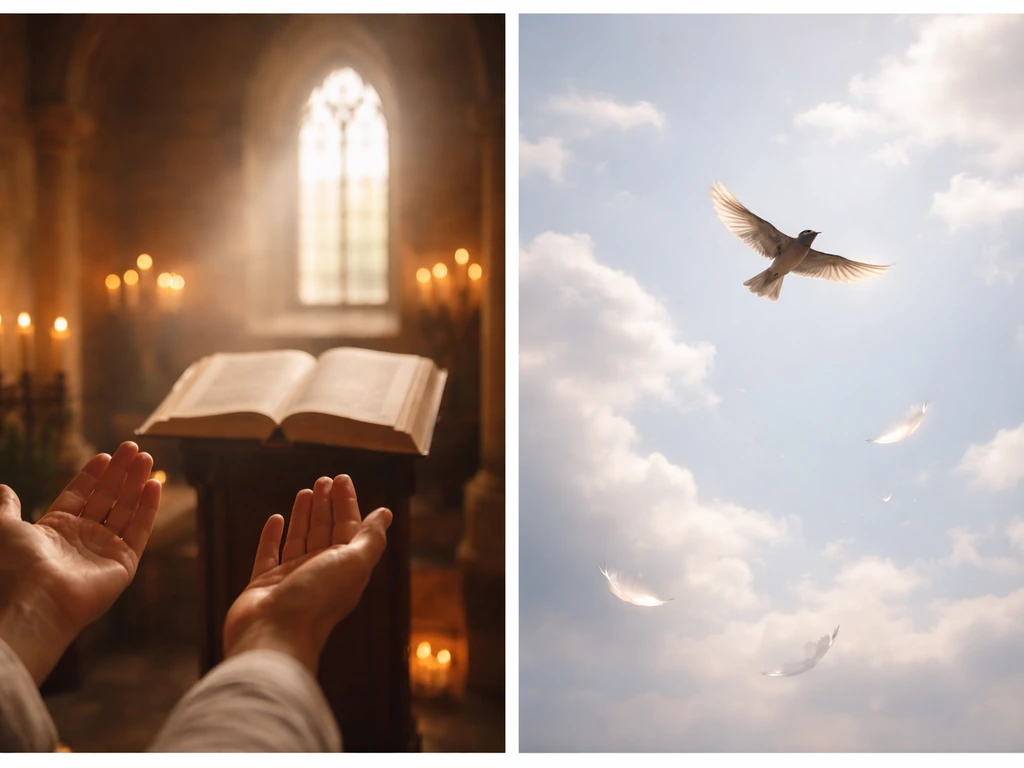
Break the phrase into its two components and you get a cleaner picture. 'Good omen' places the bird inside one of humanity's oldest interpretive traditions: ornithomancy, the practice of reading bird behavior, flight direction, and calls as messages from the divine. This practice shows up in ancient Greece (Homer's Odyssey includes bird-omen interpretation), in Egyptian religious life, in Celtic and Norse traditions, and in countless other cultures. A bird arriving at the right moment, flying in a particular direction, or behaving in an unusual way was understood as communication from the gods or from the spirit world.
'Pious,' on the other hand, lifts the concept above pure fortune-telling. It suggests the bird is not just a lucky charm but a representative of something sacred and covenantally faithful. This is an important distinction: a 'pious' bird of good omen isn't delivering a prediction you can act on mechanically, like a lottery number. It's more like a reminder, a nudge toward reverence, gratitude, and right relationship with the divine and with creation. That distinction matters a lot when you get to the practical question of what to actually do when you encounter one.
Bird symbolism themes tied to piety and good omen
Across traditions, certain recurring themes consistently mark a bird as a positive, spiritually significant sign. These aren't arbitrary; they follow from the bird's actual behavior and the way humans across cultures have responded to it.
- Messenger and return: The dove is the clearest example. In Hebrew Bible and early Christian traditions, the dove symbolizes divine communication, peace, and purity. The Gospel accounts of Jesus's baptism describe the Holy Spirit descending 'like a dove,' and the return of Noah's dove carrying an olive branch is one of the oldest recorded bird-as-divine-messenger stories. The dove's return-to-nest behavior amplifies this: it is a bird that goes out and comes back, mirroring the messenger's function.
- Guidance through difficulty: The albatross in Coleridge follows the ship through ice and fog, appearing when the crew is lost. A bird that arrives when you're navigating uncertainty carries that symbolism regardless of species. This is why 'bird of good omen' sightings are often reported at turning points, not during easy periods.
- Moral reverence: The 'pious' quality signals that the encounter asks something of you. It isn't passive. The mariner's failure was treating the albatross as disposable once it stopped being convenient. A spiritually charged bird encounter traditionally invites a response of gratitude, care, and attentiveness.
- Protection and royal favor: In Egyptian tradition, the Egyptian vulture carried associations with royal protection and divine favor, and was recognized as a 'bird of good omen' in folklore across multiple regions. The connection between large soaring birds and protective divine presence is cross-cultural.
- Gathering and belonging: When birds flock together, cultural readings tend toward themes of kinship, community, and 'like attracting like.' The proverb 'birds of a feather flock together' encodes a positive omen of alignment, a sign that you're in the right company or moving in the right direction.
How to read a real-world encounter
If you've seen an unusual bird, found a feather, had a recurring dream about a bird, or keep noticing bird imagery, here's the honest starting point: context matters enormously. Ancient ornithomancy wasn't a simple 'bird appeared, good news coming' system. Practitioners attended to species, flight direction, behavior, timing, and calls. Modern discernment should be similarly attentive rather than rushing to a universal answer.
- Note the species and behavior. A dove landing calmly near you carries different symbolic weight than a crow circling overhead. White and light-colored birds are almost universally read as positive across European and biblical traditions; large soaring birds suggest perspective, overview, and protection. Crows and ravens, while powerful messengers in Celtic and Norse traditions, carry the opposite valence in European folklore, where they're more often associated with ill omen (think of the Irish figure Badb, who takes raven form as a herald of death).
- Notice your internal state at the moment. A 'good omen' bird encounter tends to feel different from an ordinary sighting. If you felt a distinct sense of peace, recognition, or comfort, take that seriously as data. If you felt uneasy, that's also worth attending to.
- Consider the timing. Was the encounter at a decision point, a moment of grief, a transition? Birds appearing at thresholds, crossroads, and turning points are the ones most consistently read as meaningful across traditions.
- Look at the behavior, not just the species. Was the bird still or moving? Did it seem to be leading somewhere? Did it call out or remain silent? Ornithomantic traditions specifically tracked flight direction and vocalization as interpretive data.
- Resist the urge to over-specify. You may not be able to identify the bird as 'the' pious bird of good omen in some exact taxonomic sense. That's fine. The symbolic tradition is pointing toward a quality of encounter rather than a checklist species identification.
What different traditions say about birds of good omen
No single tradition owns this concept, and it's worth knowing how they differ before you decide which framework resonates for you.
| Tradition | Positive Bird Symbols | What 'Good Omen' Means | Cautions |
|---|---|---|---|
| Biblical / Hebrew | Dove (peace, Holy Spirit, divine favor) | God's communicative presence, not fortune-telling; signs point toward Providence | Deuteronomy 18 explicitly prohibits 'interpreting omens' as a divination practice; guidance belongs to prayer and Scripture |
| Ancient Greek | Eagle, dove (divine messengers in Homer and others) | Direct messages from the gods delivered through flight direction and calls (ornithomancy) | Highly context-dependent; the same bird could reverse meaning based on direction or behavior |
| Celtic / Irish | Swan (purity, transformation), crane (wisdom) | Otherworldly connection, transition between worlds | Ravens and crows (Badb) represent ill omen; not all birds are positive |
| Egyptian | Ibis (wisdom, Thoth), Egyptian vulture (royal protection, spring herald) | Divine protection, favor from the gods, seasonal renewal | Symbolism varied by dynasty and region; not a single unified doctrine |
| Native American | Eagle (spiritual vision, connection to the Great Spirit), hawk (observation, message) | Communication from the spirit world, guidance for the community or individual | Meaning is highly tribe-specific; do not generalize across all nations |
| Aztec | Hummingbird (Huitzilopochtli, warrior souls), eagle (sun, sacrifice, courage) | Solar power, divine favor in battle and renewal | Deeply embedded in cosmological cycles; context of ritual matters |
The consistent thread across all of these is that a 'good omen' bird arrives as a communication, not a guarantee. What the traditions disagree on is whether that communication is from a personal God, from impersonal divine forces, or from ancestral spirits, and whether you should act on it predictively or simply respond with reverence. The biblical tradition is especially pointed on this: interpreting omens as a fortune-telling system is explicitly warned against, while genuine signs of Providence are understood as invitations to trust God more fully, not to extract hidden knowledge. That's a practical distinction worth holding.
The deeper lesson Coleridge was actually teaching
It's worth pausing on what The Rime of the Ancient Mariner is really doing with the albatross, because it's directly applicable to how you should respond to a bird you read as a good omen. The mariner doesn't lack belief in the bird's sacred status; he acknowledges it's a 'pious bird of good omen. For the clearest literary framing of what that phrase means in context, see the full “bird of good omen rime of the ancient mariner” usage in Coleridge pious bird of good omen. ' His failure is that he kills it anyway, once the weather clears and the bird no longer seems useful. Coleridge's moral is stark: recognizing a sacred sign and then disregarding it in favor of convenience is worse than not recognizing it at all. It invites penance. The poem's practical lesson is that a genuine encounter with a bird of good omen calls you toward a sustained posture of reverence, not a one-time acknowledgment followed by business as usual.
Feathers, flight, and nesting: what these symbols add
When you encounter a bird symbolically, the encounter rarely stops at the bird itself. Feathers, the act of flight, and nesting behavior each carry their own layered meanings that can deepen or clarify what the sighting might be pointing toward.
Feathers

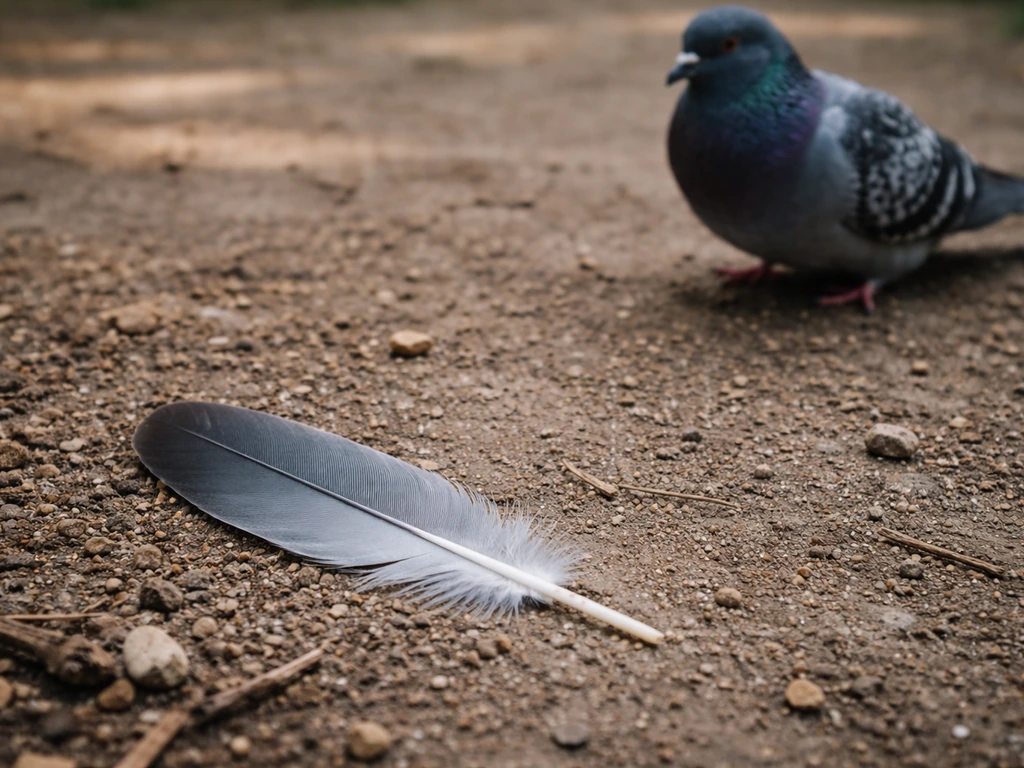
Finding a feather is widely interpreted as a residue of the bird's passage, something left behind as a reminder. Across Native American traditions, feathers carry the energy and spiritual authority of the bird they came from; an eagle feather, for instance, is treated as sacred and is not handled casually. In a broader symbolic reading, a feather found at a meaningful moment is often read as confirmation: the message arrived even if the bird didn't land. The color matters too: white feathers are the most universally read as peace, purity, and angelic presence; dark feathers require more context.
Flight
Flight, across nearly every tradition, represents transcendence, the soul's ability to rise above earthly limitation, and the movement between worlds. A bird in upward flight is almost always read as an ascending sign: hope, prayer being carried upward, liberation. A bird circling overhead suggests watchfulness and protection from a higher vantage point. A bird flying directly toward you is often interpreted as a message arriving; one flying away may suggest a transition or a farewell. Ancient ornithomancy tracked these directions systematically, and while you don't need a Greek diviner's manual, paying attention to direction and movement is still genuinely useful interpretive data.
Nesting
A bird building or occupying a nest near your home is one of the most consistently positive omens across folk traditions worldwide. It carries themes of homecoming, new beginnings, fertility, and the establishment of something lasting. The dove's return-to-nest behavior is specifically highlighted in biblical scholarship as the heart of its messenger symbolism: the bird goes out, returns, and in returning signals safety and renewal. If you're finding nesting imagery recurring in dreams or repeatedly encountering birds near their nests, the thematic cluster being pointed at is: something is being built, a foundation is being laid, return and rootedness are in season for you.
What to actually do after a meaningful encounter
This is where most symbolic guides fall short: they explain the meaning but leave you without a next step. Here's a practical process you can start today.
Journaling the encounter
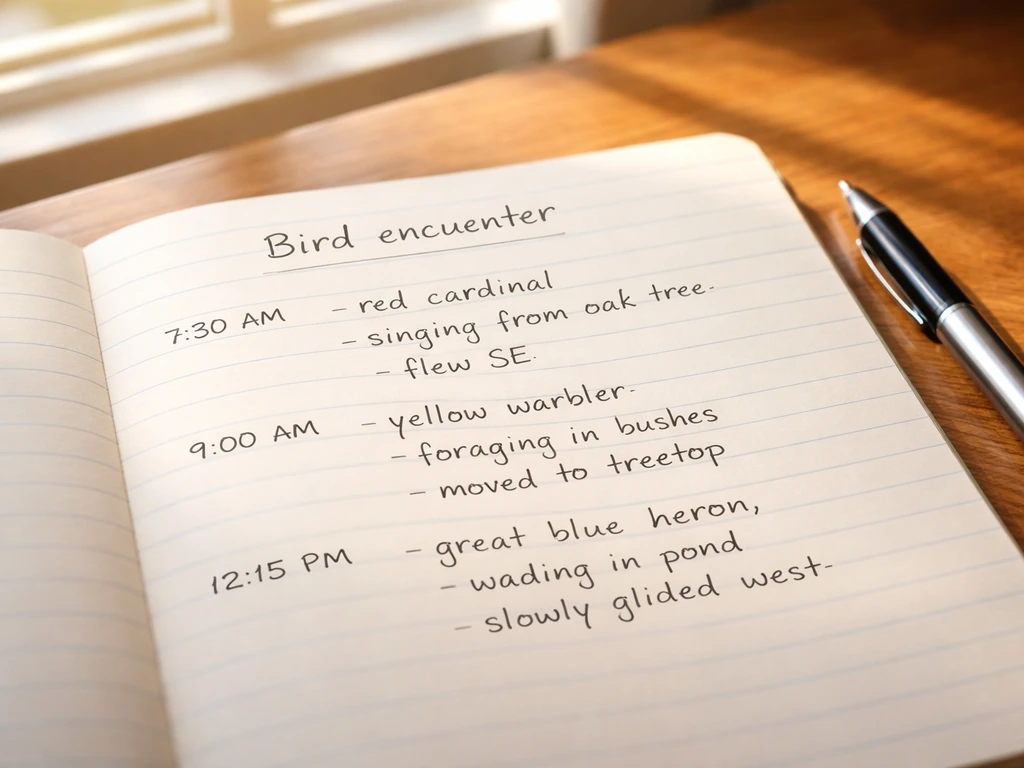
Write down everything you remember while it's fresh. Species (or your best description if you couldn't identify it), behavior, direction of movement, time of day, what you were thinking or worried about immediately before the encounter, and what you felt during it. This isn't woo-adjacent record-keeping; it's the same contextual data ancient ornithomancers tracked, and it gives you something concrete to return to. Ask yourself: What question was I sitting with at the time? What was I most afraid of or most hoping for? The encounter may be answering one of those rather than delivering a general blessing.
Questions to ask for discernment
- What theme does this bird carry in the tradition closest to my own belief system? (Peace? Protection? Renewal? Transition?)
- Does that theme speak to something specific in my current life, or does it feel generic?
- Am I treating this as a prompt for reflection, or am I trying to extract a prediction? (The biblical caution against omen-interpretation as fortune-telling is worth holding here.)
- What would it look like to respond with reverence rather than just relief? (Coleridge's lesson: recognizing the sign is not enough.)
- Is there a pattern? Recurring encounters or imagery are worth taking more seriously than a single sighting.
Prayer, ritual, and contemplative practice
If your framework is Christian or broadly biblical, the most aligned response to a bird encounter you read as meaningful is gratitude and renewed trust, not predictive analysis. Pray about the theme the bird represents (peace, return, protection) rather than asking God to confirm a specific outcome. If you find a feather, many people keep it as a physical anchor for prayer or meditation on the themes it carries. If your framework is indigenous, Celtic, or another tradition, lighting a candle, spending time in nature, or making an offering of thanks at the place of the encounter are all contextually appropriate responses. The through-line across traditions is that a 'good omen' encounter invites a response of gratitude and attentiveness, not passive waiting for the prediction to unfold.
Turning the omen into everyday decisions
A good omen bird encounter is most practically useful as a calibration tool. If you're at a decision point and the encounter felt like confirmation, that's worth weighing, but alongside your actual circumstances, not instead of them. Use it to ask: Am I moving toward peace, return, and renewal, or away from them? Is this decision one I could describe as reverent and protective of what matters, or is it more like the mariner's choice to discard what he recognized as sacred? Good omen symbolism across traditions consistently points toward timing (this is a favorable moment), protection (something is watching over this), and moral alignment (act with care, not just cleverness). Those are usable lenses for any significant choice.
On the question of timing specifically: a bird appearing at a threshold moment is often read as a green light to move forward, but the 'pious' quality of the phrase adds a caveat. For the clearest literary framing of what that phrase means in context, see the full “bird of good omen rime of the ancient mariner” usage in Coleridge pious bird of good omen. For the clearest literary framing of what that phrase means in context, see the full “bird of good omen rime of the ancient mariner” usage in Coleridge pious bird of good omen. Move forward with reverence and care, not with the recklessness of someone who thinks they have divine immunity. The mariner had a 'bird of good omen' and still managed to ruin everything by treating the blessing carelessly. Good omens don't override the need for wise action; they accompany it.
Where to go from here
If you want to go deeper on the specific bird at the center of this phrase, the albatross and its symbolism in The Rime of the Ancient Mariner is worth exploring on its own terms, as is the broader category of birds of ill omen, which gives the 'good' category its contrast and meaning. The Fleetwood Mac compilation that borrowed Coleridge's title is also an interesting cultural artifact showing how poetic bird symbolism migrates into popular consciousness across generations. If you are exploring other famous bird phrases too, the “wonderful bird is the peacock limerick” is another memorable way poets spotlight birds and symbolism a wonderful bird is the peacock limerick. And if you're drawn to the ornithomantic tradition more broadly, the ancient Greek and Celtic frameworks for reading bird behavior are genuinely rich systems, just worth approaching with the discernment boundary in mind: reflection and reverence, not prediction and control.
FAQ
Is “pious bird of good omen” meant literally, or is it just poetic symbolism?
Yes, the phrase is typically best understood as a literary and symbolic marker, not a literal claim that a bird will predict events. In Coleridge’s usage, the “pious” emphasis means the bird functions as a moral invitation, so you respond with reverence and care rather than treating the sighting like actionable foreknowledge.
What should I do if I keep wanting a prediction after I see a bird I interpret as an omen?
Avoid turning the bird into a yes-or-no system. Instead of asking “Will this happen?”, ask what the encounter is calling you to do differently in the next step you can actually control (for example, repairing a relationship, slowing down, choosing patience). This keeps the meaning aligned with the “communication, not guarantee” theme.
What if the bird encounter feels frightening instead of comforting?
A common mistake is assuming every bird omen is positive. The framework in the article distinguishes “good” from the rest by tying the sign’s weight to behavior, timing, and your response, not to your preference for comfort. If the bird encounter coincides with fear or harm, treat it as a prompt for caution and ethical alignment rather than a celebratory confirmation.
How should I interpret a feather or repeated bird sightings without making it too mystical?
If you find a feather or repeated bird imagery, consider whether the “confirmation” you are reading matches a specific practice you can adopt, like daily gratitude, prayer, or a check-in on your values. Also note practical context, for example where you were standing, weather conditions, and how often the same kind of bird appears locally, so you do not overread coincidence.
If I’m Christian, is it okay to treat the omen as guidance for decisions?
If you have a Christian or biblical framework, the safer next step is gratitude and trust, not “reading” the bird to extract hidden instructions or gamble on an outcome. The article’s emphasis suggests praying about the theme rather than asking God to confirm a particular plan, then acting through wise, normal means.
How do I choose between biblical, Celtic, and other traditions if they seem to interpret omens differently?
No single tradition “owns” meaning, so decide which one matches your conscience and community rather than borrowing the most convenient system. A practical rule is to use symbolism as a lens for reflection and moral posture, then verify decisions against real-world information and responsibility, not just the felt sense of a sign.
What if journaling about omens makes me anxious or obsessed?
Record-keeping can backfire if it becomes obsession or anxiety. If you notice you are spiraling, shorten the notes to a few essentials (species, behavior, time, what you were worried about) and set a boundary like “interpretation stops after 10 minutes.” Then return to concrete action steps from the decision point you’re facing.
Should I rely on flight direction (toward me, away, overhead) as the main factor?
Direction and movement can be meaningful, but they should not overrule your ability to see what is actually happening in front of you (for example, migratory patterns, wind, nesting season). Use direction as a secondary “meaning enhancer,” not as the primary evidence, especially if you cannot identify the species.
What about dreams involving a bird, do they count as the same kind of omen?
Yes, but you should treat dreams as interpretive prompts, not instructions. If you dream of a bird, compare it to your current theme and emotions, then ask what “reverence, gratitude, renewal” could look like in waking life. If the dream is recurrent and tied to trauma or fear, consider speaking with a mental health professional rather than relying on omen interpretation alone.
How can I interpret a good omen in a healthy way if I’ve had bad experiences with superstition?
If you have been harmed or scared by superstition in the past, keep the “pious” aspect grounded in character and care. Use the sign as a reminder to act rightly, protect what matters, and seek support if needed, rather than blaming yourself for outcomes or feeling spiritually “immune” to consequences.