
The owl is the bird most commonly associated with Goddess Lakshmi in Hindu tradition. Specifically, it is a white owl called Uluka in Sanskrit, and it serves as Lakshmi's vahana, meaning her divine vehicle or mount. You will find this connection documented in Puranic texts, devotional literature, and museum-cataloged artworks ranging from classical temple iconography to Kalighat-style paintings from Calcutta. Lakshmi is even given the epithet blank" rel="noopener noreferrer">Uluka Vahini, literally meaning 'she who rides the owl.'
Which Bird Is Associated with Goddess Lakshmi? Meaning

Eleanor Hartwell
3 Jun 2026
The owl as Lakshmi's vahana: what that actually means
In blank" rel="noopener noreferrer">Hindu iconography, a vahana is more than a pet or a symbol sitting nearby. It is the animal a deity chooses as a mount or seat, and its nature is understood to reflect something deep about that deity's character and domain. Lakshmi's white owl, Uluka, is her vahana in this full sense.
The Philadelphia Museum of Art catalogs a work explicitly titled 'The Goddess Lakshmi on her Owl Vehicle (Vahana),' and the Penn Museum holds a Kalighat painting where the iconography field simply reads 'Lakshmi' and 'Owl. If you are wondering where the specific “giving the bird” idea comes from, it helps to trace how owl imagery developed from Lakshmi’s vahana tradition Goddess Lakshmi on her Owl Vehicle (Vahana). ' These are not fringe associations.
[A University of Virginia academic dissertation states plainly that 'Lakshmi's only vahana is the owl,'](https://libraetd. lib. virginia. edu/downloads/w0892b613?
filename=1SinghSheena2020PHD. pdf) and the Britannica entry on Lakshmi describes the vehicle as 'the white owl Uluka. '
It is worth noting that the owl is not the only creature you will see near Lakshmi in art. Elephants flanking her and pouring water over her head (a scene called Gaja Lakshmi) are extremely common, and the lotus flower is her most persistent symbol. The owl tends to appear more prominently in specific regional traditions and in certain iconographic forms. The Ashtalakshmi tradition, which celebrates eight distinct forms of Lakshmi, assigns different mounts to different manifestations. So if you see a Lakshmi image without an owl, that does not mean the connection is wrong. It means you are looking at a different artistic or regional emphasis.
Why the owl represents Lakshmi's themes
The symbolism works on several levels that all circle back to Lakshmi's core qualities: prosperity, wealth, abundance, beauty, grace, and auspiciousness.
The owl sees clearly in complete darkness. In a devotional reading, this maps onto the idea that true wealth and wisdom require the ability to perceive what others cannot see, to recognize opportunity and abundance even when the world appears dark or obscure. Lakshmi is not only the goddess of material wealth but also of spiritual fortune, and the owl's nocturnal vision is a fitting emblem for that kind of discernment.
There is also a practical-cultural layer. In much of India, an owl calling near the home around Diwali is considered an auspicious omen, a sign that Lakshmi is visiting. The Times of India has described the owl as 'the most favorite bird of the Goddess' in exactly this Diwali-puja framing. During Lakshmi puja on Diwali night, owl imagery in lamps, rangoli, and ritual objects is common precisely because of this belief that the owl heralds her arrival.
There is a paradox embedded here that devotional thinkers find meaningful. In everyday Hindi slang, 'ullu' (owl) is also used as a mild insult meaning a fool. The juxtaposition, a so-called foolish bird as the mount of the goddess of wisdom and wealth, is read by many teachers as a teaching: Lakshmi can ride even folly, turning ignorance into fortune for those who are devoted. It is a reminder that grace does not require perfection.
How bird associations work in spiritual traditions
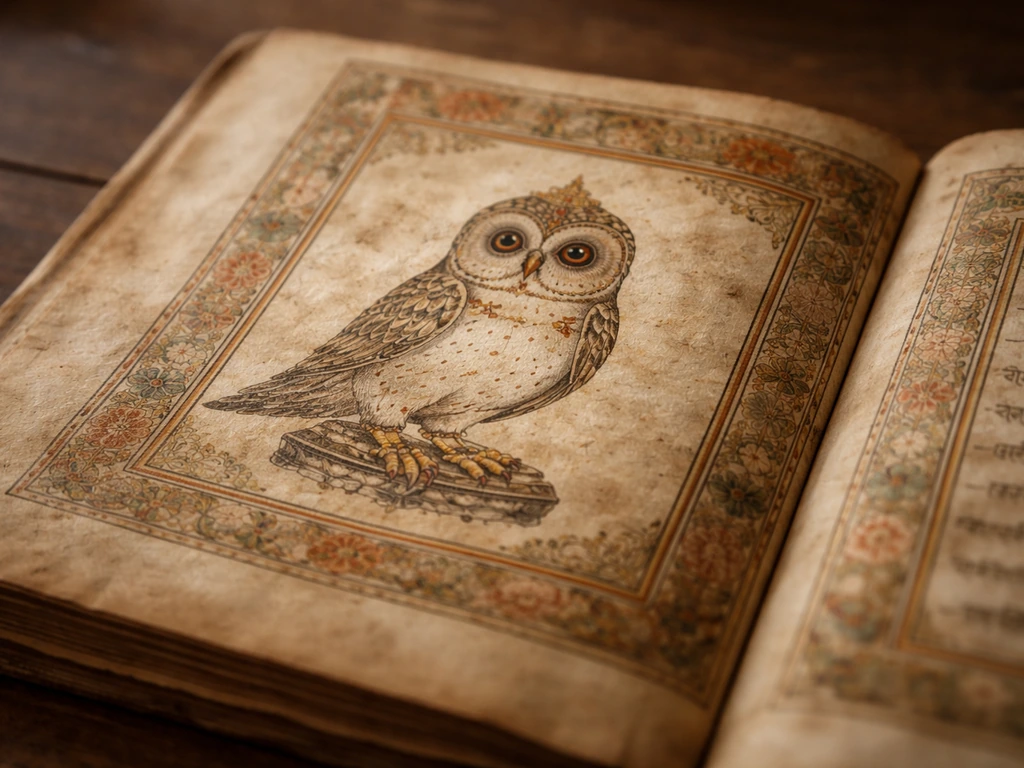
Before you take any single bird-deity connection as a fixed universal rule, it helps to understand how these associations are built and transmitted. In Hindu tradition, a vahana relationship is the strongest tier of connection: the animal is structurally part of the deity's iconographic identity, described in canonical texts and reproduced consistently in temple sculpture and devotional art. Below that, you have companion animals shown nearby in paintings without being mounts, then auspicious omens rooted in regional folklore, and finally purely artistic choices made by individual painters or craftspeople.
The owl-Lakshmi link sits at the vahana level: it appears in Puranic textual material, in the Sanskrit glossary term Uluka, in the devotional epithet Uluka Vahini, and in multiple museum-cataloged art objects. Glossary entries for Ulūka tie the owl-term directly to Lakṣmī’s vahana concept, stating that the owl is considered her vāhana.
This also helps explain the idea that on this tree is a bird, which many people associate with Kabir Das through the broader theme of divine discernment owl-Lakshmi connection. That makes it more stable than, say, a peacock appearing in a single modern painting of Lakshmi.
It also means the connection varies in visibility by region: in Bengal and parts of eastern India the owl-Lakshmi association is vivid and widely depicted, while in some South Indian Sri Vaishnava traditions, the emphasis falls more heavily on the lotus and elephant imagery, with the owl appearing less often in everyday devotional art.
How to verify the connection yourself
If you want to go beyond secondhand sources, here is where to look:
- Puranic texts: Several Upapuranas and Puranic compilations state that the owl is Lakshmi's vehicle. The Lakshmi Tantra, a Pancharatra text dedicated to Lakshmi, is a good starting point for her iconographic and ritual attributes, though for the owl-vahana verse specifically you will want to search Puranic glossaries under the Sanskrit term 'Uluka' or 'Uluka Vahini.'
- Sanskrit dictionaries: The term 'ulûka' is defined as 'owl' in standard Sanskrit-English dictionaries including the Oxford-based Anglo-Indian reference works. Searching this term in the ShastraDeep glossary or WisdomLib will pull up the explicit statement: 'The owl is considered a vahana of the goddess Lakshmi.'
- Museum collections: The Philadelphia Museum of Art and the Penn Museum both hold cataloged objects that directly link the owl motif to Lakshmi. These are publicly searchable collections. Searching 'Lakshmi owl vahana' in major museum databases (Brooklyn Museum, MFA Boston, LACMA) will surface additional material.
- Temple iconography: Look for Lakshmi panels in temples that include Ashtalakshmi shrines, particularly in Bengal, Odisha, and Tamil Nadu. The owl appears most consistently in panels depicting her night-associated or wealth-dispensing forms.
- Devotional literature: The epithet Uluka Vahini appears in devotional contexts and stotra (hymn) commentaries. The Sri Sukta, one of the earliest Sanskrit hymns to Lakshmi, grounds her prosperity-auspiciousness identity, though the owl-vahana detail is more specific to later Puranic and iconographic literature.
Where people get confused: other birds near Lakshmi and other deities
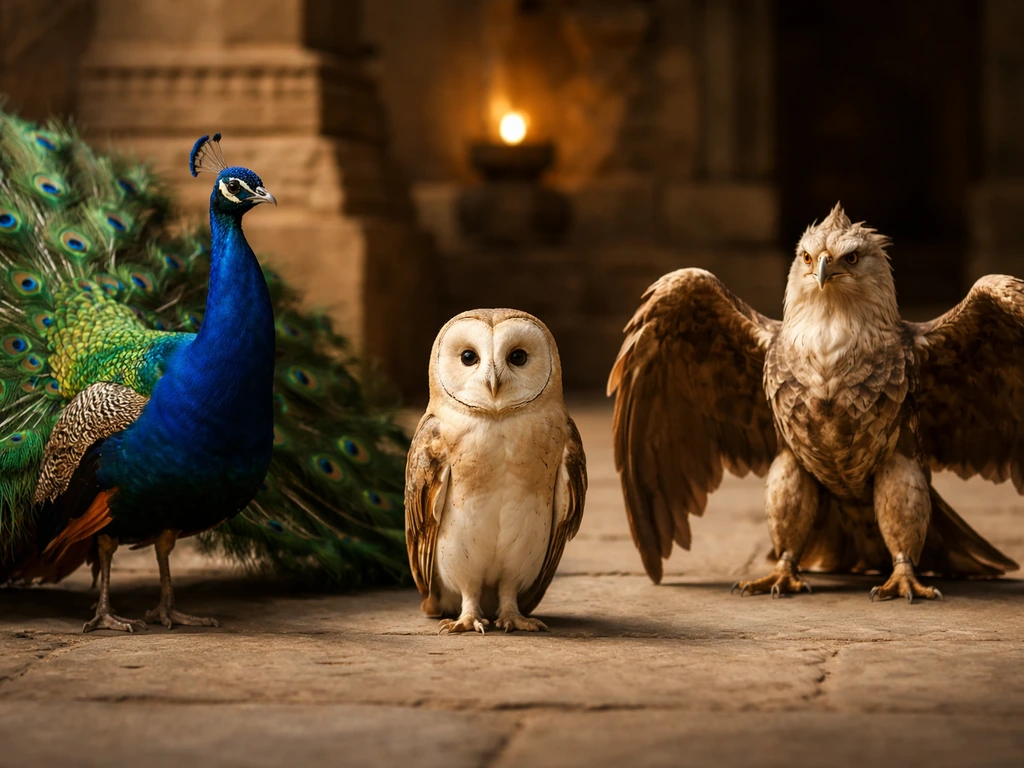
The most common point of confusion involves the peacock. Peacocks are undeniably associated with beauty, abundance, and divine grace in Hindu tradition, and you will occasionally see a peacock depicted near Lakshmi in later or modern paintings, including a Brooklyn Museum work titled 'Goddess Lakshmi with a Rose and a Peacock.' However, the peacock is primarily the vahana of Saraswati, goddess of learning and the arts, not Lakshmi. When a peacock appears near Lakshmi, it is typically an artistic choice emphasizing beauty and auspiciousness rather than a canonical vahana relationship.
Garuda, the great eagle-like bird, is another source of confusion. Garuda is Vishnu's vahana, and since Lakshmi is Vishnu's consort, she is sometimes depicted alongside Garuda in Vaishnava art. But Garuda belongs to Vishnu, not to Lakshmi independently. The distinction matters if you are trying to identify which bird carries Lakshmi's specific symbolism.
| Bird | Deity | Relationship | Key distinction |
|---|---|---|---|
| White Owl (Uluka) | Lakshmi | Vahana (canonical vehicle) | Appears in Puranic text, Sanskrit epithet Uluka Vahini, museum-documented iconography |
| Peacock | Saraswati | Vahana (canonical vehicle) | Occasionally painted near Lakshmi for beauty symbolism, but not her vahana |
| Garuda (eagle-like) | Vishnu | Vahana (canonical vehicle) | Appears in Vaishnava art that includes Lakshmi as consort, not Lakshmi's own bird |
| Swan (Hamsa) | Saraswati / Brahma | Vahana for Saraswati and Brahma | Symbol of discrimination and purity; sometimes loosely connected to Lakshmi in folk contexts but not canonical |
The rule of thumb: if someone online says a particular bird is Lakshmi's bird, ask whether it is described as her vahana in textual sources or just depicted in a single artwork. Someone familiar with the proverb may ask who said a bird in the hand, but in this context it is enough to focus on Lakshmi’s owl as a symbol of reliable discernment. The owl passes that test clearly. The peacock and swan do not, for Lakshmi specifically.
Using owl-Lakshmi symbolism in your own practice
Reading owl encounters as spiritual prompts
In many bird-symbolism frameworks, an unexpected encounter with a particular species can serve as a prompt to reflect on the qualities that bird represents. If you hear an owl near your home, especially around Diwali or during a period when you are thinking about financial decisions or new beginnings, the traditional reading is auspicious: Lakshmi is said to be present or approaching. You do not need to be Hindu to find value in pausing at that moment and asking yourself what abundance, grace, or prosperity might mean for you right now. That kind of reflective encounter is exactly how bird symbolism tends to function most usefully, not as prediction but as invitation.
Meditation and visualization
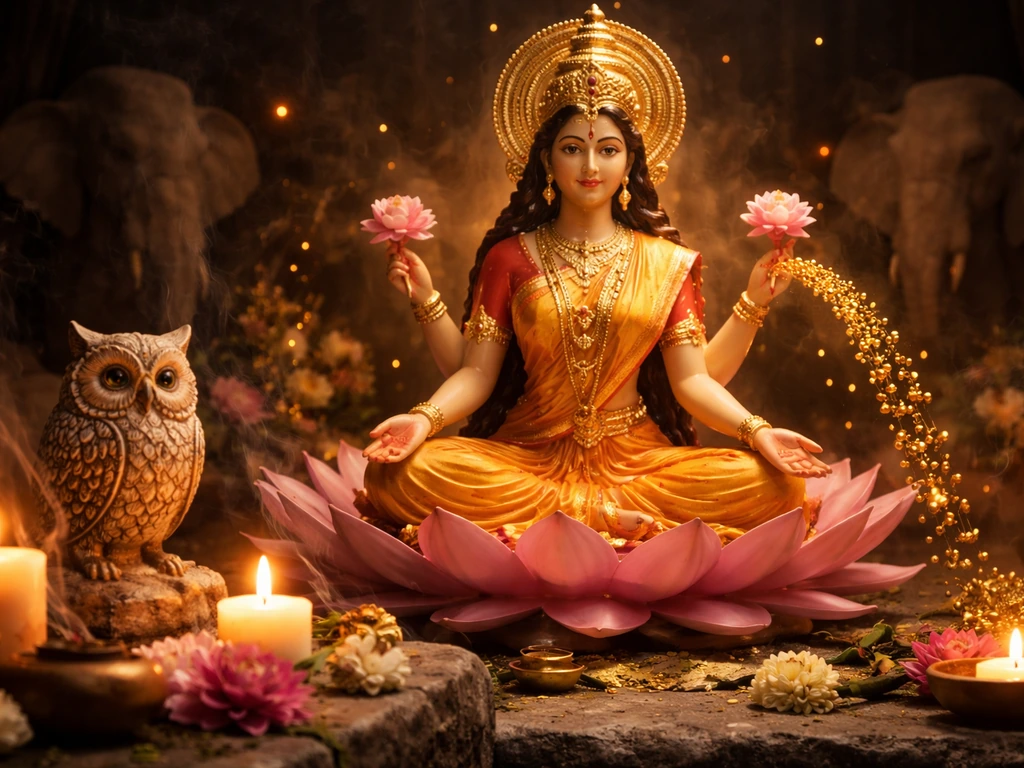
In Lakshmi meditation, the traditional form involves visualizing her seated on a lotus, flanked by elephants, often holding gold coins that flow from her palm. If you want to bring the owl into this practice, you can visualize the white owl perched beside her or beneath the lotus, its calm, wide eyes representing the clear seeing that precedes all genuine abundance. Some practitioners focus on the owl's stillness as a counterpoint to the anxious, grasping energy that often surrounds money and security. The owl sees without straining. That quality is worth sitting with.
Art, ritual decor, and journaling
If you are selecting bird imagery for a home altar, a piece of art, or a journal cover meant to carry Lakshmi's energy, an owl figure or painting is the most textually grounded choice. Museum-quality reproductions of Kalighat-style paintings showing Lakshmi with her owl are available and carry the genuine iconographic tradition behind them.
In journaling, you might work with the question the owl poses: what do you see that others around you are missing right now, especially about your own resources, talents, and capacity for abundance? In other words, bird-and-Lakshmi symbolism often leads people to ask, what does bird god mean in the first place? That prompt sits right at the intersection of Lakshmi's symbolism and the owl's nature.
Bird symbolism across traditions, from the conceptual world of the vahana to everyday omen reading, works best when it becomes a genuine lens rather than a trivia fact. The owl and Lakshmi connection has been maintained across centuries of temple art, devotional poetry, Puranic literature, and living worship practice. That longevity is itself meaningful. Whether you are approaching this from a Hindu devotional perspective, a comparative mythology angle, or simply a curiosity about what different birds represent across cultures, the white owl carries a coherent and well-documented set of meanings: clear sight in darkness, the arrival of fortune, and the grace that travels quietly by night.
FAQ
If I see Lakshmi with an owl in one picture, does that automatically mean it is always her vahana everywhere?
Not automatically. The owl is the canonical vahana in many Puranic and iconographic traditions, but some regional schools emphasize lotus and elephant imagery more strongly, so you may see Lakshmi without an owl even when the overall worship is authentic.
What is the difference between an owl beside Lakshmi and an owl as her vahana?
A vahana is treated as part of the deity’s core identity in iconography (often described in textual tradition). An owl that appears only as a nearby companion element in a specific artwork may be devotional symbolism, artistic emphasis, or local custom rather than the full vahana relationship.
Is the owl in Lakshmi art always meant to be a specific species, like Uluka?
Many traditions identify the vahana as Uluka, a white owl term used in Sanskrit and devotional epithet form (Uluka Vahini). In practice, artists may depict owls with local visual conventions, but the intended concept is the same vahana link.
How should I interpret owl imagery near Diwali if I am not following Hindu rituals?
Traditionally it is read as an auspicious omen that Lakshmi may be visiting. If you are not practicing, you can treat it as a reflective prompt (for example, pausing before money decisions) rather than a literal prediction.
Are peacocks ever correct for Lakshmi, or is it always Saraswati?
Peacocks are strongly associated with Saraswati as her vahana, so they are not usually Lakshmi’s canonical mount. If a peacock appears with Lakshmi, it is commonly read as an artistic choice to stress grace and beauty, not a definitive statement that the peacock is her vahana.
Why do some websites claim a swan is Lakshmi’s bird?
Swan imagery is more commonly linked to other divine associations in various contexts, and swan claims about Lakshmi are often based on single-artwork interpretations rather than vahana language. A quick check is whether the bird is explicitly described as her vahana in texts or named epithets.
Can Garuda be shown with Lakshmi in ways that confuse the “which bird is associated” question?
Yes, because Garuda is Vishnu’s vahana, and Lakshmi is frequently depicted in Vaishnava settings. In such cases, Garuda’s presence is about her connection to Vishnu’s world rather than making Garuda her independent vahana.
If I want to choose a bird image for a Lakshmi altar or artwork, what is the safest choice based on tradition?
An owl image is the most textually grounded option because it aligns with the vahana framework (Uluka) and Lakshmi’s epithet tradition. If you prefer variety, you can include the lotus and elephant motifs too, since they are widely persistent in Lakshmi iconography.
Next Articles
Who Said A Bird in the Hand? Provenance and Meaning
Find who said a bird in the hand, why no single source is sure, plus spiritual bird symbolism for daily guidance.
On this Tree Is a Bird Kabir Das Explanation and Meaning
Kabir Das meaning: tree as inner world, bird as soul or divine freedom, with reflection tips and summary.
What Bird Is a Sign From Heaven? Meaning and How to Interpret
Which bird is often seen as a sign from heaven, plus a step-by-step way to interpret your specific encounter.