
The first bird mentioned in the Bible is the generic category of birds (or "winged fowl"), introduced in Genesis 1:20-21 during the creation account. In the ESV, Genesis 1:20 reads: "blank" rel="noopener noreferrer">Let birds and other winged creatures fly above the earth across the expanse of the heavens." The KJV follows in Genesis 1:21 with "blank" rel="noopener noreferrer">every winged fowl after his kind." No specific species is named here. If you're looking for the first named bird species in canonical order, that honor goes to the raven, which appears in Genesis 8:7 during Noah's flood narrative.
What Is the First Bird Mentioned in the Bible?

Eleanor Hartwell
16 May 2026

Defining "first bird", what actually counts

Before you can answer this question confidently, you need to agree with yourself on what you're looking for. The Bible references birds in a few distinct ways: as a broad category of created creatures, as named species in narrative scenes, and as ritual or symbolic imagery (think of the birds used in Levitical offerings). The answer shifts depending on which layer you're tracking.
For this article, "first bird" means the earliest explicit reference to birds in canonical order, starting from Genesis and moving forward through the Hebrew scriptures. That means we're prioritizing order of appearance in the text, not the internal chronology of the story being told. We're also setting aside coded or metaphorical bird language (like God's "wings" in Deuteronomy 32:11) and focusing on references where an actual bird or bird category is being described. This is the most defensible way to verify an answer, and it's how biblical concordances and lexicons approach the question.
The earliest bird reference in canonical order
Genesis 1:20-21 is where birds first appear in the Bible, introduced as part of the fifth day of creation. The underlying Hebrew word is עוֹף (oph, Strong's H5775), which the Lexham Bible Dictionary specifically notes "first appears in the Genesis creation account (Gen 1:20, 22, 30)." This word is broad: it covers birds, flying creatures, and even winged insects in some contexts, which is why different translations render it differently.
| Translation | Verse | Exact Wording |
|---|---|---|
| ESV | Genesis 1:20 | "Let birds and other winged creatures fly above the earth" |
| KJV | Genesis 1:21 | "every winged fowl after his kind" |
| NIV | Genesis 1:21 | "every winged bird after its kind" |
Note the slight variance: the ESV places the bird language in verse 20, while the KJV and NIV shift the clearest "bird" phrasing to verse 21. This is a translation boundary issue, not a contradiction. Both verses are part of the same fifth-day creation speech, and all major translations agree that Genesis 1 is the first place birds appear in the text. The Bible Gateway ESV translation even includes a footnote on Genesis 1:20 noting "Or flying things; see Leviticus 11:19-20," which is a helpful signal that the Hebrew here is intentionally broad.
So the answer is Genesis 1:20-21, and the "bird" in question is not a single species but an entire category of created life, called into existence by God on the fifth day alongside sea creatures.
Why so many people say raven or dove instead
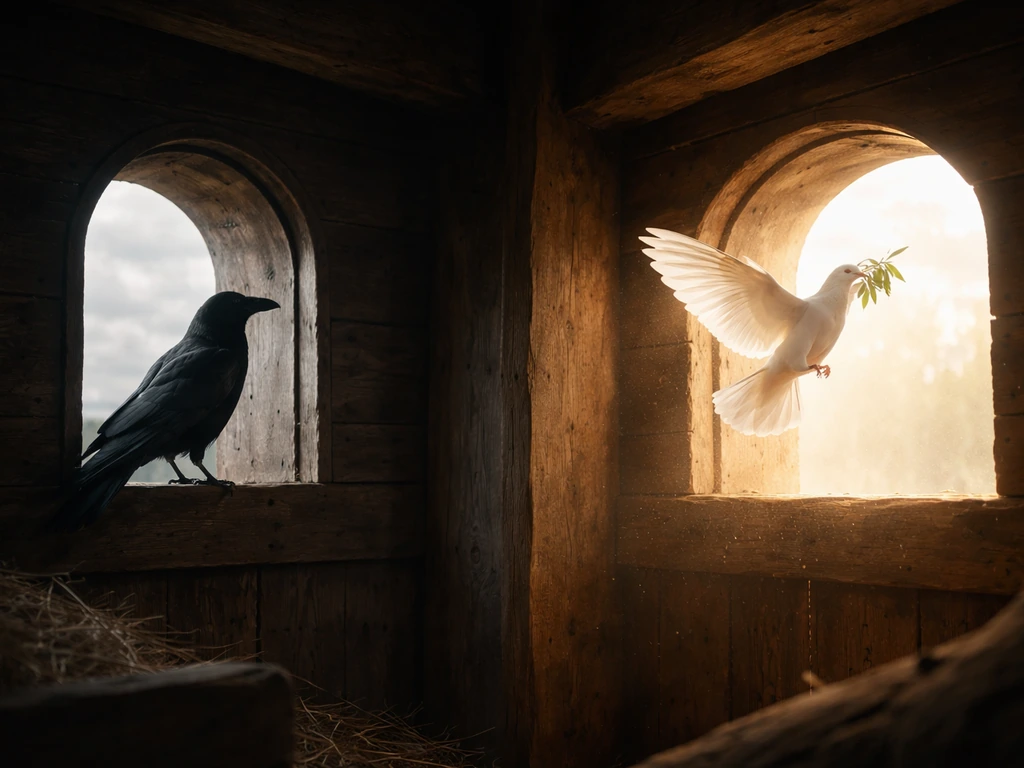
This is the most common mix-up, and it happens for an understandable reason. If you're wondering why people link Thanksgiving to a specific bird, it's worth looking at how tradition turned the turkey into the holiday bird why is turkey the thanksgiving bird. The raven and the dove are the first individually named bird species in the Bible, and they appear in one of scripture's most dramatic scenes: the recession of the flood waters in Genesis 8. Noah releases a raven in verse 7 ("And he sent forth a raven, which went forth to and fro, until the waters were dried up from off the earth," KJV) and then a dove in verse 8 ("Also he sent forth a dove from him, to see if the waters were abated from off the face of the ground," KJV). These are the Hebrew words עֹרֵב (oreb, Strong's H6158) for raven and יונה (yownah, Strong's H3123) for dove.
Because Genesis 8 is a vivid, story-driven scene and the birds are given distinct roles and meanings, they tend to stick in memory far better than the relatively abstract creation language of Genesis 1. Bible trivia questions often ask "what was the first bird sent out from the ark?" (the raven), which people then misremember as "first bird in the Bible." The distinction matters: Genesis 1 comes before Genesis 8 in canonical order, so the generic category of birds precedes both the raven and the dove by several chapters.
There's also the matter of Genesis 15:11, where "birds of prey" (a different Hebrew term) swoop down on Abraham's sacrifice. This is another early bird reference, but it comes well after Genesis 1 and Genesis 8 in canonical order, so it doesn't factor into the "first" question.
What the first birds in Genesis symbolize spiritually
The birds of Genesis 1 carry a specific theological weight. In the creation account, they are spoken into existence directly by God, placed in the domain of the sky, and declared good. This positions birds, from their very first biblical appearance, as part of God's intentional and ordered creation. They exist between the earth and the heavens, occupying a liminal space that would become symbolically rich across the entire arc of scripture.
The Hebrew word oph (flying creature) used in Genesis 1 connects birds to the concept of divine provision and creative abundance. When God says "let birds fly above the earth," there's an expansiveness to it, a filling of the sky that mirrors how God fills the seas with creatures in the same verse. Birds, from this first moment, represent life in motion, freedom of movement, and the populated fullness of creation.
That symbolic thread runs through everything that follows. The raven and the dove of Genesis 8 each inherit this created nature and carry their own additional meanings: the raven is associated with endurance and judgment (it keeps flying until the waters dry), while the dove becomes one of scripture's most enduring symbols of peace, hope, and the presence of the Spirit. Both meanings make sense against the backdrop of birds as creatures called into being by God's own word and declared good at the very foundation of the world.
If you're drawn to the spiritual dimension of this question, it's worth sitting with what it means that birds were among the first living creatures God named and blessed. Many people also ask, what is God’s favorite bird, and that question is answered differently depending on whether you’re looking for explicit biblical statements or later devotional interpretations. Across the site's broader exploration of bird symbolism, you'll notice that birds consistently appear at turning points: at creation, at the covenant with Noah, at the baptism of Jesus. Their first appearance in Genesis 1 is not just trivia. And if you are tracking unusual “red bird” themes, that kind of imagery often comes up in discussions of how God sends warnings or signs through birds when god sends a red bird. It's the opening note of a long symbolic theme.
How to confirm this for yourself across translations

The most direct way to verify the earliest bird reference is to do a word search across translations using a free tool like Bible Gateway. Here's a practical workflow:
- Go to BibleGateway.com and use the Passage Lookup to check Genesis 1: 20-21 in multiple translations at once (KJV, NIV, ESV, NKJV). You can enter up to five passages in one search. Look for the words "bird," "fowl," or "winged creature."
- Next, run a keyword search for the word "bird" or "fowl" in whichever translation you prefer. The first results returned should confirm Genesis 1 as the earliest hit in canonical order.
- To go deeper, visit BibleHub.com and look up Genesis 1: 20. Click on any individual Hebrew word to see the Strong's number and lexicon entry. The word for birds here is oph (H5775). You can then click through to see every verse where that word appears, with Genesis 1:20 listed first.
- For the raven and dove specifically, search Strong's H6158 (oreb, raven) and H3123 (yownah, dove) on BibleHub or OpenBible to confirm their first appearances in Genesis 8:7 and 8:8 respectively.
- If you use Logos Bible Software, you can run a lemma-based search on the Hebrew root עוֹף to pull every occurrence in canonical order, which will surface Genesis 1:20 as the first hit and allow you to trace how the word evolves through the text.
One thing to watch for: some concordances distinguish between the generic category word (oph, flying creatures) and specific species terms (oreb for raven, yownah for dove). If a concordance only indexes the English word "bird" as it appears in a specific translation, results can vary slightly by version. The ISBE (International Standard Bible Encyclopedia) notes that KJV often uses "fowl" where modern translations use "bird," so searching both terms covers your bases. The underlying Hebrew evidence, especially the Lexham Bible Dictionary's explicit statement that oph first appears in Genesis 1:20, is the most authoritative confirmation available.
The raven vs. the dove: which matters more symbolically?
Even though Genesis 1 wins the "first bird" question on a canonical basis, the raven and dove of Genesis 8 are arguably where bird symbolism in the Bible becomes most theologically layered. The raven, sent out first, doesn't return with news of dry land. It keeps flying, often interpreted as a symbol of persistence or of nature's own indifferent rhythms. The dove, by contrast, returns, first empty-handed, then bearing an olive leaf, and finally not returning at all, signaling that the land is habitable. The dove's journey becomes a three-act story of waiting, hope, and fulfillment.
These two birds set up a symbolic contrast that echoes through scripture and beyond: the raven as a creature of the wild and the margins, the dove as a messenger of peace and divine favor. If you're exploring what different birds represent across biblical tradition, the Genesis 8 scene is an essential reference point alongside other appearances, like the quail God provided to the Israelites in the wilderness, which answers a very different question about divine provision through birds. In the wilderness, God provided quail to the Israelites as another example of divine provision through birds quail God provided to the Israelites. It also connects to the question of what bird God provided for meat in the wilderness, an episode that shows divine provision through birds.
Putting it all together
The first bird mentioned in the Bible is the broad category of "birds" or "winged fowl" created by God on the fifth day, found in Genesis 1:20-21. However, the Bible does not appear to mention the specific animal "turkey" by name is turkey bird mentioned in the bible. The Hebrew term oph (H5775) covers all flying creatures, and this is where birds make their first canonical appearance. The first named species are the raven (Genesis 8:7) and the dove (Genesis 8:8), both introduced in Noah's flood narrative. Micah 1:16 mentions specific birds, so the verse provides a later example of bird references beyond Genesis 1 and Noah's flood the raven. The mix-up between these two answers is common, but easy to resolve once you know what you're comparing. And far from being dry trivia, the first appearance of birds in Genesis carries real symbolic weight: birds enter scripture as part of God's spoken creation, filling the sky as visible signs of a world declared good. If you're specifically asking about the Great Speckled Bird mentioned in some Christian discussions, that phrase is commonly traced to interpretations and wordplay rather than a named animal in the Genesis bird category.
FAQ
Is the first bird in the Bible a specific species, or just “birds” in general?
No, not if you mean a literal bird species. Genesis 1:20-21 uses a broad Hebrew term for flying creatures, so you get a category, not a named animal. The first individually named birds (raven, then dove) show up later in Genesis 8:7-8.
If I mean the first bird sent out in the flood, is it still Genesis 1?
It depends on what you count as “first.” In canonical order, birds first appear in Genesis 1. But if you mean earliest in the flood story’s timeline, the raven is the first bird sent out (Genesis 8:7), even though Genesis 1 still comes earlier in the Bible’s sequence.
Why do some translations seem to “move” the bird wording between Genesis 1:20 and 1:21?
Watch for translation choices. Some versions render the Genesis term as “fowl” or “flying things,” which can make it look like the wording changes verses. The underlying point remains the same: the initial bird reference is in Genesis 1:20-21, not in a later book.
Do verses that use bird imagery (like God’s “wings”) count as “first birds”?
Yes, Genesis includes other “bird-like” references that are not the “first bird” answer. For example, Deuteronomy 32:11 uses bird imagery for God’s care, but it is metaphorical, not the introduction of a real bird category.
What’s the best way to verify the answer using a concordance if my Bible search tool only returns “bird” as an English term?
A concordance can miss what you want if it only searches the English word “bird” in one translation. To be safe, search for the Hebrew-based idea (flying creatures/winged fowl) and also check named species terms like raven and dove, which are much easier to locate across translations.
What’s the difference between “first bird mentioned” and “first named bird species” in the Bible?
Some people mix up “first named bird” with “first bird mentioned.” Genesis 1 gives the earliest appearance of birds as a category. Genesis 8 gives the first named species, raven first, then dove.
Is a turkey ever mentioned in the Bible as the first bird?
No, the Bible does not name “turkey” in the text. The Genesis term covers flying creatures broadly, and later named birds in the early narratives are raven and dove, not specific domesticated species like turkey.
If I broaden the search to all winged creatures, does Genesis 1:20-21 still remain the starting point for birds?
If you include every place a “winged” creature is mentioned, you will get more candidates, but your key answer still anchors at Genesis 1:20-21 for the first explicit appearance of the birds category. Later references to specific birds (and to “birds of prey” language) occur after that.
Next Article
What Bird Did God Provide for the Israelites? Quail and Manna
Bible answer: God provided quail for the Israelites in the wilderness, with manna as daily divine provision and meaning.